


Translation missing: en.blog.tags.lecture_7min

10 Mistakes to Avoid When Buying a Baby Carrier

10 erreurs à ne pas faire lors de l'achat d'un porte bébé

Are you looking to invest in a baby carrier but don't know how to choose? From price to online reviews, the number of carrying positions, and recommendations from friends, this article is here to help you sort through the questions you need to ask yourself before purchasing.


1 – Respect for physiology

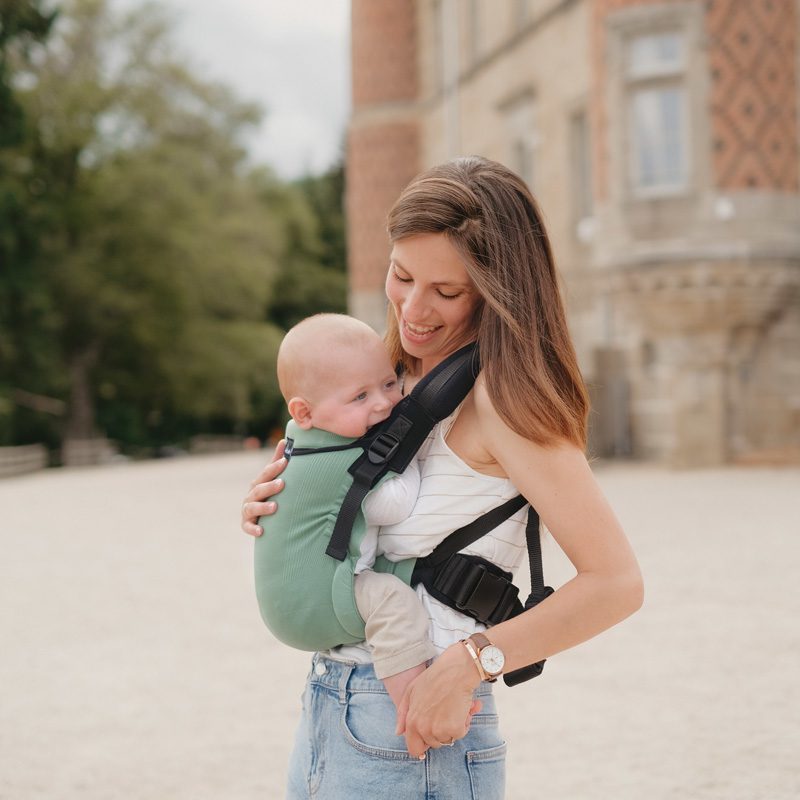
Let's start with the basics: respecting physiology is one of the criteria to keep at the top of the list! It impacts both your comfort and that of your baby . The carrying system must be flexible to respect the natural curve of the baby's back , allow him to be grouped with his knees higher than his hips, and promote body-to-body contact and proximity . Beware of ambivalent mentions of the "ergonomic" type, which are not really in line with true physiology (often slightly wider crotch, but always rigid backrest for example)

2 – Security

Another important point: the baby carrier must comply with safety regulations . The main points to check are:

  • Compliance with current standards which guarantee safe manufacturing, strong seams, etc.
  • Textile standards guaranteeing the absence of toxic products in materials (Oekotex for example)
  • The baby must be able to be carried upright with clear airways (no lying position, no material behind the head)

3 – Facing the world

The forward-facing position is not recommended in the field of physiological babywearing. Indeed, it is a posture in which you cannot really allow your baby to sit in a squat position without ending up parallel , squashed, or arched because of your chest behind his back. The forward-facing position offers far too many stimuli that your little one cannot handle. And above all, it is a posture in which he is not one with you: he pulls you forward and obstructs your field of vision, thereby increasing the risk of falling with him.

Brands offering forward-facing babywearing are responding to a public demand to open babies outwards to stimulate them, but at the expense of safety and respect for their physiology . This is a good way to assess the brand's overall ethics!

4 – The “Swiss army knife” baby carrier

Being aware that buying a good baby carrier remains a significant budget, it is very logically tempting to invest in the model that will offer the most possibilities . We will then look for the baby carrier that allows carrying from birth to 4 years, in front and back, adapted to the mother of 1.50m but also to the father of 1.95m, which is practical and quick to install but comfortable, suitable for both everyday use and hiking, breathable in summer but warm in winter and which protects from the sun, wind and rain, and if it could also make coffee that would be perfect !

Consider a newborn, a one-year-old, and a four-year-old, and see the enormous disparities in their sizes, weights, motor development, and needs. No baby carrier can perfectly meet such different requirements!

The same goes for uses , we could compare the baby carrier to a pair of shoes, we will not use the same pair depending on whether we want to go to the beach, just do a little shopping, or go hiking.

It is therefore advisable to target the main need that we will have as well as the age of the baby to be carried, to look for a model that will adapt precisely to these criteria and not to be caught up in the illusion of the baby carrier that does everything (and which in fact does not exist).

5 – Too much simplicity

Conversely, a carrying system sold as too simple should always be questionable. What has been cut to simplify its use ? Can the system still be properly adjusted to the size of the wearer and their baby?

One-size-fits-all systems without any adjustment will never provide you with a satisfactory carrying experience ; they will always be too big or too small , leading to questions about the safety of their use.

6 – Anticipation of needs

As we saw in point number 4, it is important to target our desires and constraints to choose the model that will be the most suitable. Be careful, however, not to anticipate too much! No one can know how it will wear 6 months or 1 year later and the risk is to make a choice that will not suit the needs of the present moment, nor later , and from which you will not benefit.

Choose according to the needs you know, in order to fully enjoy these sweet moments with your little one and make the experience as pleasant and helpful on a daily basis as possible.

7 – Advice from friends and other internet comments

Your friend whose baby is a few months older than yours assured you, " the Model X is gen-ial " and she swears by it! But on the internet, the Model Y also seems to be well-rated and has lots of good reviews.

A group of 3 friends carry their children in front in different baby carriers

Who to believe? No one.

Choosing a baby carrier is extremely subjective . It depends on the sensations you like and your body shape (preformed carriers have different cuts depending on the brand, for example, like clothes ). The Model X may have suited your girlfriend perfectly, while you will be terribly uncomfortable in it. Online reviews are also biased because they are rated by people who are mostly just as new to the subject as you are and will not have been able to try other systems to have points of comparison. Would you be as satisfied with the comfort of your 2CV if you had also tested a Mercedes before choosing?

8 – The price

Quite counterintuitively, price is not necessarily a good selection criterion . While a low cost should indeed alert you to the overall quality and place of manufacture of the product, a high cost does not guarantee that the model is comfortable, physiological and safe!

9 – The soft textile

Your baby seems tiny and fragile, and you dream of wrapping him in a cocoon of softness. Your choice might then fall on a very soft sling, so pleasant to the touch. But your cute, tiny baby will soon grow up. He's expected to gain about 1 kg per month and quickly start to kick more vigorously!

A material barely thicker than a bodysuit or pajamas will quickly become difficult to handle and unusable in good conditions (we are looking for a baby carrier and not an item of clothing). A firmer fabric poses no problem on a newborn and will provide more lasting comfort.

10 – The baby carrier that stays in the closet

Last but not least: the best baby carrier is always the one you REALLY see yourself carrying your little one in! While the baby sling is often cited as the ideal system, if you're not comfortable with it staying at the bottom of the closet, the benefit will be very limited.

As long as the system is age-appropriate and safe for your baby , the main thing is that you are comfortable with it and comfortable using it.

In short, choosing a baby carrier is very subjective and personal. Take the time to assess your needs and constraints, and don't hesitate to contact a baby carrier instructor for more specific advice, to try out different models, and to learn how to use them!


Related articles
BébéLe portage hanche : une ouverture sur le monde en toute sécurité

Le portage hanche : une ouverture sur le monde en toute sécurité

Le temps d’un câlin, d’une petite course ou d’une fin de promenade à gambader dans le parc… le portage sur la hanche est instinctif et accueille spontanément votre enfant.C’est une manière naturelle de porter à partir du moment où le bébé tient bien sa tête et son dos. Il est ainsi bien calé et peut voir tout ce qu’il se passe à hauteur d’adulte. C'est beaucoup plus amusant pour lui et favorise son éveil !Pourquoi privilégier le portage sur le côté ?Il y a plus facile et plus confortable que le portage à bras ! Il faut opter pour une solution simple et confortable pour répondre aux besoins de découverte de bébé, tout en assurant sa sécurité émotionnelle.On ne parle donc pas du « face au monde » qui est vraiment peu adapté pour les bébés (voir notre article sur les risques du portage face au monde). Le portage côté permet d'ouvrir le champ de vision sans pour autant mettre votre bébé en hyperstimulation. En portant sur la hanche, votre bébé conserve un contact visuel fort avec vous ET cela vous permet de libérer au moins un bras. Une nécessité lorsqu’on est parent, n’est-ce pas ?Sling ou Aide à bras : quel porte-bébé choisir pour le portage hanche ?Chez Néobulle, le Sling et le Hop’la sont deux solutions de portage parfaitement adaptées pour installer bébé sur la hanche. Mais lequel choisir ?Le Sling : le portage hanche mains-libres dès la naissanceLe Sling conviendra dès la naissance. Il permet autant le portage ventral que le portage sur le côté, au gré des besoins et de l’envie de « tout voir » de votre petit. Il permet de bien soutenir le dos du bébé grâce au tissu qui monte jusqu’à la nuque, surtout s’il a moins de 4 ou 5 mois et que son dos est peu musclé. Bien soutenu, il pourra profiter d’un paysage plus large, voir ce que vous voyez, ce qui conduit à une interaction plus fréquente.L'avantage pour le parent : Le Sling apporte un confort indéniable grâce au tissu déployé sur l'épaule et au serrage précis. Cela crée un contrepoids et limite la sensation de déséquilibre. C’est le moyen de portage idéal en dessous de 9/12 mois car il vous libère vos deux bras.Le Hop'la : l'aide à bras pour les plus grandsLe système de portage Hop’la est encore moins encombrant que le Sling ! C’est ce qu’on appelle une aide à bras ou un porte-bébé d'appoint. Convenant aux enfants de plus de 6 mois (qui tiennent bien leur dos), il soutient les fesses et les jambes de bébé en position physiologique (accroupi). Vous n’aurez plus qu’à garder une seule main sur son dos par sécurité.En tricot léger, il épouse votre épaule et la morphologie du bébé pour un portage agréable sans réglage. Il sera d’un grand secours jusqu’aux 3 ans de votre enfant, pour ces moments où la fatigue se fait sentir et où les bras sont réclamés ! Pratique, il se glisse dans votre sac à main.Résumé : Bien choisir son portage hanche chez NéobullePour résumer, nos deux systèmes garantissent une position physiologique et un confort ergonomique (tissu ajusté et épaule enveloppée) contrairement à d'autres systèmes du marché parfois douloureux.1- Le Sling (Porte-bébé) :Dès la naissance et jusqu’à 3 ans.Libère les 2 bras du porteur.Demande un réglage précis (petit apprentissage nécessaire)2- Le Hop’la (Aide à bras) :À partir de 6 mois (bébé tonique) et jusqu’à 3 ans.Libère 1 bras du porteur.Sans réglage, installation immédiate.Alors, quel est votre choix ?N’oubliez pas que notre monitrice de portage est disponible au service client pour répondre à vos questions. Nos tutos et visios sont également là pour vous aider.

Journal de bordNoël, mode d’emploi pour parents (presque) zen

Noël, mode d’emploi pour parents (presque) zen

Noël approche.Les lumières brillent, les chants résonnent, les listes s’allongent… et bizarrement, la charge mentale aussi.Car soyons honnêtes :Derrière les jolis pulls et les photos souriantes, Noël peut vite devenir un marathon émotionnel, surtout quand on est parent.Penser aux cadeaux (des enfants, mais pas que), aux repas, aux trajets, aux siestes à respecter, aux remarques à anticiper…Et très souvent, ce sont encore les femmes qui portent l’essentiel de cette organisation invisible.Alors oui, Noël peut être une fête joyeuse, chaleureuse, pleine de sens.Mais parfois aussi, c’est juste fatigant. Et ça aussi, ça mérite d’être dit.Noël avec un bébé (ou un jeune enfant) : spoiler alertNon, ce ne sera peut-être pas comme avant.Et non, ce n’est pas grave.Quand on devient parent, les grandes réunions familiales peuvent prendre une autre couleur :des horaires chamboulésdes bébés passés de bras en bras (astuce imparable : installer bébé en portage, personne n'osera vous demander de le défaire ! )des conseils non sollicités (toujours donnés avec les meilleures intentions, bien sûr 😅)👉 « Tu devrais le couvrir davantage »👉 « Laisse-le pleurer un peu »👉 « Nous on faisait comme ça, et ça allait très bien »Respirez.Vous n’avez rien à prouver.Et surtout, vous avez le droit de faire à votre façon.Nos petits conseils pour survivre à Noël (et y trouver du bon)🎄 Faire moins, mais mieuxVous n’êtes pas obligé·e de tout faire.Dire non à un repas, écourter une visite, simplifier un menu… ce n’est pas gâcher Noël, c’est prendre soin de vous.🎄 Baisser le niveau d’exigenceNoël Pinterest, ce sera pour une autre année.Un enfant a surtout besoin de parents disponibles, pas d’une table parfaite.🎄 Se protéger des injonctionsUn sourire, une phrase courte, et on passe à autre chose :« Merci, on a trouvé ce qui nous convient. »(Répéter si nécessaire.)🎄 Créer ses propres rituelsMême tout petits, les rituels comptent : une balade, une histoire, un moment calme.Ce sont souvent eux dont on se souvient le plus.Et si on se rappelait l’essentiel ?Noël n’a pas à être parfait pour être beau.Il peut être doux, imparfait, un peu chaotique… et profondément vivant.Alors cette année, si on essayait surtout de :💛 préserver notre énergie💛 écouter nos besoins💛 et faire de la place à ce qui nous fait vraiment du bienChez Néobulle, on vous souhaite un Noël à votre image :authentique, sensible… et le plus serein possible.Besoin d’un coup de pouce pour les cadeaux ?Pour alléger un peu la charge mentale de décembre, on a préparé un guide cadeau de Noël : des idées utiles, pleines de sens, pour faire plaisir sans se compliquer la vie.👉 À découvrir quand vous voulez.

Guide cadeaux noël Néobulle : des idées douces et utiles pour toute la famille

Guide cadeaux noël Néobulle : des idées douces et utiles pour toute la famille

Trouver LE cadeau parfait pour toute la famille ? Mission quasi impossible.Heureusement, chez Néobulle, on a de quoi sauver Noël, les anniversaires, les baby-showers…Accrochez-vous, voici le guide cadeaux Néobulle, garanti sans stress et 100 % utile !