

Comment appliquer notre lotion traitante anti-poux efficacement : le tuto raie par raie

lotion traitante anti-poux

      Le petit mot est tombé dans le cartable, ou pire, vous avez repéré la fameuse petite bête en train de se balader sur le crâne de votre enfant pendant le brossage des dents. Pas de panique : bien appliquée, une lotion anti-poux peut faire des miracles dès la première utilisation. On vous montre tout, raie par raie.

Sommaire

Pourquoi la technique d'application change tout

Chaque année, jusqu'à 20 % des enfants scolarisés sont infestés par des poux, principalement entre 3 et 10 ans, selon l'Assurance Maladie. Un chiffre qui explique pourquoi presque toutes les familles y passent, souvent plusieurs fois dans l'année scolaire. Alors pas de panique, rien d'anormal si vous êtes en train de lire cet article un soir de rentrée…

Une lotion anti-poux agit par contact direct sur le pou et la lente. Le petit secret, c'est de bien enrober chaque mèche : c'est ce que permet le geste raie par raie, en veillant à n'oublier aucune zone de la chevelure, y compris les recoins où les poux aiment se cacher (derrière les oreilles, dans la nuque, etc.).

Le matériel à préparer avant de commencer

Un peu d'organisation en amont, et le moment se passe beaucoup plus sereinement pour tout le monde. Voici ce qui est utile d'avoir sous la main :

Installez votre enfant dans un endroit confortable, si possible avec une activité calme à portée de main pour le distraire. L'application dure une petite dizaine de minutes, et le temps de pose est d'une heure. De quoi transformer ce moment en petite pause plutôt qu'en corvée.

Le tuto pas à pas, raie par raie

Voici le déroulé complet pour une application efficace :

Étape 1 : Appliquez la lotion sur cheveux secs et démêlés.

Contrairement à un shampoing classique, la lotion s'applique sur cheveux secs, pour permettre au produit d'enrober correctement chaque mèche.

Étape 2 : Séparez la chevelure en petites sections.

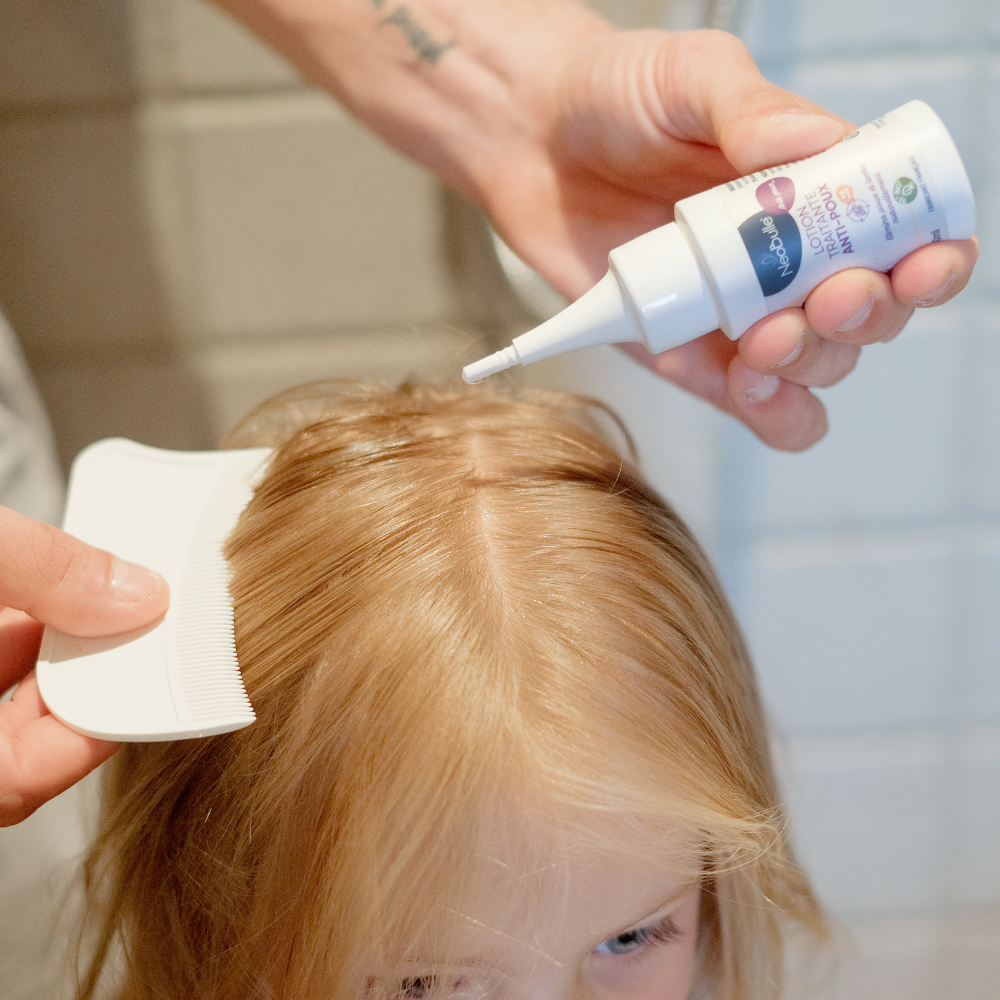
À l'aide d'un peigne, divisez les cheveux en mèches fines, en commençant par la nuque et en remontant vers le sommet du crâne. C'est le principe du "raie par raie" : on traite mèche par mèche, méthodiquement, pour n'oublier aucune cachette.

Étape 3 : Appliquez généreusement la lotion grâce à son applicateur.

Sur chaque mèche préalablement démêlée, déposez la lotion à la racine puis massez pour bien répartir le produit jusqu'aux pointes. Un petit coup d'attention derrière les oreilles et au niveau de la nuque, deux zones où les poux et les lentes ont tendance à se concentrer, et le tour est joué !

Étape 4 : Séchez au sèche-cheveux.

Petit geste qui change tout : le séchage fait partie intégrante du mode d'action de la lotion, ce n'est pas juste pour le confort. Un coup de sèche-cheveux (ou à défaut un séchage à l'air libre) avant de démarrer le temps de pose, et l'efficacité est optimale.

Étape 5 : Laissez poser une heure.

Le chronomètre démarre une fois les cheveux secs. Dès 5 minutes de pose, les poux sont "knock-down", c'est-à-dire comateux, mais l'heure complète permet une action totale sur les lentes et les poux.

Étape 6 : Passez le peigne fin.

Une fois le temps de pose écoulé, peignez méticuleusement mèche par mèche pour retirer poux et lentes, en essuyant régulièrement le peigne sur un mouchoir ou du papier absorbant pour vérifier ce que vous retirez.

Étape 7 : Rincez abondamment.

Terminez par un lavage avec votre shampoing habituel ou notre shampoing bio apaisant anti-poux qui aide à calmer un cuir chevelu qui gratouille après plusieurs jours ou semaines d'infestation. Il peut aussi être utilisé en prévention.

Les réflexes qui font vraiment la différence

Trois petits détails, et vous mettez toutes les chances de votre côté :

  • Cheveux bien secs avant l'application, et non mouillés : la lotion agit par asphyxie et déshydratation grâce à sa base d'huile de coco, sans insecticide ni huile essentielle. Sur cheveux mouillés, l'eau peut faire barrière et réduire l'efficacité du produit.
  • Le séchage au sèche-cheveux avant le temps de pose, une étape qui fait partie du mode d'action.
  • L'heure de pose complète, notamment pour bien cibler les lentes, qui sont souvent plus difficiles à éliminer.
  • Le passage du peigne fin après la pose, pour retirer tous les poux et lentes, même déjà neutralisés.

Après le traitement : le rappel à J+7, le petit plus qui rassure

Même avec une application soignée, il arrive de retrouver quelques poux quelques jours plus tard. C'est souvent une lente qui a résisté au premier passage et qui vient d'éclore, rien d'inquiétant. C'est pour cette raison qu'un second traitement à J+7 est conseillé, histoire d'intercepter ces éventuelles nouvelles éclosions avant qu'elles ne prennent de l'ampleur.

Pensez aussi à traiter toute la maisonnée en même temps si plusieurs personnes sont concernées, et à laver draps, taies d'oreiller, doudous et bonnets à 60°C pour repartir sur des bases saines.

Compléter sa routine avec le lot Anti-Poux et notre peigne anti-poux Néobulle (offert dans le lot)

Si vous préférez avoir tous les réflexes anti-poux réunis en un seul geste, notre lot Anti-Poux regroupe l'essentiel : la lotion traitante pour le curatif, le shampoing bio apaisant pour calmer le cuir chevelu et accompagner la prévention, le petit peigne fin à poux en cadeau et l'huile protectrice anti-poux, un roll-on à base d'huiles essentielles de lavandin, lavande fine et géranium rosat, à appliquer dès 18 mois derrière les oreilles avant de partir à l'école, en cure de 7 jours consécutifs renouvelable après une pause de 48 heures.

Au-delà du traitement curatif, notre peigne anti-poux, aux dents fines et légèrement biseautées, permet un mouvement "à raclette" efficace pour débusquer poux et lentes lors des inspections régulières. Glissé dans la trousse de toilette, c'est un réflexe simple à intégrer au rituel du brossage des dents, pour repérer une infestation dès son apparition.

Utilisez les produits biocides avec précaution. Avant toute utilisation, lisez l'étiquette et les informations concernant le produit.

Questions fréquentes

Combien de temps faut-il laisser poser la lotion anti-poux ?

Une heure complète. Dès 5 minutes, les poux sont neutralisés, mais l'heure entière permet une action efficace sur les lentes également.

Pourquoi appliquer la lotion sur cheveux secs et pas mouillés ?

C'est ce qui permet au produit d'enrober correctement chaque cheveu et d'agir efficacement sur les poux et les lentes qui s'y trouvent.

Pourquoi sécher les cheveux au sèche-cheveux avant le temps de pose ?

Le séchage fait partie du mode d'action du produit et participe directement à son efficacité, ce n'est pas une étape à sauter même si on est pressé.

Faut-il refaire un traitement après la première application ?

Oui, un rappel à J+7 est conseillé pour intercepter les lentes qui auraient résisté au premier passage et viendraient d'éclore.

Cette lotion convient-elle aux femmes enceintes ou allaitantes ?

Oui, la lotion traitante anti-poux est compatible avec la grossesse et l'allaitement, et utilisable dès 6 mois chez l'enfant.

Related articles
lecture_9minComment se débarrasser des poux chez bébé, nos conseils ! Photo d'un bébé de 6 mois dans sa baignoire.

How to get rid of lice in babies? All our tips and products

When thinking about lice, they are generally associated with school life, children at school or in community settings. However, lice do not spare young children! Yes, lice in babies are possible, and it can quickly become a source of stress for parents. Their delicate skin, fine hair, and difficulty expressing discomfort make managing lice in infants particularly delicate.In this article, we give you all the keys to understand how lice appear in babies, whether they are dangerous, how to treat them safely, and which natural products to use to soothe and protect your child's scalp. Summary Can a baby have lice? Can lice harm a baby? What products to use against lice in babies? How to treat lice in babies safely? Preventing lice in babies: good habits to adopt In conclusion: say goodbye to lice in babies in a gentle and natural way Can a baby have lice? The answer is yes. Even if infants are less exposed than children in community settings, it is indeed quite possible for a baby to catch lice. For example, this can happen if a brother or sister brings them home, if the child is cared for by a babysitter, or if they come into contact with contaminated textiles or objects.However, lice do not fly or jump. They are transmitted through direct contact or shared objects (combs, cushions, blankets...). Moreover, their presence is not always suspected in a baby with short or sparse hair, which can delay diagnosis. Can lice harm a baby? Fortunately, lice are not dangerous to the health of infants. They do not transmit serious diseases, for example. However, they can cause intense itching, scalp irritation, or even lesions if the baby scratches. This can disturb their sleep, mood, comfort, and lead to significant nervousness. Not to mention the mental burden for the rest of the family.Therefore, it is essential to act quickly, ideally with products respectful of their sensitive skin and young age. What products to use against lice in babies? Baby's skin is delicate: We therefore recommend prioritizing care products whose ingredients are derived from organic farming. At Néobulle, we offer a specific and natural range of anti-lice products, formulated in France, suitable for very young children from 3 months old while respecting their scalp. From 3 months: Anti-Lice Shampoo Formulated for babies from 3 months, the Soothing Anti-Lice Shampoo by Néobulle is a gentle, natural, organic cleansing care product. Thanks to organic lavender essential oil, known for its repellent properties, it soothes and repels lice while respecting their delicate skin. It can be used preventively or as a supplement to treatment.Advantages:Possible frequent useOnly a small amount of shampoo is neededGentle on sensitive baby scalps from 3 monthsCompatible with breastfeedingSuitable for pregnant women from 3 monthsMade in France, in Haute-Loire From 6 months: Anti-Lice Treatment Lotion Have you spotted lice on your baby? For a more targeted treatment, the Anti-Lice Treatment Lotion by Néobulle is an effective solution from 6 months old. It works by suffocating lice and nits. Composed 100% of natural ingredients thanks to coconut oil, it is formidable against unwanted visitors but obviously respects the skin of the whole family. Free from insecticides, perfumes, or essential oils, it is THE natural solution from the first application. This treatment is applied to dry hair and can be used in conjunction with an Anti-Lice shampoo.Advantages:Without harsh ingredientsEliminates lice and nits naturallyEffective in 5 minutes for lice, and after 1 hour for nitsMade of 100% natural ingredientsCompatible with pregnancy, breastfeeding, and babies from 6 monthsMade in France, in Loir-et-Cher From 18 months: Protective Anti-Lice Oil The Protective Anti-Lice Oil is ideal for prevention in children from 18 months old. Easy to apply thanks to its roll-on format, this stick is used daily during high-risk periods to create a barrier against lice. Simply apply behind the ears and on the nape of your child's neck. Composed of a clever blend of 3 essential oils (lavandin, fine lavender, and rose geranium), it emits a subtle floral scent that repels unwanted visitors while respecting the sensitive skin of children.Advantages :Quick, practical, and targeted applicationFun roll-on for easy useRecommended use in a 7-day treatmentVery convenient portable format for daily use and on the go100% of ingredients from Organic FarmingMade in France, in the Loire How to safely treat lice in babies? 1. Recognize the signs of lice presence in babies Detecting infestation signs in a child is not always easy... so identifying lice in a baby is a real challenge for young parents. We therefore invite you to pay attention to the following signs :Baby often scratches their headSmall red bumps or sores on the scalpPresence of nits (small white dots) attached to the hair 2. Use a gentle and respectful routine Using natural products with ingredients from Organic Farming is preferable for children under 2 years old. Indeed, their skin and scalp are fragile and therefore require gentle, suitable care.Recommended routine (in 3 steps!):Apply the Anti-Lice Treatment Lotion on dry hair and dry with a hairdryer or air dry. Leave on for one hourRinse thoroughly then wash with the Soothing Anti-Lice ShampooMeticulously comb with a lice combIt is not necessary to repeat the operation; one application is enough. If you detect lice in your baby, do not hesitate to take proactive measures by treating all members of your household. Parents, siblings, and relatives... Certainly, it’s not the most pleasant task, but it greatly increases your chances of getting rid of lice.💡 Tip: To make the application fun, suggest they listen to their favorite music so that this moment remains friendly despite everything. 3. Disinfect the environment To prevent re-infestation, here are four essential steps:Soak brushes, combs, and hair accessories in very hot water (at least 60°C) for at least 10 minutesWash all textiles that have been in contact with your child's head at 60°C: bedding, clothing, hats, plush toys, bed bumpers, etc.Vacuum carpets, sofas, and car seatsSeal non-washable objects in a sealed bag for 48 hours Prevent lice from appearing in babies: good habits to adopt Even if prevention is difficult, it remains your best ally, especially if you have older children at home or if the baby is in a group setting. Here are a few simple gestures to adopt daily" to limit the risks of infestation. 💡  And to keep a record of our tips, download our anti-lice memo!   Routine n°1: Adopt a preventive routine Use regularly a shampoo with natural repellent active ingredients such as the Anti-Lice Shampoo (from 3 months). During epidemic periods (back to school, community settings...), it can be used 2 to 3 times a week to repel unwanted visitors. For older children, the protective anti-lice oil roll-on Routine n°2: Regularly inspect your children’s hair A weekly visual check allows for quick detection of early infestation. On damp hair, use a fine comb to hunt for lice and nits. The earlier you catch it, the easier it is to treat. Routine n°3: Favor clever hairstyles (for those with more hair) Does your baby have enough hair to tie back? Take advantage of it! Gathering hair into a bun, braid, or ponytail helps limit contact with other children’s hair. Lice are transmitted by direct contact: the less free hair, the lower the risk. Routine n°4: Fight against spread within the family If an older sibling is infested, treat the whole family quickly, and apply the same preventive measures to the baby. Remember that lice can move very quickly from one head to another! Routine n°5: Wash everyday objects in contact with hair During epidemic periods, thoroughly wash accessories or clothing in contact with the scalp:Soak brushes, combs, and hair accessories in very hot water (at least 60°C) for at least 10 minutesWash hats, caps, hoods, beanies, scarves... at 60°C In conclusion: say goodbye to lice on your baby in a gentle and natural way Lice on babies may seem intimidating, but effective and safe solutions exist. At Néobulle, we have designed a specific range for infants, to act gently: The Soothing anti-lice shampoo suitable from 3 months The Anti-lice treatment lotion, effective from 6 months The Protective anti-lice oil, preventive from 18 months By adopting a natural and gentle routine, you protect your child's delicate skin while helping them regain comfort and serenity. That said, don’t panic: lice are neither a hygiene issue nor an inevitability. With the right products and a few simple gestures, everything quickly gets back to normal.

BébéAlerte aux poux !

Lice alert!

“Lice have been reported in the classroom, please check your children's heads.” This little note in your child's notebook triggers a tachycardia attack doubled by a furious urge to scratch your head and disinfect the entire house to get rid of the invader? Don't panic, put away that hair clipper, and let's take the time together to see how to face the situation! 1 – Some general information about lice Lice (Pediculus humanus capitis for their scientific name), are parasites of humans. As for us, we will only talk here about those that live in the hair, but some can also live in body hair (morgellons) or on the body (less common). They measure about 2 to 4mm and feed on blood, their bites causing significant itching (related to their saliva). If an infestation does not pose a danger to health by itself, prolonged situations where scratching occurs can eventually lead to infection. During its life cycle, the lice go through several stages of development: J0 : laying an egg (the nit) at the root of the hair J7-8 : hatching Between J10 and J17 approximately : the larva goes through 3 successive molts J17-18 : first possible mating From J18 until the end of its life around J50 : females can lay up to 8-10 eggs per day We spare you the calculations: During its lifetime, a single female louse can lay up to 300 eggs! Each egg once laid can generate a mature louse capable of mating in about 3 weeks. Dizzying, isn't it? It quickly becomes clear why it is better to take the problem in hand as quickly as possible! 2 – Identifying the infestation How to tell if your child has lice? Often at the beginning, there is not much visible, and you have to wait until proliferation has started to realize that your little one scratches his head a bit frantically, mainly around the neck or behind the ears. A more careful examination of the scalp can reveal small red spots on the skin of the scalp, nits (about 0.5 to 1mm, yellowish or grayish in color while the egg is full, then white once the larva has emerged), or even lice that are walking around… Distinguishing between nits and dandruff is sometimes not easy. Dandruff are not attached to the hair, and can be easily removed with your fingers or a brushing. Nits, on the other hand, are firmly glued to the hair. In case of lice alert in a setting frequented by your child, it is highly recommended to check their scalp, or even preventively use a fine-tooth comb throughout their hair to remove any unwanted lice before they start reproducing! It should be noted that, contrary to popular beliefs, an infestation is not at all related to poor hygiene. 3 – What to do if you find lice on your child? The time when they shaved their head is fortunately over! And chemical and aggressive products are now forbidden (potentially harmful, lice have developed resistance anyway…) Smother nits and lice with an appropriate product At Nébulle, we offer a lice treatment lotion, made from ingredients derived from coconut oil. It contains no insecticides, fragrances, or essential oils, and its primary action is mechanical: it blocks the respiratory openings of lice and nits, suffocating them. During rinsing, lice and nits lose their fluids, which kills them through desiccation. Applied carefully over the entire scalp (not wet), it is enough to leave it on for 1 hour before using a fine-tooth comb and rinsing. Attention: the application time is calculated from the moment the lotion dries, you can use a blow dryer to speed up the process. Use a fine-tooth comb The fine-tooth comb is a comb with very close teeth that allows you to remove lice and nits from the hair. For an effective pass, it is recommended to thoroughly comb the entire hair and to start from the scalp. You can use clips or hairpins to identify areas remaining to be combed. Regularly passing the comb is also an effective technique to get rid of lice, but it requires a bit of patience.  ! Indeed, this requires using it long enough to have: Eliminated all adults capable of laying eggs Eliminated all larvae from previously laid nits before they are able to reproduce If you followed the above, the development cycle of the lice taking about 3 weeks, this means you should commit to daily treatment for at least this period… This also requires being sufficiently diligent not to miss any areas. Treat the environment Lice do not survive very long away from a head (about 36 hours), and they do not detach from hair when still alive. Environmental transmission is therefore quite limited. Nonetheless, it is recommended to wash bed sheets and pillowcases at 60°C, the same goes for other surfaces in contact with hair : car seat covers, hats… You can also consider disinfecting the hairbrush to prevent recontamination, using for example our Deo Couches spray! Note that if something cannot be washed at 60°C, it can be replaced by either placing it in the freezer for 8 hours or leaving it in a sealed bag for 48 hours. Inspect the whole family Since family cohabitation is a major factor of infestation, it is strongly advised to inspect and comb all heads in the household when one of the residents shows signs of lice! Lice can colonize everyone and not just children: babies, teenagers, adults, elderly… As long as there are hair, lice can be present. Sooth the scalp Bites and scratching can cause scalp irritations. Alongside treatment products, using a soothing shampoo can help relieve discomfort! 4 – Avoid lice! Better to prevent than to cure… Although it can sometimes be difficult to completely eliminate, we can significantly reduce the risk of infestation with a few simple gestures: Tie long hair in a ponytail or braids Use different brushes and combs for each of your children Encourage your children to not exchange hats with friends Apply a little of preventive anti-lice oil behind the ears on school mornings Regularly inspect your children’s heads who attend group settings, even if there are no reports currently in the class. If your children have "a head full of lice" and catch them easily despite all prevention advice, it may be helpful to use the comb regularly (at least once a week) to immediately stop any new infestations! Lice are able to survive in water, so swimming pools can also be a place of contamination. It is recommended to wear a swim cap while swimming. There you go, you now know everything about these infernal creatures! Stay strong, parent team, and we wish you encounter them as little as possible!

lecture_4minLes coiffures anti-poux !

Anti-lice hairstyles!

You know EVERYTHING about lice. You have already read our previous article about them. You smear your children with protective oil every morning, and you have what it takes to prevent any invasion. What is the next step? What more can you do? We offer you 5 hairstyle ideas to fight lice! Top lice-proof hairstyle idea: a ponytail Level of difficulty: Beginner hairdresser Execution time: Less than 3 minutes Accessible with a simple elastic band, even the most inexperienced can achieve a more than satisfactory result! Anti-lice hairstyle idea number 2: a braid Level of difficulty: Hair apprentice Execution time: 5 minutes A bit more technical than a ponytail, the braid remains accessible to beginners, as long as they can count up to 3! Anti-lice hairstyle idea number 3: pigtails Level of difficulty: Aspiring Hair Artist Execution time: 5 minutes Prerequisite: Knowing how to do a simple ponytail The main difficulty of this hairstyle is to center the parting (the part)... Or fully accept that you don't know where the middle is and deliberately decenter it (and go all out to clearly show that yes, it's done ON PURPOSE)! Anti-lice hairstyle idea number 4: braided buns Level of difficulty: Tangle Padawan Execution time: 10 minutes Prerequisite: - Knowing how to make pigtails - Knowing how to braid Skillful combination of pigtails and braids, braided buns clearly take you to the next level (hair-wise) in the playground comparisons. Much less technical to do than it looks, you too can show off at school pretending you spent a lot of time styling your kids! Anti-lice hairstyle idea number 5: African braids Level of difficulty: Grandmaster of the Frizz Wig Execution time: 30 minutes Prerequisite: - Knowing how to make pigtails - Knowing how to braid - Knowing how to do African braids We include it because it's a bit the Everest for beginner parent-hairdresser, just to be somewhat comprehensive, but let's be clear, we strongly advise against venturing there until you master at least basic hair skills! The big advantage of this hairstyle is that once well done, it can be worn for several days in a row without coming undone, which greatly saves time spent on styling. Plus, it's pretty! That's it, you're ready for the next wave! We're waiting for photos of your wildest experiments, anything goes as long as no hair strand falls in!