Baby

Porte-bébé et mal de dos : comment porter votre enfant sans douleur ?

Porte-bébé et mal de dos : comment porter votre enfant sans douleur ?

On entend souvent dire qu’il faut arrêter de porter son enfant dès qu’il devient "trop grand" ou "trop lourd" pour préserver ses vertèbres. Pourtant, le portage est une aventure familiale qui peut durer bien plus longtemps qu'on ne le pense. Chez Néobulle, nous vous accompagnons pour reconnecter à l'essentiel tout en prenant soin de votre corps.


Sommaire


Réponse rapide : Pourquoi mon porte-bébé me fait-il mal au dos ?

Le mal de dos lié au porte-bébé provient généralement d'une installation inadaptée ou d'un matériel qui ne soutient plus assez le poids de l'enfant :

  • Le tissu : Un tissu élastique (tricot) finit par "rebondir", sollicitant trop les épaules quand bébé grandit.
  • Le serrage : S'il est insuffisant, l'enfant s'affaisse et son poids tire sur vos lombaires.
  • La hauteur : Plus bébé est porté bas, plus la sensation de lourdeur est amplifiée.

Le vrai coupable du mal de dos

Contrairement aux idées reçues, ce n'est pas le portage physiologique qui blesse, mais bien le portage "à bras". Lorsque vous portez votre enfant sans aide, vous décalez naturellement la hanche pour compenser, ce qui fatigue vos muscles prématurément.

Puisque nos bambins ne marchent pas vraiment avant 12 mois (pour les plus téméraires !) et ont encore besoin de nos bras vers 2 ans, l'utilisation d'un système de portage adapté est une solution pragmatique pour votre parentalité consciente.

Le choix du tissu : du tricot au tissage technique

Au début, l'écharpe en tricot est une merveilleuse "seconde peau" adoptée dès la sortie de maternité. Mais avec la croissance de bébé, ce tissu peut se distendre, créant un effet rebond inconfortable.

Pour retrouver un confort absolu, il est conseillé de passer à un tissage technique (chaîne et trame) :

  • Le Sergé Brisé ou le Jacquard : Ces tissages offrent un soutien parfait et sans aucun rebond.
  • La Qualité Néobulle : Nos porte-bébés sont fabriqués en France (Loire) avec des tissus d'écharpe offrant souplesse pour bébé et maintien pour le porteur.

Les 3 règles d'or pour un portage sans douleur

1. Osez le serrage précis

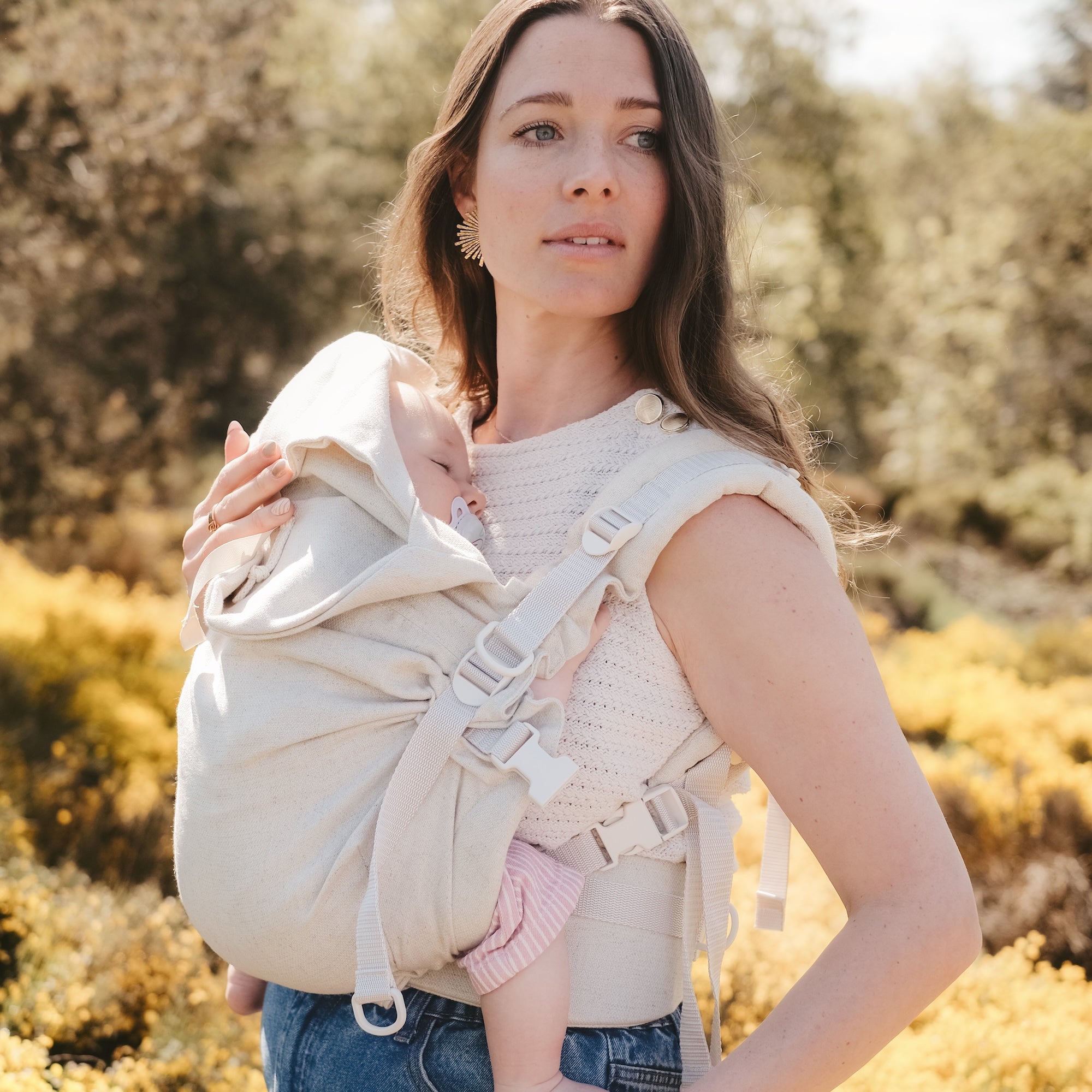
On a souvent peur de trop serrer bébé, pourtant un serrage suffisant est primordial pour son confort et le vôtre. L'enfant doit être soutenu de manière à ce que son dos soit arrondi mais pas avachi. S'il n'est pas assez maintenu, le poids tirera inévitablement sur le haut de votre dos.

2. La hauteur de bisous

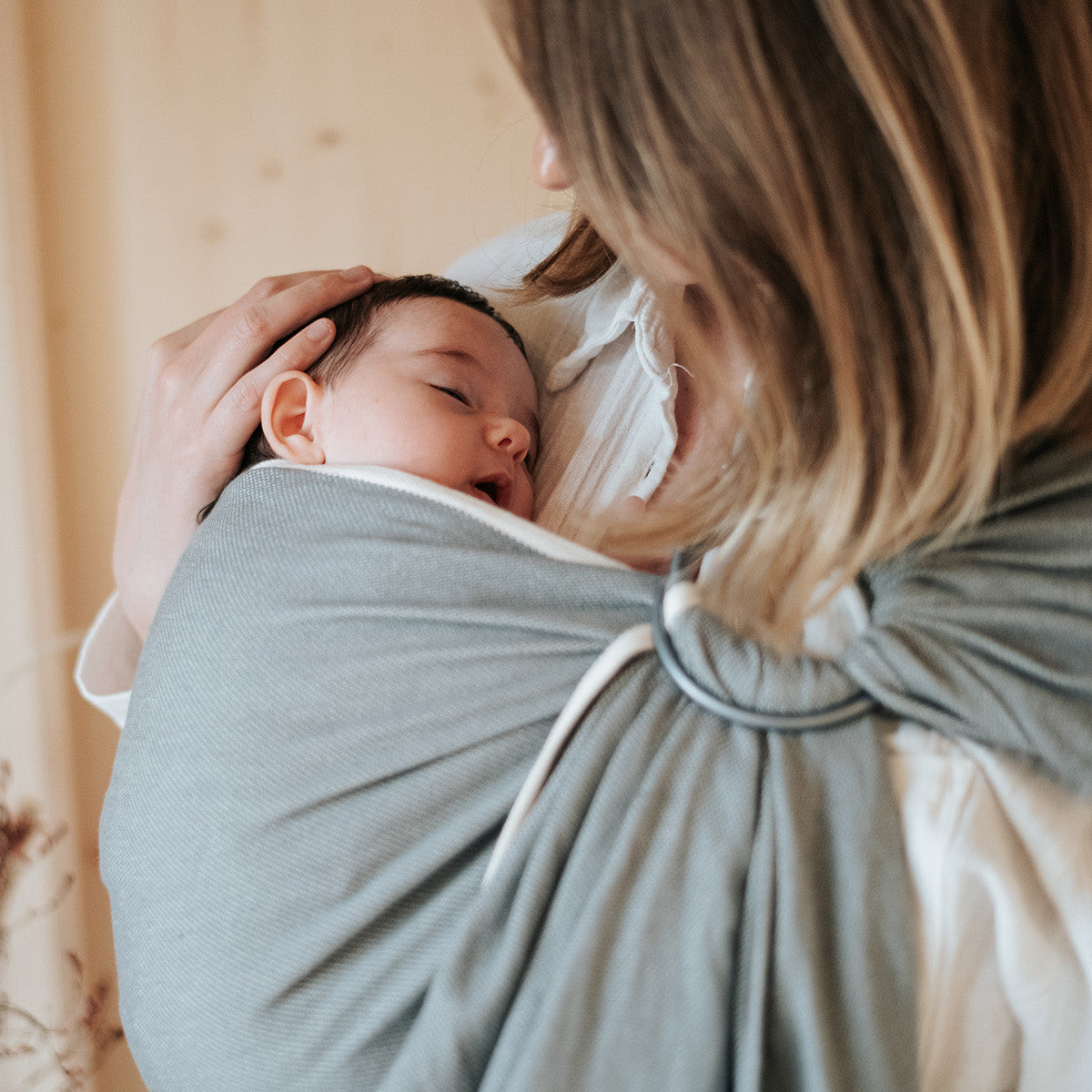
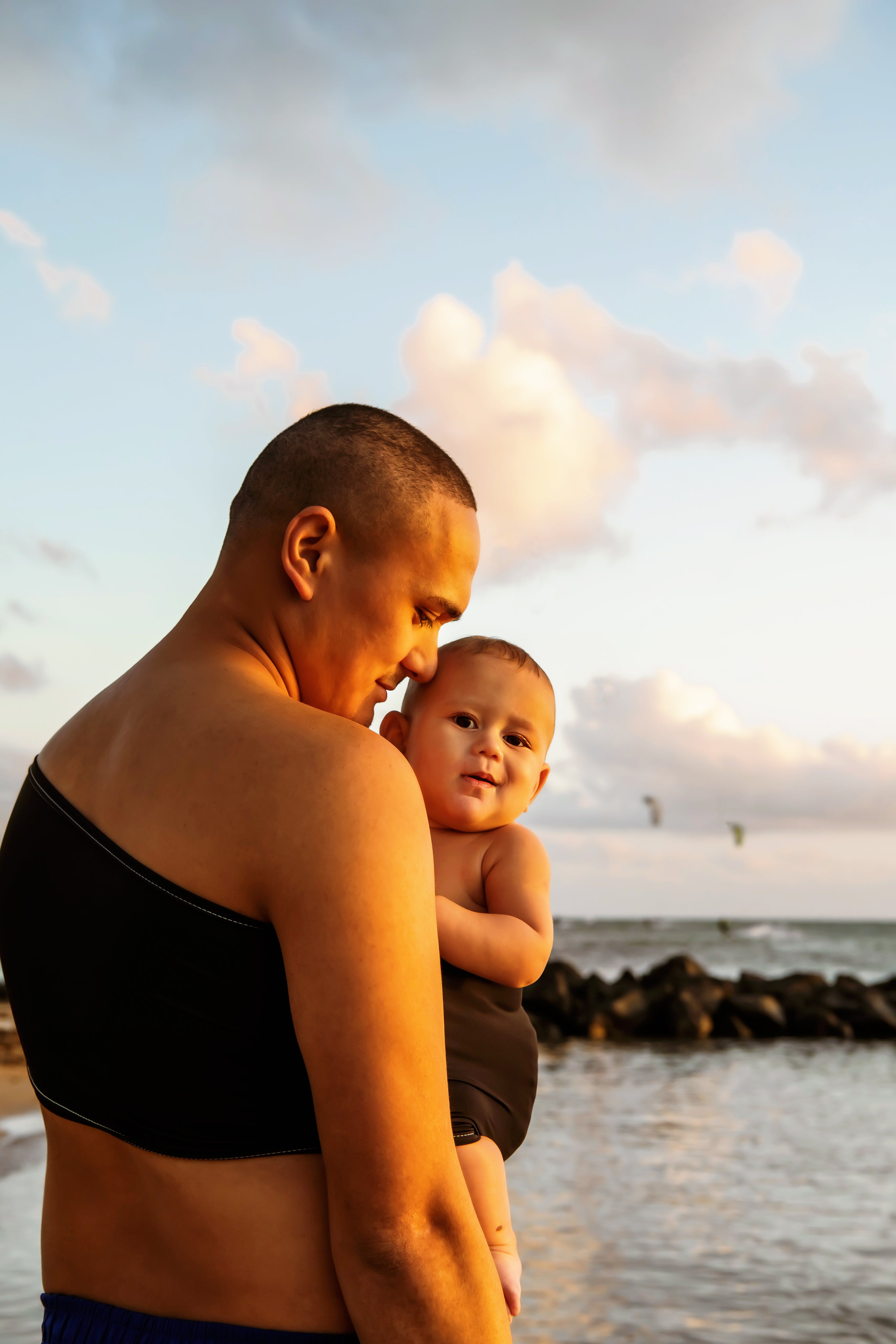
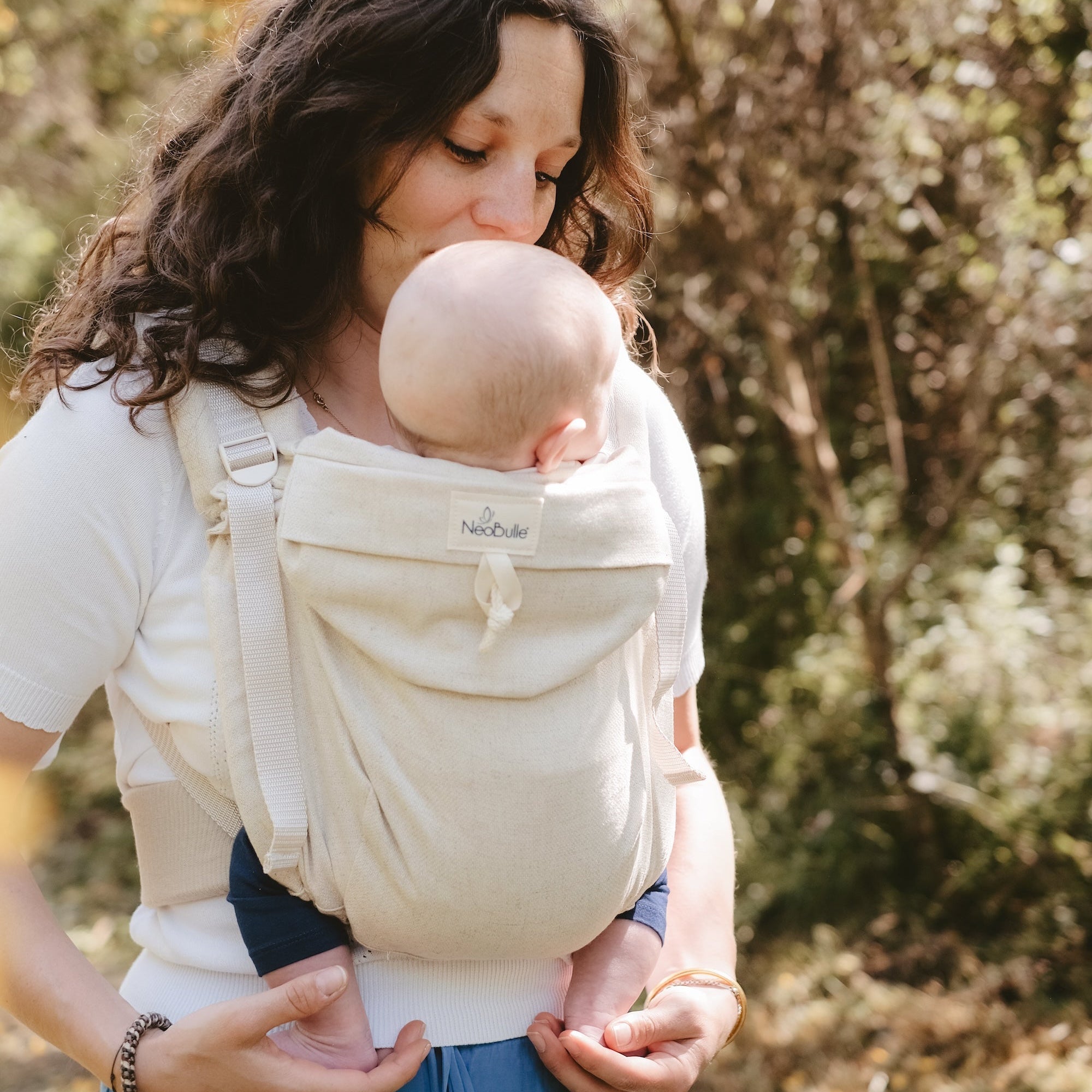
C’est la clé de la légèreté ! La tête de votre enfant doit être assez haute pour que vous puissiez l'embrasser spontanément. Plus vous descendez le bébé, plus son centre de gravité s'éloigne du vôtre, augmentant la sensation de poids.

3. La proximité physiologique

Vous devez percevoir la respiration de votre enfant contre votre corps. En étant tenu très proche de vous, le poids de l'enfant fait corps avec le vôtre, préservant ainsi votre équilibre et votre posture.

FAQ : Vos questions sur le portage et le mal de dos

Pourquoi mon écharpe me fait-elle mal aux épaules ?

Cela arrive souvent avec les tissus extensibles quand le poids du bébé devient trop important pour l'élasticité du tricot, créant des pressions localisées.

Puis-je porter si j'ai déjà des problèmes de dos ?

Oui, car un porte-bébé bien réglé répartit le poids de manière symétrique sur votre buste, contrairement au portage à bras qui engendre des torsions musculaires.

Comment savoir si le serrage est bon ?

Bébé doit être stable contre vous : si vous vous penchez légèrement en avant, il ne doit pas se décoller de votre buste.

Related articles
lecture_5minMaman qui porte son bébé en randonnée

Which baby carrier should I choose for hiking?

Stand up campers and raise your hearts! You are eager to share your passion for hiking with your baby, and to introduce them to beautiful landscapes, but you are hesitant about the carrying equipment that would be most suitable for this activity? This article is for you! The Classic In the field of hiking, when we think of baby carriers, we immediately imagine rigid "tours", which offer some storage but are quite not very physiological or ergonomic. These models are designed by hiking gear specialists certainly, but not by baby-carrying specialists. This small nuance is actually a key point, because logically: a baby does not behave exactly the same as technical equipment, clothing, or water bottles (if that’s the case: consult!). Among other things: The child is often suspended by the crotch: top comfort during several hours of walking… There is no real support for the baby, so they cannot fall asleep without ending up completely crooked (corollary: the parent ends up with a completely unbalanced load) The child is very far from their carrier: the center of gravity is very shifted backward and their movement perception is amplified. This design choice is all the more surprising as it goes completely against usual best practices, which involve positioning heavy loads as close as possible to the carrier, to limit lever effects and the perceived weight increase! No one would think of placing a moving water pack 30cm behind the top of their bag. This type of gear is also particularly heavy and bulky (frames, large volume), and you need to wait until the child is at least 9-10 months old to install them. The Comfortable So what gear to choose? Well, it depends. Not on the wind direction or the captain’s age (although... ), but mainly on whether your little one walks or not… Option 1: Babychou does not walk In this setup, you can be sure that they will be carried throughout the entire hike. It’s on comfort that you should focus! Since comfort is subjective, the simplest is to use the carrying system you feel most comfortable with: wrap, mei-tai, or preformed, even if some lengths hang down anyway you are not supposed to re-install the baby 15 times Once gone. Bad point: If your usual favorite is the sling, in this case, it’s probably not the one to prioritize, due to the asymmetry that might make it quickly unpleasant ! Option 2: cute but functional In this configuration, things get complicated. The child is TALL. The child is STRONG. The child wants to CONQUER THE WORLD. And they want to do it ALL BY MYSELF. But not too much, though… Understand that he will launch an assault on the universe, but only 100 meters at a time. Then he will be too tired. You will need to carry him. Then let him re-explore ME ALL ALONE, ME BIG 100 meters. And so on. During the X (insert a very high number here for your patience) km of the hike. Preserve your mental health (and your eardrums) and put away the baby carrier. This is exactly the right moment to pull out a preformed baby carrier ! Clipped to your waist, it will allow you to let your little one climb up and down as often as needed during his trip, while avoiding complicated adjustments. Lightweight and compact, preformed ergonomic baby carriers are really essential for parents who enjoy walking without being too bulky. And they guarantee comfort for both the baby and the carrier! Tip: Is the walk a bit long? Our neo + offers 2 different carrying modes that allow you to switch during the hike which part of the carrier is used, and comfortably extend the outing. So, ready for new adventures with baby?

BébéPorte-bébé préformé My Néo de Néobulle, adapté dès la naissance et jusqu'à 12 mois, confortable et physiologique

At what age should a baby carrier be used?

Here it is, your baby is here! The only remaining question is: at what age is it safe to use a baby carrier? First of all, it depends on the model. To help you see more clearly, here are the options for each age group.Carrying a baby is a precious practice, both ancestral and universal, and ideal for reducing the mental load of young parents. Passed down through generations in certain cultures, it is now attracting more and more families thanks to its many benefits.It is also a natural response to the needs of parents and the infant. After spending 9 months cradled in the uterus, the baby discovers a new world. It doesn’t realize that it is safe in its cradle… but instinctively, it knows it is safe in your arms. No wonder it calms down so easily there. However, these arms are also essential for daily tasks. Carrying takes on its full meaning here: it frees your hands while preserving the soothing proximity that the baby needs.After reading, you will know exactly which baby carrier to choose depending on your child's developmental stage!Summary From what age is it safe to use a baby carrier? Focus: from what age can you use a preformed baby carrier? Focus: carrying scarf or sling, what’s the difference? From birth to 4 months: physiological and adjustable carrying From 4-6 months: explore new positions From 12 months or once walking is acquired Questions about carrying based on the baby’s age Questions about installing the baby In conclusion From what age is it safe to use a baby carrier? It is quite possible to carry a baby from birth, provided you choose a model suitable for its size. The important thing is to respect its physiology: rounded back, tilted pelvis, knees raised, and head well supported. It is indeed the baby carrier that must adapt to the baby’s age, not the other way around. The key is to respect the natural position that the toddler adopts spontaneously: this is called the “physiological position.” In short, using a baby carrier is good. But opting for a model adapted to your child's age and development is even better. To do this, here are three essential tips, regardless of the model used:Check the physiological position: tilted pelvis forward, knees higher than the hips, rounded back, head well supported. Adjust the position as the baby evolves: over the months, you can choose to carry the baby on your hip or on your back. Carry your baby against your stomach: facing the world is not recommended, prefer the hip or back position. Follow the manufacturer's recommendations: each baby carrier has its own specifics (minimum weight, recommended age, etc.).💡 At Néobulle, our models are designed with perinatal professionals to adapt to the baby's development while ensuring the comfort of the wearer. Padded straps, flexible waistband, breathable and soft fabrics, intuitive adjustments… everything is designed to meet your needs.  Quick tip: from what age can you use a preformed baby carrier? A physiological and adjustable baby carrier, adjustable in width and height, can be used from 4kg. The MyNéo, a flexible and adjustable model, is even suitable from 3kg thanks to its innovative 3D knitted fabric!   However, more rigid models, which are less adjustable in height or seat level, are not recommended until the child can sit alone, around 5-7 months. ➡️ To learn everything about models suitable for newborns, check out our article "Which preformed baby carrier to use from birth?"!  Quick tip: sling or wrap, what’s the difference? It’s not always easy to distinguish between different carrying methods. For the preformed baby carrier, it’s quite visual: it is made of straps and clips. For other alternatives, let’s review them together!  The sling: quickness and lightness The sling is a short strapless wrap that adjusts with rings. The carrier is asymmetrical, so the fabric passes over only one shoulder. Suitable from birth up to 10-12 kg, it allows carrying on the stomach or hip, both inside and outside. Practical for breastfeeding or bottle-feeding, quick to handle, and easily slips into a bag. 🎥 Discover the basic sling setup ! The babywearing wrap: comfort and optimal adjustment The babywearing wrap is a long piece of fabric, several meters long. Often intimidating at first glance, it offers optimal comfort, adjusts perfectly to the size of the wearer and the baby, with precise support. It can be tied in dozens of ways: on the stomach, hip, back... For an ideal weight distribution, use it symmetrically, with fabric on each shoulder. In stretch version, it is suitable up to about 8kg. In woven version, like in the photo, it is suitable up to 18kg! Compatible with breastfeeding, it requires some practice to get used to. 🎥 Discover the basic woven wrap installation ! Our recommendations for each age Now that you know at what age to use a baby carrier, let's see which models correspond to each stage! From birth to 4 months: adjustable physiological carrying From 3kg, carrying is possible thanks to solutions that adapt to the infant's morphology:  à the traditional babywearing wrap, stretchable (with at least two layers of fabric on the baby's back) or woven to the cotton sling, a preformed adjustable in height and width like the My Neo or the Neo, The sling and wrap, for example, allow very precise adjustment: we talk about tightening fold by fold. The fabric thus envelops the entire little one. The My Neo, on the other hand, has no seams and has the perfect elasticity to fit your baby's body perfectly.  The goal? To promote proximity, which is beneficial for:  strengthening the attachment bond,  reduce reflux (GERD), soothe baby's crying, facilitate falling asleep, allow thermoregulation, thanks to the carrier's body heat, limit the risk of plagiocephaly promote the secretion of prolactin and oxytocin (yes, you can breastfeed in a baby carrier!) 💡MyNéo or Néo, what's the difference? These two preformed baby carriers are adjustable in width and height, thus adapting to an infant's size. The MyNéo is made of 3D knit, an innovative, slightly stretchable material. With its low price, it is particularly designed for use from birth to 12 months. The Néo is made of wrap fabric. Flexible and adaptable, it suits from birth to about 18/24 months, depending on your child's morphology. À partir de 4-6 mois : explorez de nouvelles positions ! The development of your baby progresses: increasingly curious, they observe, turn their head, look at their surroundings. It is often around 4-6 months that we start to question the possibility of using a baby carrier facing the world. However, carrying facing the world is not recommended . Indeed, this position exposes the child to too many stimulations which they cannot turn away from by snuggling against the carrier. Moreover, their spine is pressed against your chest and cannot be wrapped from the start. This type of baby carrier is designed so that the baby is supported by the crotch, which is uncomfortable. Finally, if the baby falls asleep, their head will sway forward, like when falling asleep on a plane or train, which strains the neck. As you understand: this is not ideal. Therefore, explore alternative positions:On your hip, for example with a woven wrap or sling,On your back, with your woven wrap, preformed baby carrier, or a mei-tai, these hybrid carrying methods that combine quick setup with a clip belt and the comfort of a wrap with tied straps.💡 Many parents mention the Pti-Evo as a trusted solution for carrying the baby on the back with confidence! https://youtu.be/Jb36-kOKPHI?si=ttvPKMm38gtkWlhJ&t=246 From 12 months or once walking is acquired When the baby starts walking, carrying becomes more occasional but remains a valuable daily aid. For dropping your child off at the nanny or at daycare, for running errands, using public transport, during walks (a 12-month-old's legs tire quickly!).At this stage, you will probably want to prioritize hip and back positions.💡 The Neo+ baby carrier emphasizes versatility thanks to its adjustable seat and height. Wondering at what age to use this carrier? It is suitable from 3 months to 3-4 years old, making it a long-lasting solution! FAQ - Frequently Asked Questions about Carrying and Child Age Questions about carrying according to the baby's age: Can I carry from birth?Yes, unless contraindicated medically. For young mothers, it is recommended not to overstrain immediately postpartum to protect the perineum. Carrying is, of course, still possible but for short periods. The co-parent can take over in the first few weeks.💡 Good to know: Limit the use of baby carriers to rigid, low belts that compress the carrier's abdomen. Prefer soft belts worn high, at the waist level, to reduce any pressure on the perineum.Should I wait until my baby can hold their head to carry them?No, if your baby is positioned physiologically (upright, pelvis tilted forward, knees higher than hips), their head will naturally stay aligned with the spine, against the carrier's chest. The fabric should reach up to their nape. If their head swings, adjust the settings: simply tighten the fabric a bit more or tighten the strap.Up to what age can I use a baby carrier? There is no fixed limit. The key word? Listen to your child. Continue to carry your child as long as it suits both of you. The duration and frequency of carrying sessions evolve over the months. Generally, it becomes less frequent when the child starts walking. 💡Good to know : you will notice that manufacturers indicate weight ranges for use on packaging and tags of their baby carriers. For example, from 3.5kg to 20kg. Keep in mind that these indications are based on safety tests carried out. This does not mean that the use will be physiological for a 20kg child. Each baby has its own size... and there is no one-size-fits-all model perfectly adapted from 0 to 3 years, for example. That is why at Néobulle, we have chosen to restrict the age of use of our baby carriers according to specific age ranges, for optimal back support for children.  Questions about installing the baby: Should I tuck my baby's feet into the fabric?No, always keep your baby's feet outside the carrying device. The goal: avoid activating the primitive reflex of automatic walking, otherwise your baby will push against the fabric and "stand". Therefore, opt for an adjustable baby carrier, whose seat adjusts to your baby's size.  Is it better to cover my baby's head with the fabric to better hold their head in place?No, it is not recommended to cover your baby's face, regardless of their age. The fabric should stay at the level of their neck so that the respiratory pathways are clear. This allows for safe carrying. Your child will be able to move their neck, strengthen their muscles, and observe their surroundings.Is it possible to sit with a baby carrier?Yes, regardless of your baby's age. Make sure not to compress their legs, but rest assured: you can eat, work, paint, play the piano... all while sitting and carrying your baby. In conclusion In summary, you can practice physiological carrying from birth by using equipment suited to your baby's size. Carrying and the type of installation evolve according to your child's age. Wraps, slings, preformed or hybrid baby carriers, each method meets specific needs. Some, like woven wraps, will accompany you from birth to preschool. Others are more suitable for a specific age range. To conclude, keep these 3 key points in mind:Respect your baby's physiology,Adapt the carrying method or installation to the child's age, development, and needs, Prioritize safety throughout carrying : clear airways, vertical carrying, high and properly adjusted installation.By applying these tips, carrying becomes a true extension of the intra-uterine cocoon, providing comfort, proximity and freedom to parents. To extend this experience, do not hesitate to get support from a carrying instructor or to register for virtual workshops led by the Neobulle team!

lecture_6minFocus sur le Mei-tai

Focus on the Mei-tai

The article of the day is dedicated to the mei-tai, also called Asian-inspired baby carrier or more simply "the thing like a scarf but easier". What is a mei-tai? What are the advantages and disadvantages of this type of system? We explain everything to you! So, what exactly is a Mei-tai? The Asian-inspired baby carrier is presented in the form of a rectangle of fabric (called the apron), with four straps inserted at the corners which form the waistband and shoulder straps. Many traditional carrying systems are used in Asia, but the versions we find here have been highly westernized and often bear little resemblance to their original models (hence the increasing avoidance of the term "Asian baby carrier" in favor of Asian-inspired). What are the main characteristics of the Mei-tai? There are many different mei-tai models on the market. While the earliest versions were very basic (no adjustments), the most recent ones allow for adjusting the size of the apron, notably by reducing the width between the legs and the height, which allows significantly improving comfort and ensuring a better fit to the baby’s size (at least for the reference brands). Among the possible variations, you can find: Straps that are extendable or padded at the shoulder of the wearer Belts that can be tied or clipped (mei-tais in this category are called "hybrids" because they are halfway between preformed models) Most Asian-inspired baby carriers on the market are suitable for children from 3 or 4 months: this is because, even when maximally reduced, the apron often turns out to be a bit too wide and too high to comfortably and safely carry a newborn (risk of collapse in the system). They can be suitable for carrying up to about 3 years old, after which they are generally too narrow to allow for physiological use (support up to the hollow of the knee no longer possible). It is highly recommended to choose a mei-tai with long enough and wide straps to be crossed outside the baby's legs and then attached at the back of the wearer: this provides better support, ensuring the baby is positioned high on the chest, and most importantly, that the load is supported by the straps and not the belt. When passing the straps between the wearer and the child, as suggested in some instructions, the load shifts onto the belt, which exerts quite strong compression on the wearer's abdomen (very discouraged for the integrity of the young mother’s perineum since it increases the risk of organ prolapse!), and the baby will inevitably slide lower on the chest. which makes carrying less stable and less comfortable. Straps that are too narrow, even if long, cannot be crossed outside the baby's leg risk hindering proper blood circulation. The question of whether to pad the strap is much more subjective and totally depends on the wearer's preferences. Nevertheless, in ventral carrying, one often prefers panels that unfold over the shoulder and back, whereas in dorsal carrying, padding is often more comfortable because the strap can unfold less and "pinch" the trapezius a bit. The advantages of the Mei-tai The mei-tai is the perfect compromise between a carrying scarf and a preformed baby carrier. It is a system that has managed to combine some of the advantages of both systems to give a simple, lightweight, and comfortable result to wear. This baby carrier presents very few difficulties in installation: no fold upon fold nor adjustments on the baby (other than those of the panel but which are done beforehand), very little risk of mishandling or error. It is more enveloping than the preformed baby carrier and allows for better close contact, making it consequently more comfortable. It remains less enclosing than a scarf and is perfect for parents who do not like to feel too tight. Regarding the baby, it is an interesting solution to address some installation difficulties, notably: Babies suffering from gastroesophageal reflux, who often struggle with overly enveloping carriers and can be very stiff when they are in pain. Since it passes between the child's legs, the mei-tai allows for a safe installation with a stiff as a board baby and who screams, not very academic but at this stage, we don’t care much — the main thing is to survive! Babies a bit more "older" who haven't been used to the scarf: after 3 or 4 months, it can sometimes be more delicate to install a toddler in a scarf, as they are not used to the sensations and are often not patient enough to let their parent learn the technique. The mei-tai, being more immediate and less enclosing, is generally better tolerated. Babies who present hyperextension and/or torticollis issues, who tend to adopt very stiff and sometimes twisted postures naturally: here again, the mei-tai is often more accessible for parents and better accepted by the child. Note that both its breathable cotton twill composition and the fact that it is open on the sides make it one of the most comfortable carrying systems to use in hot weather. The weaknesses of the Mei-tai The main weakness of the mei-tai is that it can be less adjustable than other carriers, especially for very small or very large babies, and may require additional accessories or adjustments for optimal fit. It remains its less versatile and evolutive nature compared to a baby carrier wrap. This is mainly due to its panel, which, even adjustable, cannot optimize coverage for a child's large age gap: it will be ideal for a newborn but a bit short from 2 years old, or it can be used up to 3 or 4 years old but only from 3 or 4 months old. Another small downside is that its easier installation is less precise adjustments than those of the wrap. If the use of the wrap is very well mastered, one might feel a slightly less comfortable in comparison. The corollary is that it is better to have a well-mastered mei-tai than a poorly adjusted wrap. Finally, like the wrap, you find straps dragging on the ground during setup, which makes outdoor installation in the rain more complicated than with a preformed carrier! Nothing too disabling! The Asian-inspired baby carrier, less known than its counterparts the wrap or the preformed, thus quite rightly deserves its place within the family of ergonomic carriers and would benefit from greater recognition! It’s an excellent choice for parents who are intimidated by using a wrap but still want more closeness than with a preformed carrier.