
Quel traitement anti-poux choisir pour s’en débarrasser efficacement ?

traitement anti-poux

   Il y a ce moment très particulier, connu de tous les parents : vous brossez tranquillement les cheveux de votre enfant à la sortie du bain, et là, un petit point qui bouge... C'est la vision d'horreur. Bienvenue dans le club, peu glamour mais très fréquenté, des familles aux poux.

Bonne nouvelle : si vous lisez ces lignes le peigne à la main, respirez. Ce n'est ni une catastrophe, ni une fatalité. Les poux s'invitent chez tout le monde dès que des têtes d'enfants se frôlent à la récré, et encore plus à la rentrée scolaire. On vous explique comment ils fonctionnent, on vous dit exactement quoi faire, et on vous évite de chercher LE remède maison miracle à minuit. Spoiler : ce remède 100 % maison n'existe pas.

Sommaire

Poux et lentes : apprenons à connaître l'ennemi

Avant de dégainer la première bouteille de vinaigre du placard, prenons deux minutes pour comprendre à qui on a affaire. Les poux sont d'une redoutable efficacité pour se camoufler dans les cheveux, ce qui les rend difficiles à repérer.

Première fausse idée à enterrer une bonne fois pour toutes : le pou ne saute pas et ne vole pas. Il marche, d'un cheveu à l'autre, ce qui explique qu'il se transmette (presque) exclusivement par contact direct entre deux têtes : un câlin, une photo collée-serrée, une partie de cache-cache un peu trop rapprochée...

Et si le pou est doué pour se déplacer, la femelle, elle, est surtout championne de la ponte : jusqu'à 10 œufs par jour, qu'on appelle des lentes, durant toute sa vie d'adulte, qui dure de 3 à 5 semaines. On reconnaît les lentes à ce petit grain blanc-nacré ou brunâtre, collé fermement à la base du cheveu (à ne pas confondre avec une pellicule, qui elle tombe dès qu'on secoue un peu la mèche).

Une lente met environ 7 à 10 jours à éclore, et c'est précisément ce détail de calendrier qui explique pourquoi un seul traitement, même excellent, ne suffit parfois pas à tout régler d'un coup.

Une question revient très souvent chez les parents, en général au moment de refaire le lit : quelle est la durée de vie d'un pou sur un oreiller ou dans un vêtement ? Vous pouvez ranger le désinfectant, la réponse est plutôt rassurante. Un pou adulte, ayant besoin de sang pour survivre, ne tient généralement pas plus de 24 à 48 heures loin d'une tête. Un bon lavage à 60° des textiles les plus en contact avec la tête de votre enfant (taies d'oreiller, bonnets, écharpes, capuches) fait très largement l'affaire. Pour ce qui ne passe pas à la machine, un petit séjour de 48h dans un sac poubelle bien fermé suffit.

Pour les lentes, c'est encore plus simple : elle a besoin de la chaleur du cuir chevelu pour arriver à terme et éclore, c'est pour ça qu'elle est toujours collée tout près de la racine. Une fois détachée du cheveu, elle perd cette source de chaleur et n'éclot généralement pas. Le risque de contamination par une lente isolée sur du linge est donc quasi nul.

Les différents traitements anti-poux qui existent aujourd'hui

Devant le rayon anti-poux, on se sent vite un peu perdu face à la multitude de flacons qui promettent tous d'être LA solution. En réalité, tout se ramène à trois grandes familles de traitements.

Les traitements à base d'insecticides neurotoxiques

Ce sont les plus anciens. Vendus en pharmacie, ils contiennent le plus souvent des insecticides de synthèse, qui neutralisent le système nerveux du pou. Leur plus grand atout : une efficacité rapide, éprouvée depuis des décennies. Toutefois, à force d'être utilisés, ils peuvent favoriser l'apparition de poux devenus plus résistants, et ils sont généralement déconseillés ou peu adaptés aux tout-petits et aux cuirs chevelus sensibles.

Les traitements d'origine naturelle

Ils séduisent de plus en plus de parents, et on comprend pourquoi. Ils misent sur des huiles essentielles reconnues pour leurs vertus répulsives (lavande fine, lavandin, géranium rosat, tea tree) ou sur des ingrédients comme l'huile de coco. L'idée est simple : plutôt que d'empoisonner le pou, on l'asphyxie. Résultat, aucune résistance n'est possible. C'est une option de choix pour les cuirs chevelus fragiles des enfants, pour les traitements qu'on répète en période d'épidémie scolaire, et, selon les formules, compatible avec la grossesse et l'allaitement.

Les méthodes mécaniques

Souvent les grandes oubliées alors qu'elles sont indispensables : le passage du peigne à dents fines reste incontournable quel que soit le traitement utilisé. Même après un traitement efficace, les poux morts restent accrochés aux cheveux, tout comme les lentes. Le peigne est donc la seule façon de les retirer réellement de la tête. C'est aussi une méthode redoutable en préventif, à utiliser régulièrement même sans infestation en cours.

Tableau comparatif des traitements anti-poux

Pour y voir plus clair d'un coup d'œil, voici comment se comparent ces trois grandes familles de traitements :

Type de traitement Mode d'action Avantages Points de vigilance
Insecticide neurotoxique Paralyse puis tue le système nerveux du pou Action rapide, efficacité éprouvée de longue date Risque de résistance en cas d'usage répété, irritations possibles sur cuir chevelu, précautions chez la femme enceinte, allaitante et chez les tout-petits
D'origine naturelle (huiles essentielles, huile de coco) Asphyxie du pou Doux pour le cuir chevelu de l'enfant, adapté à un usage répété ou préventif Temps de pose parfois un peu plus long, efficacité liée au respect du mode d'emploi
Mécanique (peigne à poux) Retrait physique des poux et des lentes Sans aucun produit, complément indispensable à tout traitement Demande un peu de patience et de minutie, mèche par mèche. Ne suffit pas à lui seul en cas de grosse infestation


Comment bien appliquer un traitement anti-poux

C'est souvent là que tout se joue, et la bonne nouvelle, c'est que ça se joue sur des détails tout simples. La plupart des « échecs » de traitement viennent d'une application expédiée un peu trop vite entre le bain et le repas du soir. Voici ce qui fait vraiment la différence :

  • Appliquer sur cheveux secs pour la majorité des lotions naturelles, et non sur cheveux mouillés : l'eau dilue le produit actif et réduit son efficacité.
  • Respecter le temps de pose indiqué sur la notice.

  • Masser généreusement le cuir chevelu et toute la chevelure, sans oublier la nuque, derrière les oreilles, le haut du front.

  • Rincer abondamment à l'eau tiède, puis laver avec un shampoing adapté.

  • Peigner mèche par mèche avec un peigne à poux à dents fines, sur cheveux humides et démêlés, pour retirer toutes les lentes et les poux qui auraient résisté au traitement.

  • Traiter toutes les personnes concernées du foyer en même temps, sinon les poux font simplement du tourisme d'une tête à l'autre.

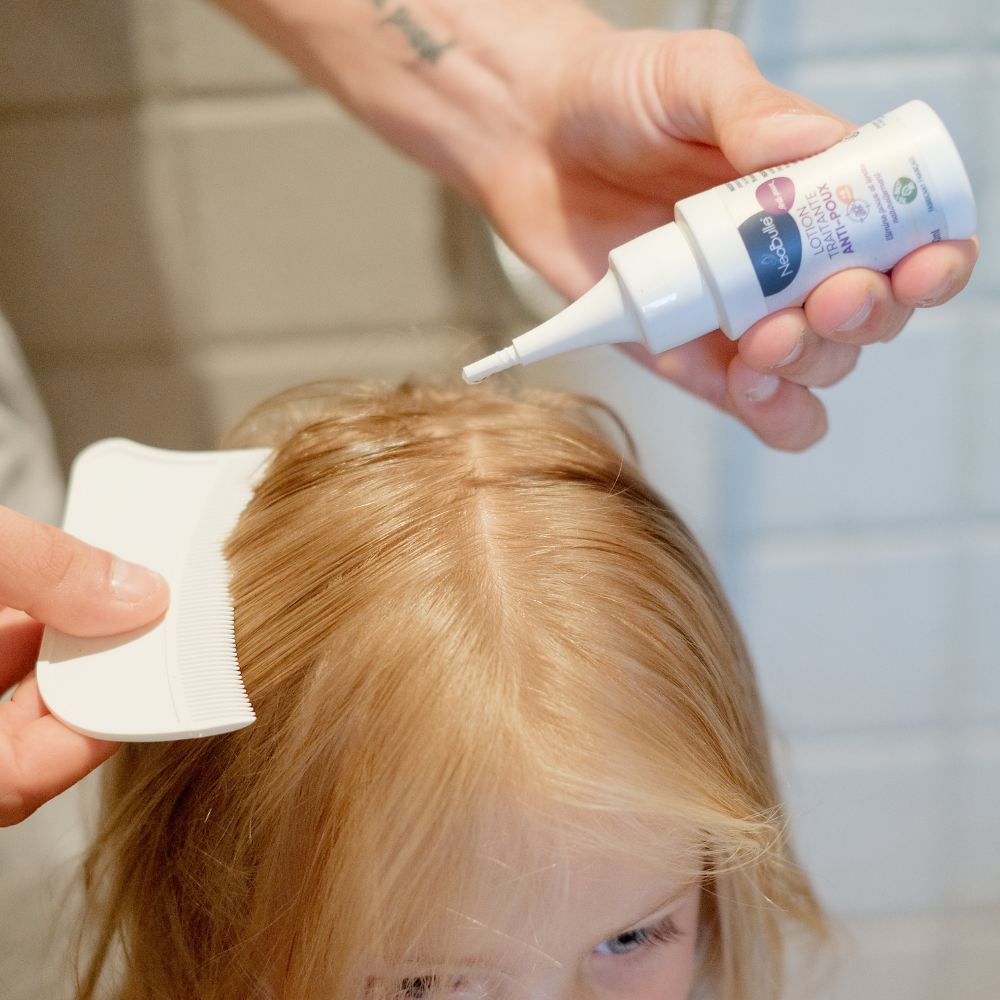
Chez Néobulle, on a construit toute notre gamme anti-poux autour de cette logique naturelle et douce : la Lotion Traitante Anti-Poux, formulée à base d'huile de coco, combat 100 % des poux et des lentes dès la première application, tout en douceur pour le cuir chevelu. En complément, le Shampoing Anti-Poux Apaisant nettoie et assainit les cuirs chevelus qui grattouillent, et l'Huile Protectrice Anti-Poux, en format roll-on, devient vite le petit réflexe répulsif du matin avant l'école. Sans oublier le peigne à poux, qui reste votre meilleur allié quel que soit le traitement choisi.

Utilisez les produits biocides avec précaution. Avant toute utilisation, lisez l'étiquette et les informations concernant le produit.

Retrouvez le tuto d’application de notre gamme anti-poux dans l’article : Comment appliquer notre lotion traitante anti-poux efficacement : le tuto raie par raie


Pourquoi ça gratte encore après un traitement anti-poux ?

Classique, et souvent source d'angoisse... Votre enfant continue de se gratter plusieurs jours après un traitement pourtant bien mené ?

Avant de retourner acheter un flacon, voici les explications possibles, parfois cumulées :

  • La démangeaison n'est pas causée par le pou lui-même, mais par une réaction allergique à sa salive : elle peut mettre plusieurs jours à s'estomper.

  • Quelques lentes ont pu passer entre les mailles et éclore ensuite. Continuez à surveiller la tête de votre enfant et à passer le peigne à poux en préventif.

  • Une réinfestation a pu se produire via un camarade de classe, un cousin ou un membre de la famille non traité en même temps.

  • Le cuir chevelu peut être légèrement irrité par le traitement lui-même, ce qui entretient une démangeaison indépendante des poux.

  • Des microlésions ont pu se former sur le crâne de votre enfant à force de se gratter.

Si les démangeaisons persistent, un nouveau contrôle minutieux au peigne fin, voire un second traitement complet, reste la meilleure chose à faire.

Comment ne plus jamais avoir de poux ? Les bons réflexes de prévention

Soyons honnêtes : personne ne peut vous promettre une immunité totale et définitive. Dès que des têtes d'enfants se rapprochent à l'école, le risque existe. Mais certains réflexes simples réduisent vraiment la fréquence et l'ampleur des infestations.

  • Attacher les cheveux longs de votre enfant, en tresse, chignon ou queue de cheval : c'est probablement le geste le plus efficace, puisqu'il limite le contact direct entre chevelures.

  • Faire un contrôle visuel régulier, surtout en période d'épidémie à l'école, pour repérer une infestation dès son tout début.

  • Utiliser un soin répulsif préventif, en particulier à la rentrée ou lors des pics signalés à l'école : une huile ou un roll-on aux huiles essentielles répulsives peut devenir un petit rituel du matin.

Sur la question du linge, on entend tout et son contraire : faut-il laver les draps tous les jours pour éviter les poux ?

Non, et c'est tant mieux pour votre pile de lessive déjà bien remplie (et aussi pour l'écologie et votre porte-monnaie). Un pou ne survivant pas plus de 24 à 48 heures loin d'un cuir chevelu, il suffit de laver à 60 °C les textiles les plus en contact avec la tête de votre enfant dans les jours qui suivent la découverte de poux.

Et chez bébé, ça se passe comment ?

Contrairement à une idée reçue, les tout-petits ne sont pas à l'abri : un bébé peut tout à fait attraper des poux, le plus souvent via un proche.

Son cuir chevelu étant particulièrement fin et sensible, il vaut mieux privilégier chez lui des soins doux, d'origine naturelle, pensés spécifiquement pour les premiers mois de vie. Les traitements standards sont généralement trop costauds pour cet âge.

Nous avons consacré un article complet à ce sujet, avec une routine détaillée pensée pour les tout-petits : Comment se débarrasser des poux chez bébé ?

En résumé

Se débarrasser des poux durablement ne tient pas à un produit miracle, mais à une méthode bien menée : un traitement adapté à votre enfant, associé à un peu de discipline. C'est cette petite rigueur, bien plus qu'un flacon miracle, qui transforme une soirée poux en simple souvenir.

Chez Néobulle, notre gamme anti-poux, composée d'un shampoing apaisant, d'une huile protectrice répulsive en roll-on et d'une lotion traitante d'origine naturelle, a été pensée pour accompagner votre famille avec cette philosophie en tête : des formules douces, fabriquées en France, aussi bien pour vous, pour vos grands enfants que pour les tout-petits. De quoi affronter la prochaine épidémie scolaire avec un peu plus de sérénité.

Related articles
lotion traitante anti-poux

Comment appliquer notre lotion traitante anti-poux efficacement : le tuto raie par raie

Poux détectés à la maison ? Suivez notre tuto pas à pas pour appliquer efficacement une lotion anti-poux et éliminer poux et lentes dès la première utilisation.

lecture_9minComment se débarrasser des poux chez bébé, nos conseils ! Photo d'un bébé de 6 mois dans sa baignoire.

How to get rid of lice in babies? All our tips and products

When thinking about lice, they are generally associated with school life, children at school or in community settings. However, lice do not spare young children! Yes, lice in babies are possible, and it can quickly become a source of stress for parents. Their delicate skin, fine hair, and difficulty expressing discomfort make managing lice in infants particularly delicate.In this article, we give you all the keys to understand how lice appear in babies, whether they are dangerous, how to treat them safely, and which natural products to use to soothe and protect your child's scalp. Summary Can a baby have lice? Can lice harm a baby? What products to use against lice in babies? How to treat lice in babies safely? Preventing lice in babies: good habits to adopt In conclusion: say goodbye to lice in babies in a gentle and natural way Can a baby have lice? The answer is yes. Even if infants are less exposed than children in community settings, it is indeed quite possible for a baby to catch lice. For example, this can happen if a brother or sister brings them home, if the child is cared for by a babysitter, or if they come into contact with contaminated textiles or objects.However, lice do not fly or jump. They are transmitted through direct contact or shared objects (combs, cushions, blankets...). Moreover, their presence is not always suspected in a baby with short or sparse hair, which can delay diagnosis. Can lice harm a baby? Fortunately, lice are not dangerous to the health of infants. They do not transmit serious diseases, for example. However, they can cause intense itching, scalp irritation, or even lesions if the baby scratches. This can disturb their sleep, mood, comfort, and lead to significant nervousness. Not to mention the mental burden for the rest of the family.Therefore, it is essential to act quickly, ideally with products respectful of their sensitive skin and young age. What products to use against lice in babies? Baby's skin is delicate: We therefore recommend prioritizing care products whose ingredients are derived from organic farming. At Néobulle, we offer a specific and natural range of anti-lice products, formulated in France, suitable for very young children from 3 months old while respecting their scalp. From 3 months: Anti-Lice Shampoo Formulated for babies from 3 months, the Soothing Anti-Lice Shampoo by Néobulle is a gentle, natural, organic cleansing care product. Thanks to organic lavender essential oil, known for its repellent properties, it soothes and repels lice while respecting their delicate skin. It can be used preventively or as a supplement to treatment.Advantages:Possible frequent useOnly a small amount of shampoo is neededGentle on sensitive baby scalps from 3 monthsCompatible with breastfeedingSuitable for pregnant women from 3 monthsMade in France, in Haute-Loire From 6 months: Anti-Lice Treatment Lotion Have you spotted lice on your baby? For a more targeted treatment, the Anti-Lice Treatment Lotion by Néobulle is an effective solution from 6 months old. It works by suffocating lice and nits. Composed 100% of natural ingredients thanks to coconut oil, it is formidable against unwanted visitors but obviously respects the skin of the whole family. Free from insecticides, perfumes, or essential oils, it is THE natural solution from the first application. This treatment is applied to dry hair and can be used in conjunction with an Anti-Lice shampoo.Advantages:Without harsh ingredientsEliminates lice and nits naturallyEffective in 5 minutes for lice, and after 1 hour for nitsMade of 100% natural ingredientsCompatible with pregnancy, breastfeeding, and babies from 6 monthsMade in France, in Loir-et-Cher From 18 months: Protective Anti-Lice Oil The Protective Anti-Lice Oil is ideal for prevention in children from 18 months old. Easy to apply thanks to its roll-on format, this stick is used daily during high-risk periods to create a barrier against lice. Simply apply behind the ears and on the nape of your child's neck. Composed of a clever blend of 3 essential oils (lavandin, fine lavender, and rose geranium), it emits a subtle floral scent that repels unwanted visitors while respecting the sensitive skin of children.Advantages :Quick, practical, and targeted applicationFun roll-on for easy useRecommended use in a 7-day treatmentVery convenient portable format for daily use and on the go100% of ingredients from Organic FarmingMade in France, in the Loire How to safely treat lice in babies? 1. Recognize the signs of lice presence in babies Detecting infestation signs in a child is not always easy... so identifying lice in a baby is a real challenge for young parents. We therefore invite you to pay attention to the following signs :Baby often scratches their headSmall red bumps or sores on the scalpPresence of nits (small white dots) attached to the hair 2. Use a gentle and respectful routine Using natural products with ingredients from Organic Farming is preferable for children under 2 years old. Indeed, their skin and scalp are fragile and therefore require gentle, suitable care.Recommended routine (in 3 steps!):Apply the Anti-Lice Treatment Lotion on dry hair and dry with a hairdryer or air dry. Leave on for one hourRinse thoroughly then wash with the Soothing Anti-Lice ShampooMeticulously comb with a lice combIt is not necessary to repeat the operation; one application is enough. If you detect lice in your baby, do not hesitate to take proactive measures by treating all members of your household. Parents, siblings, and relatives... Certainly, it’s not the most pleasant task, but it greatly increases your chances of getting rid of lice.💡 Tip: To make the application fun, suggest they listen to their favorite music so that this moment remains friendly despite everything. 3. Disinfect the environment To prevent re-infestation, here are four essential steps:Soak brushes, combs, and hair accessories in very hot water (at least 60°C) for at least 10 minutesWash all textiles that have been in contact with your child's head at 60°C: bedding, clothing, hats, plush toys, bed bumpers, etc.Vacuum carpets, sofas, and car seatsSeal non-washable objects in a sealed bag for 48 hours Prevent lice from appearing in babies: good habits to adopt Even if prevention is difficult, it remains your best ally, especially if you have older children at home or if the baby is in a group setting. Here are a few simple gestures to adopt daily" to limit the risks of infestation. 💡  And to keep a record of our tips, download our anti-lice memo!   Routine n°1: Adopt a preventive routine Use regularly a shampoo with natural repellent active ingredients such as the Anti-Lice Shampoo (from 3 months). During epidemic periods (back to school, community settings...), it can be used 2 to 3 times a week to repel unwanted visitors. For older children, the protective anti-lice oil roll-on Routine n°2: Regularly inspect your children’s hair A weekly visual check allows for quick detection of early infestation. On damp hair, use a fine comb to hunt for lice and nits. The earlier you catch it, the easier it is to treat. Routine n°3: Favor clever hairstyles (for those with more hair) Does your baby have enough hair to tie back? Take advantage of it! Gathering hair into a bun, braid, or ponytail helps limit contact with other children’s hair. Lice are transmitted by direct contact: the less free hair, the lower the risk. Routine n°4: Fight against spread within the family If an older sibling is infested, treat the whole family quickly, and apply the same preventive measures to the baby. Remember that lice can move very quickly from one head to another! Routine n°5: Wash everyday objects in contact with hair During epidemic periods, thoroughly wash accessories or clothing in contact with the scalp:Soak brushes, combs, and hair accessories in very hot water (at least 60°C) for at least 10 minutesWash hats, caps, hoods, beanies, scarves... at 60°C In conclusion: say goodbye to lice on your baby in a gentle and natural way Lice on babies may seem intimidating, but effective and safe solutions exist. At Néobulle, we have designed a specific range for infants, to act gently: The Soothing anti-lice shampoo suitable from 3 months The Anti-lice treatment lotion, effective from 6 months The Protective anti-lice oil, preventive from 18 months By adopting a natural and gentle routine, you protect your child's delicate skin while helping them regain comfort and serenity. That said, don’t panic: lice are neither a hygiene issue nor an inevitability. With the right products and a few simple gestures, everything quickly gets back to normal.

BébéAlerte aux poux !

Lice alert!

“Lice have been reported in the classroom, please check your children's heads.” This little note in your child's notebook triggers a tachycardia attack doubled by a furious urge to scratch your head and disinfect the entire house to get rid of the invader? Don't panic, put away that hair clipper, and let's take the time together to see how to face the situation! 1 – Some general information about lice Lice (Pediculus humanus capitis for their scientific name), are parasites of humans. As for us, we will only talk here about those that live in the hair, but some can also live in body hair (morgellons) or on the body (less common). They measure about 2 to 4mm and feed on blood, their bites causing significant itching (related to their saliva). If an infestation does not pose a danger to health by itself, prolonged situations where scratching occurs can eventually lead to infection. During its life cycle, the lice go through several stages of development: J0 : laying an egg (the nit) at the root of the hair J7-8 : hatching Between J10 and J17 approximately : the larva goes through 3 successive molts J17-18 : first possible mating From J18 until the end of its life around J50 : females can lay up to 8-10 eggs per day We spare you the calculations: During its lifetime, a single female louse can lay up to 300 eggs! Each egg once laid can generate a mature louse capable of mating in about 3 weeks. Dizzying, isn't it? It quickly becomes clear why it is better to take the problem in hand as quickly as possible! 2 – Identifying the infestation How to tell if your child has lice? Often at the beginning, there is not much visible, and you have to wait until proliferation has started to realize that your little one scratches his head a bit frantically, mainly around the neck or behind the ears. A more careful examination of the scalp can reveal small red spots on the skin of the scalp, nits (about 0.5 to 1mm, yellowish or grayish in color while the egg is full, then white once the larva has emerged), or even lice that are walking around… Distinguishing between nits and dandruff is sometimes not easy. Dandruff are not attached to the hair, and can be easily removed with your fingers or a brushing. Nits, on the other hand, are firmly glued to the hair. In case of lice alert in a setting frequented by your child, it is highly recommended to check their scalp, or even preventively use a fine-tooth comb throughout their hair to remove any unwanted lice before they start reproducing! It should be noted that, contrary to popular beliefs, an infestation is not at all related to poor hygiene. 3 – What to do if you find lice on your child? The time when they shaved their head is fortunately over! And chemical and aggressive products are now forbidden (potentially harmful, lice have developed resistance anyway…) Smother nits and lice with an appropriate product At Nébulle, we offer a lice treatment lotion, made from ingredients derived from coconut oil. It contains no insecticides, fragrances, or essential oils, and its primary action is mechanical: it blocks the respiratory openings of lice and nits, suffocating them. During rinsing, lice and nits lose their fluids, which kills them through desiccation. Applied carefully over the entire scalp (not wet), it is enough to leave it on for 1 hour before using a fine-tooth comb and rinsing. Attention: the application time is calculated from the moment the lotion dries, you can use a blow dryer to speed up the process. Use a fine-tooth comb The fine-tooth comb is a comb with very close teeth that allows you to remove lice and nits from the hair. For an effective pass, it is recommended to thoroughly comb the entire hair and to start from the scalp. You can use clips or hairpins to identify areas remaining to be combed. Regularly passing the comb is also an effective technique to get rid of lice, but it requires a bit of patience.  ! Indeed, this requires using it long enough to have: Eliminated all adults capable of laying eggs Eliminated all larvae from previously laid nits before they are able to reproduce If you followed the above, the development cycle of the lice taking about 3 weeks, this means you should commit to daily treatment for at least this period… This also requires being sufficiently diligent not to miss any areas. Treat the environment Lice do not survive very long away from a head (about 36 hours), and they do not detach from hair when still alive. Environmental transmission is therefore quite limited. Nonetheless, it is recommended to wash bed sheets and pillowcases at 60°C, the same goes for other surfaces in contact with hair : car seat covers, hats… You can also consider disinfecting the hairbrush to prevent recontamination, using for example our Deo Couches spray! Note that if something cannot be washed at 60°C, it can be replaced by either placing it in the freezer for 8 hours or leaving it in a sealed bag for 48 hours. Inspect the whole family Since family cohabitation is a major factor of infestation, it is strongly advised to inspect and comb all heads in the household when one of the residents shows signs of lice! Lice can colonize everyone and not just children: babies, teenagers, adults, elderly… As long as there are hair, lice can be present. Sooth the scalp Bites and scratching can cause scalp irritations. Alongside treatment products, using a soothing shampoo can help relieve discomfort! 4 – Avoid lice! Better to prevent than to cure… Although it can sometimes be difficult to completely eliminate, we can significantly reduce the risk of infestation with a few simple gestures: Tie long hair in a ponytail or braids Use different brushes and combs for each of your children Encourage your children to not exchange hats with friends Apply a little of preventive anti-lice oil behind the ears on school mornings Regularly inspect your children’s heads who attend group settings, even if there are no reports currently in the class. If your children have "a head full of lice" and catch them easily despite all prevention advice, it may be helpful to use the comb regularly (at least once a week) to immediately stop any new infestations! Lice are able to survive in water, so swimming pools can also be a place of contamination. It is recommended to wear a swim cap while swimming. There you go, you now know everything about these infernal creatures! Stay strong, parent team, and we wish you encounter them as little as possible!