



How to get rid of lice in babies? All our tips and products
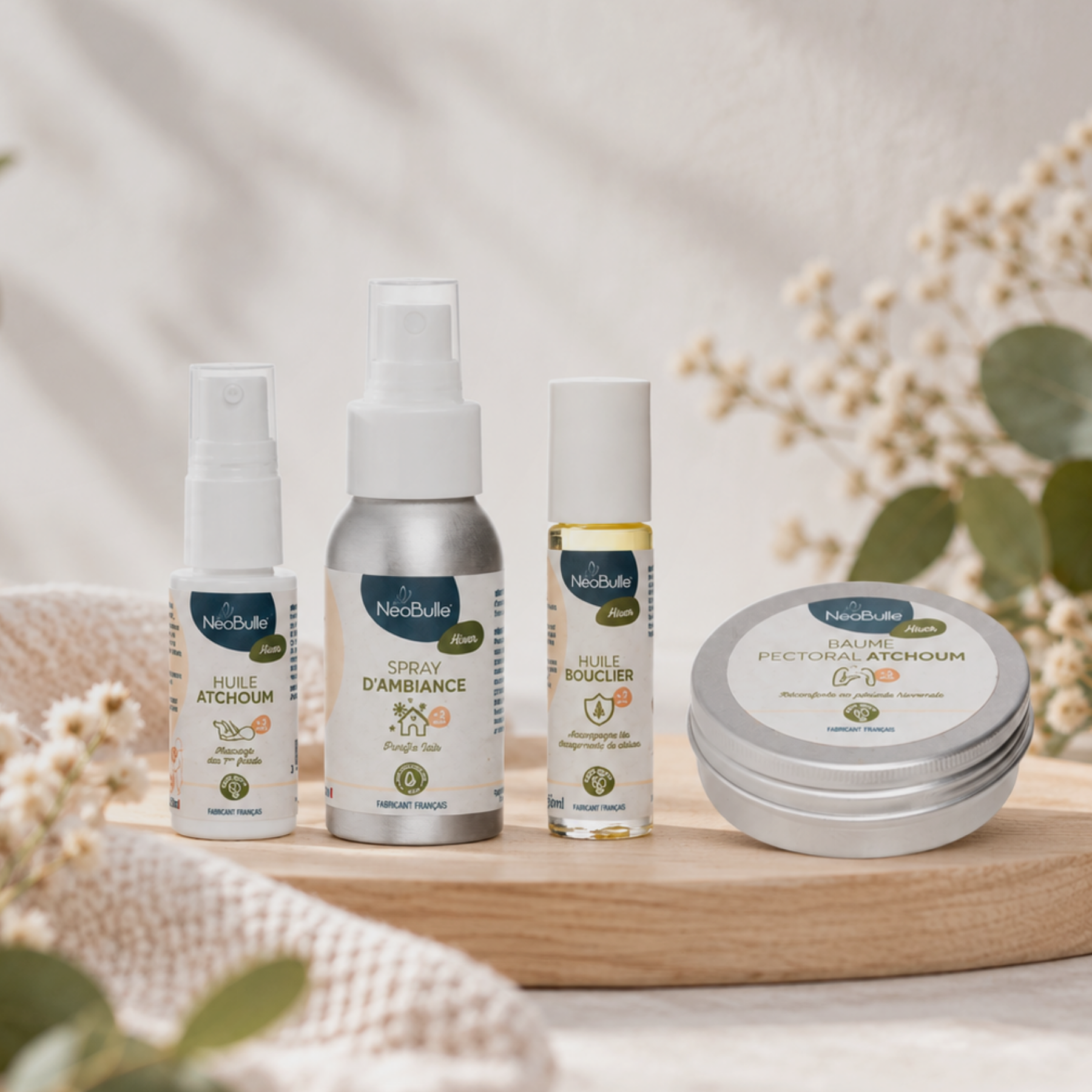
When thinking about lice, they are generally associated with school life, children at school or in community settings. However, lice do not spare young children! Yes, lice in babies are possible, and it can quickly become a source of stress for parents. Their delicate skin, fine hair, and difficulty expressing discomfort make managing lice in infants particularly delicate.In this article, we give you all the keys to understand how lice appear in babies, whether they are dangerous, how to treat them safely, and which natural products to use to soothe and protect your child's scalp. Summary Can a baby have lice? Can lice harm a baby? What products to use against lice in babies? How to treat lice in babies safely? Preventing lice in babies: good habits to adopt In conclusion: say goodbye to lice in babies in a gentle and natural way Can a baby have lice? The answer is yes. Even if infants are less exposed than children in community settings, it is indeed quite possible for a baby to catch lice. For example, this can happen if a brother or sister brings them home, if the child is cared for by a babysitter, or if they come into contact with contaminated textiles or objects.However, lice do not fly or jump. They are transmitted through direct contact or shared objects (combs, cushions, blankets...). Moreover, their presence is not always suspected in a baby with short or sparse hair, which can delay diagnosis. Can lice harm a baby? Fortunately, lice are not dangerous to the health of infants. They do not transmit serious diseases, for example. However, they can cause intense itching, scalp irritation, or even lesions if the baby scratches. This can disturb their sleep, mood, comfort, and lead to significant nervousness. Not to mention the mental burden for the rest of the family.Therefore, it is essential to act quickly, ideally with products respectful of their sensitive skin and young age. What products to use against lice in babies? Baby's skin is delicate: We therefore recommend prioritizing care products whose ingredients are derived from organic farming. At Néobulle, we offer a specific and natural range of anti-lice products, formulated in France, suitable for very young children from 3 months old while respecting their scalp. From 3 months: Anti-Lice Shampoo Formulated for babies from 3 months, the Soothing Anti-Lice Shampoo by Néobulle is a gentle, natural, organic cleansing care product. Thanks to organic lavender essential oil, known for its repellent properties, it soothes and repels lice while respecting their delicate skin. It can be used preventively or as a supplement to treatment.Advantages:Possible frequent useOnly a small amount of shampoo is neededGentle on sensitive baby scalps from 3 monthsCompatible with breastfeedingSuitable for pregnant women from 3 monthsMade in France, in Haute-Loire From 6 months: Anti-Lice Treatment Lotion Have you spotted lice on your baby? For a more targeted treatment, the Anti-Lice Treatment Lotion by Néobulle is an effective solution from 6 months old. It works by suffocating lice and nits. Composed 100% of natural ingredients thanks to coconut oil, it is formidable against unwanted visitors but obviously respects the skin of the whole family. Free from insecticides, perfumes, or essential oils, it is THE natural solution from the first application. This treatment is applied to dry hair and can be used in conjunction with an Anti-Lice shampoo.Advantages:Without harsh ingredientsEliminates lice and nits naturallyEffective in 5 minutes for lice, and after 1 hour for nitsMade of 100% natural ingredientsCompatible with pregnancy, breastfeeding, and babies from 6 monthsMade in France, in Loir-et-Cher From 18 months: Protective Anti-Lice Oil The Protective Anti-Lice Oil is ideal for prevention in children from 18 months old. Easy to apply thanks to its roll-on format, this stick is used daily during high-risk periods to create a barrier against lice. Simply apply behind the ears and on the nape of your child's neck. Composed of a clever blend of 3 essential oils (lavandin, fine lavender, and rose geranium), it emits a subtle floral scent that repels unwanted visitors while respecting the sensitive skin of children.Advantages :Quick, practical, and targeted applicationFun roll-on for easy useRecommended use in a 7-day treatmentVery convenient portable format for daily use and on the go100% of ingredients from Organic FarmingMade in France, in the Loire How to safely treat lice in babies? 1. Recognize the signs of lice presence in babies Detecting infestation signs in a child is not always easy... so identifying lice in a baby is a real challenge for young parents. We therefore invite you to pay attention to the following signs :Baby often scratches their headSmall red bumps or sores on the scalpPresence of nits (small white dots) attached to the hair 2. Use a gentle and respectful routine Using natural products with ingredients from Organic Farming is preferable for children under 2 years old. Indeed, their skin and scalp are fragile and therefore require gentle, suitable care.Recommended routine (in 3 steps!):Apply the Anti-Lice Treatment Lotion on dry hair and dry with a hairdryer or air dry. Leave on for one hourRinse thoroughly then wash with the Soothing Anti-Lice ShampooMeticulously comb with a lice combIt is not necessary to repeat the operation; one application is enough. If you detect lice in your baby, do not hesitate to take proactive measures by treating all members of your household. Parents, siblings, and relatives... Certainly, it’s not the most pleasant task, but it greatly increases your chances of getting rid of lice.💡 Tip: To make the application fun, suggest they listen to their favorite music so that this moment remains friendly despite everything. 3. Disinfect the environment To prevent re-infestation, here are four essential steps:Soak brushes, combs, and hair accessories in very hot water (at least 60°C) for at least 10 minutesWash all textiles that have been in contact with your child's head at 60°C: bedding, clothing, hats, plush toys, bed bumpers, etc.Vacuum carpets, sofas, and car seatsSeal non-washable objects in a sealed bag for 48 hours Prevent lice from appearing in babies: good habits to adopt Even if prevention is difficult, it remains your best ally, especially if you have older children at home or if the baby is in a group setting. Here are a few simple gestures to adopt daily" to limit the risks of infestation. 💡 And to keep a record of our tips, download our anti-lice memo! Routine n°1: Adopt a preventive routine Use regularly a shampoo with natural repellent active ingredients such as the Anti-Lice Shampoo (from 3 months). During epidemic periods (back to school, community settings...), it can be used 2 to 3 times a week to repel unwanted visitors. For older children, the protective anti-lice oil roll-on Routine n°2: Regularly inspect your children’s hair A weekly visual check allows for quick detection of early infestation. On damp hair, use a fine comb to hunt for lice and nits. The earlier you catch it, the easier it is to treat. Routine n°3: Favor clever hairstyles (for those with more hair) Does your baby have enough hair to tie back? Take advantage of it! Gathering hair into a bun, braid, or ponytail helps limit contact with other children’s hair. Lice are transmitted by direct contact: the less free hair, the lower the risk. Routine n°4: Fight against spread within the family If an older sibling is infested, treat the whole family quickly, and apply the same preventive measures to the baby. Remember that lice can move very quickly from one head to another! Routine n°5: Wash everyday objects in contact with hair During epidemic periods, thoroughly wash accessories or clothing in contact with the scalp:Soak brushes, combs, and hair accessories in very hot water (at least 60°C) for at least 10 minutesWash hats, caps, hoods, beanies, scarves... at 60°C In conclusion: say goodbye to lice on your baby in a gentle and natural way Lice on babies may seem intimidating, but effective and safe solutions exist. At Néobulle, we have designed a specific range for infants, to act gently: The Soothing anti-lice shampoo suitable from 3 months The Anti-lice treatment lotion, effective from 6 months The Protective anti-lice oil, preventive from 18 months By adopting a natural and gentle routine, you protect your child's delicate skin while helping them regain comfort and serenity. That said, don’t panic: lice are neither a hygiene issue nor an inevitability. With the right products and a few simple gestures, everything quickly gets back to normal.

Baby carrier or baby sling: which to choose?
When you become a parent, carrying your baby quickly appears as a practical and gentle solution to keep your baby close to you and soothe them. Indeed, it allows parents to stay close to the baby while having their hands free. But before enjoying these carrying sessions, parents face an unavoidable question: cloth sling or baby carrier, which to choose? What are the differences between these two carrying methods? By reading this article, you will have all the information you need to make the right choice, according to your needs and those of your baby.Summary Why opt for physiological carrying? What is the best solution between cloth sling or baby carrier? What are the differences between cloth sling and baby carrier? What if you combined both? The mei-tai: halfway between the cloth sling and the baby carrier FAQ – Cloth sling or baby carrier? In conclusion: cloth sling or baby carrier, the choice is yours Why opt for physiological carrying? Before comparing the cloth sling and the baby carrier, let's recall the many benefits of physiological carrying:Respond to the baby's natural need for proximityPromote the parent-child bondCalm cries and facilitate digestionSupport breastfeeding, thanks to the secretion of oxytocin and prolactinFree the parents' arms to manage daily chores or hold older children Whether you choose a sling or a baby carrier, make sure the carrying method respects the physiological position, the one in which the baby naturally adopts: rounded back, knees raised higher than the hips (called the "M" position), pelvis tilted forward, airways free. What is the best solution between cloth sling or baby carrier? The answer to this question mainly depends on your lifestyle, the level of comfort sought, the context, and your child's age. The cloth sling: ideal from birth The cloth sling is often favored for very young children because it is soft and enveloping. It allows for a very precise adjustment , adapts to all morphologies and provides excellent support.Advantages of the carrying scarf:Suitable from birthOptimal back and head support thanks to layered tighteningMultiple positions possible (ventral, hip, back)Ideal for long carrying sessionsPossible disadvantages:Learning curve required to master tying techniquesLess quick to put on than a baby carrierExtendable carrying scarfWoven carrying scarf💡 Important to know: At Neobulle, we offer two types of carrying scarves: extendable (guaranteed cocoon effect, to be used in double layer at minimum, from birth to 9kg) and woven (high versatility, suitable in single layer from birth to 4/5 years).The baby carrier: an ultra-fast setupThe preformed baby carrier appeals to many parents due to its ease of use. It is quickly installed thanks to clips and straps, like a backpack. However, it is not always easy to find a model that respects the baby's physiology.Advantages of the baby carrier:Quick to put onEasy adjustments thanks to strapsPerfect for daily use, outings, or travelEvolving models that adapt to the baby's sizePossible disadvantages:Less precise adjustmentMany models are too rigid or not adjustable on the market💡 Important to know: Models like the MyNéo, le Néo or le Néo+ by Neobulle are adjustable. You can adjust their height and width. They therefore adapt to your baby's age and ensure a respectful carry that aligns with their physiology. What are the differences between a carrying sling and a baby carrier? Although their goals are the same — to carry the baby comfortably and safely — these two carrying methods have notable differences. CriteriaCarrying slingBaby carrierAge of useFrom birthFrom 3.5 to 6 kg (or from birth with specific models)AdjustmentVery precise (thanks to fold-by-fold tightening)Adjustable with strapsInstallation timeRequires some practiceVery quickComfortExcellent, very enveloping, even over long periodsVery good once adjustments are madeBulkinessLess bulky when foldedVaries depending on the modelType of carryVery versatile, in front, on the back, or on the hip.Ventral or dorsal positioning possibleRecommended ageExtensible sling: from birth to 8kg.Woven sling: from birth to 4/5 years.Variable depending on models:MyNéo: 0-12 monthsNéo: 0-18 months.Néo +: 3-36 months💡 À remember : if you love the enveloping feeling, precise adjustment, and are not afraid of knots, the sling is made for you. However, if you seek simplicity and speed, the baby carrier is probably your best ally. Compared to the sling, this carrying method indeed requires fewer manipulations. What if you combined both? Écharpe de portage or baby carrier: choose based on your child's age Many parents start with a écharpe de portage in the first few weeks, then opt for a preformed baby carrier as their child grows. This transition can, for example, occur:Around 3 to 4 months, when the baby holds their head betterÀ partir de 6-7 kg, for more comfort and practicality during outingsDepending on your daily routine: the sling is perfect for home, the baby carrier for outsideHowever, this is not mandatory ! Some parents remain fans of the sling until 2-3 years old, especially for back carrying. Others opt for a preformed, adjustable baby carrier in width and height, which adapts to the size of a newborn from the first few weeks. 💡 Tip : contact a Carrying Coach in your region to try different carrying methods and identify the one that suits you best. Carrying sling or baby carrier: sometimes complementary Good news: you are not required to choose exclusively between a carrying sling or a baby carrier. Many parents use:A sling at home for naps or long carrying sessionsA baby carrier for outings for quick setupAn Hop’la sling or an emergency baby carrier for short trips (errands, markets, public transport...)Ultimately, what matters is respecting your needs and those of your baby, while having a comfortable solution. At Néobulle, we are committed to offering a full range to support every stage of your baby’s growth. Want to discuss it in person? To help you choose, we offer discovery workshops via video call. The mei-tai: halfway between a carrying sling and a baby carrier Are you looking for a solution that combines the comfort of a carrying sling and the quick setup of a baby carrier? The mei-tai will meet your needs! Inspired by Asian designs, this carrying method is the perfect middle ground. Easy to handle, the Pti-Evo is a mei-tai made of tie straps and a clip-on belt. You can thus position your child in a front or back carry. The fabric, very flexible, precisely adapts to the size of the wearer and the baby, for optimal comfort.➡️ If you are hesitating between a sling, a preformed baby carrier, or a hybrid model, discover our dedicated article on the mei-tai, to be sure you make a choice that meets your needs. FAQ – Carrying sling or baby carrier? Can a newborn be carried in a baby carrier? Yes, provided you choose an appropriate model from birth, such as the MyNéo by Néobulle, which respects the infant's physiological posture. Which solution is most suitable for breastfeeding? The scarf and the sling are very practical for discreet breastfeeding. Some baby carrier models also allow breastfeeding once properly adjusted. Babywearing scarf or baby carrier: which is more practical for walks? The preformed baby carrier, lightweight and quick to put on, is ideal for walks, hikes, or holidays. Can I carry my baby for a long time with a scarf? Yes, woven scarves offer optimal support even for larger babies, up to 15-18 kg. In conclusion: babywearing scarf or baby carrier, the choice is yours In summary, there is no right or wrong choice, but a choice that suits you, based on:Your baby's ageYour comfort with tying or clipsYour lifestyleThe seasonYour personal preferencesThe important thing is to ensure physiological, comfortable, and secure carrying. At Néobulle, we support you in this beautiful adventure with products made in France, tested, certified, and designed by parents to meet the real needs of parents.

Baby carrier in summer or wrap sling? All our tips!
Summer is synonymous with family outings, outdoor walks, and special moments shared with your little one. But under high temperatures, carrying your baby can raise some questions. Is it tolerable? Should you prefer a certain type of baby carrier in summer? How to balance proximity and comfort? In this article, we share all our tips to enjoy your carrying sessions during the sunny days!SummaryCarrying in summer: is it normal for a baby to feel hot? What is the best baby carrier for summer?Which baby carrier to choose when it's hot?How to protect your baby from the sun when using a baby carrier?Using a baby carrier in summer: all our tips to cope with the heat!FAQ - 5 common questions about carrying babies in summerIn conclusion: summer baby carrying is possible and beneficial! Carrying in summer: is it normal for a baby to feel hot? Yes, it is completely normal. Carrying your baby in summer naturally leads to a feeling of warmth since your body and your child's are in contact. Adding the fabric of the carrier, it is logical to sweat a little. However, this does not mean that carrying in summer should be avoided, quite the opposite! With a few adjustments and tips, it remains perfectly feasible, even practical for traveling, strolling, or exploring places that are hard to access with a stroller, like the beach.However, using a baby carrier in summer offers advantages: your baby feels secure against you, breastfeeding is facilitated, the parent's hands are freed, and you can continue your activities. Just make sure to choose the right material suitable for this season. What is the best baby carrier for summer? Choosing a summer baby carrier depends on two main criteria: lightweight fabric and breathability. Here are 4 summer-friendly options! The sling: the knotless carrying wrap! The sling is ideal for summer. Made of cotton, it can be put on in seconds and adjusted with rings. Worn over one shoulder, you stay free to move while feeling your baby securely against you, in a physiological position. It’s perfect for short trips and city outings.💡 Tip: prefer a woven model in organic cotton rather than an elastic one. It will be more breathable in summer and suitable from birth up to about 3 years old. The woven wrap: optimal comfort! Some models of woven wraps are made from particularly breathable fibers ! At Nébulle, we offer woven scarves made from organic cotton or Seacell. Seacell is a material derived from seaweed and cellulose with thermoregulatory and breathable properties: perfect for carrying baby in the summer! Preformed baby carrier: clip it on, and you're ready to go! Preformed baby carriers consist of a waistband and clip-on shoulder straps. They are used somewhat like a backpack! Quick and easy to handle, they easily fit into your suitcase or car trunk when you're on the go. Prefer flexible models, whose adjustments allow you to position your baby high on your chest. The rule of thumb? Keep it at kissing height!Good to know: at Nébulle, our baby carriers are designed to adapt to your baby's age. This means their dimensions adjust over the months. The MyNéo is especially suitable for small infants up to 12 months, the Néo is recommended from birth to 2 years, and the Néo+ accompanies you from 3 months to 3/4 years! Hop'la: the ideal summer backup baby carrier! Have you ever heard of backup baby carrier? It is a practical solution for short-term carrying a child who is already sitting. The specificity of Hop'la: it is particularly lightweight and easy to put on in 5 seconds flat. Simply slip it on as a shoulder strap and place your child on your hip. The fabric is very breathable and stops at the top of the baby's pelvis. When it comes to backup carrying, it also means keeping one hand supporting the baby's back, as shown in the photo. Ultra-compact, it is the perfect solution to give your baby a little break, during a cuddle or a bottle/breastfeeding pause! Which baby carrier when it's hot? As you understand, there are several alternatives for carrying a baby in the summer:The sling is lightweight, appreciated for short-term use from birth to 3 years for front or hip carrying with precise adjustment thanks to rings,The woven carrying scarf is longer and requires tying, but its comfort is unmatched for long summer naps,The preformed baby carrier is easy to handle and quick to install. Opt for a flexible and adjustable version for maximum comfort,The Hop'la, an ultra-light and compact backup solution, suitable from 6 months to 3 years. No worries: you will definitely find your happiness to extend your carrying sessions in hot weather. How to protect a baby from the sun while babywearing? Summer babywearing does not exclude the rules regarding skin protection for both children and adults against the sun. Here are some simple tips to stay protected:Avoid the hottest hours: prefer morning or late afternoon outings, which are much more pleasant,Cover your baby's head with a hat,Protect their eyes with a pair of sunglasses, ideally with a small strap that goes around their head to prevent them from falling to the ground,Use a parasol during walks if shade is scarce,Favor during your outings,Apply a sunscreen suitable for infants on exposed extremities,Hydrate yourself and your baby: for example, it is normal to observe more frequent fountains of saliva, as breast milk is about 87% water! Using a baby carrier in summer: all our tips to face the heat! Skin-to-skin contact can generate a feeling of dampness, but this should not be bothersome or worrisome. Here are some practical tips:Slip a damp glove or a damp cloth between you to cool down,Choose suitable clothing made from natural fabrics that limit sweating,It is perfectly possible to carry your baby in a onesie or in layers,Favor single-layer carrying methods (one layer of fabric on the baby's back),Use a water spray or a fan to cool down.Remember to hydrate your baby regularly, FAQ - 5 frequently asked questions about babywearing in summer Can I carry a newborn in summer? Yes, with a woven wrap, MyNéo, or a lightweight sling, it is entirely possible. Prefer the cooler parts of the day and adapt the duration of carrying. While the mother recovers from childbirth, the co-parent can gladly take over. My baby sweats a lot when I carry them in summer, what should I do? That is perfectly normal: when sweat vaporizes on the skin's surface, it allows heat to escape, helping to lower the body temperature. Therefore, choose a lightweight, breathable carrying method, and slip a small damp cloth between you and your baby to prevent a suction effect. Is it possible to carry a baby at the beach or in water? Yes, it is possible!] And it's a perfectly understandable need. At Néobulle, we have designed the Aquabulle: a portable baby carrier 100% compatible with water! Suitable for the sea as well as the pool, it dries quickly. So it is possible to bathe with your baby, by taking some precautions. Can I breastfeed in a baby carrier in summer? Absolutely. Breast milk contains everything your baby needs and is naturally rich in water. The sling and the Hop'la are particularly suitable for breastfeeding, but it is also possible with other carrying methods.➡️ To learn more about infants' water needs, see this summary of studies provided by La Leche League France ! Is carrying more tiring in summer? What is tiring is not carrying in summer. It is simply managing everyday life with a baby. It is a gift of oneself, 7 days a week, 24 hours a day. The high temperatures do impact our ability to stay active, of course. Listen to yourself: maybe now is the perfect time to slow down or ask for support from your surroundings, neighbors, friends. However, with appropriate carrying methods and tips shared in this article, it remains a shared pleasure. Conclusion: summer baby carriers are possible and beneficial! In summary, using a baby carrier in summer is a wonderful way to strengthen the bond with your child while staying mobile. To travel, discover new landscapes, use public transportation, soothe your baby, have free hands to play with your older children... Some carrying methods are more suited to hot weather than others. Prefer, for example, woven wraps over stretchy ones, which are thicker and require multiple layers of fabric on the baby's back for secure installation. After some adjustments, and adopting strategies suitable for high heat, you can enjoy the entire summer according to your needs!

Baby development: which nursery equipment to choose (or avoid)?
The development of a baby is a comprehensive, rich, and fascinating process. It is partly predetermined by the transmitted genetic material and the "cabling" pre-established in the small human being. But, above all, it depends on its environment and the quality of its human interactions. Every gesture, every word, every contact helps stimulate the baby's sensory, motor, emotional, and cognitive development.Are you wondering which baby gear to choose? Which objects are truly useful and which are better to avoid, on the contrary? How, as a parent, can you support the development of your baby through your daily gestures? In this article, we guide you to make informed and tailored choices based on your child's actual needs. The role of the environment A reassuring environment based on rich human interactions A large part of the baby's development unfolds depending on all the elements that make up its environment. Its diet, sleep, rhythms, living conditions, and especially its relationship with adults are crucial. The people around it therefore play a significant role, through their gaze, words, and their interaction with it. The baby feels, touches, listens, senses, opens its eyes, observes, and feeds on all the information it receives. Its brain is wired to learn and become curious. But, without relationships with loving humans, there is no development. Your role is therefore essential.Parents are thus the first essential material for the baby's development. Indeed, the baby cannot do without them! Carry your baby, rock it, talk to it, place it in the crook of your neck, your arms, your chest, or on your knees. These gestures promote bonding, eye contact, play, communication, and stimulate its development. The essential role of carrying in the baby's development The physiological baby carrier, the carrying scarf, or the sling are perfect tools to support the sensory and motor development of the baby. Being close to you, the baby can fully express and develop its sensorimotor abilities.To learn more about choosing an appropriate model, discover which preformed baby carrier to use from birth. Respecting your baby's physiology, meaning its naturally curled position, is essential. Create a wake-up space with a mat and contrasting objects A playmat or gym mat, where parents and babies can gather on the floor together, is very useful in the first few months. Enhance this space with colorful and contrasting objects, such as a black and white book or a frieze placed near the mat. Indeed, these contrasting elements help babies focus their attention. Make sure to change the baby's position or the objects' placement so that they don't always wake up with a toy hanging above their head, or so that they don't have toys behind them that would force them to arch their back to look at them. Limit objects that replace human interaction Babies understand the world around them when they are in contact with the people who care for them. Consequently, mechanical swings that rock and play music, or music boxes reproducing parents' voices, should be used with caution. Baby development primarily relies on real, qualitative human interactions, with those who care for them daily.💡 Want to choose a baby carrier suitable for your baby's development? Take a look at the Neobulle carriers made in France! The first suitable toys to support baby's development Later, baby discovers their hands, mouth, and feet. Their hands, initially closed, open and then close around objects. The first toys should be small, lightweight, and easy to grasp with small handles suitable for their hands. They can be larger if they are lightweight. Colorful toys with varied textures Colorful and contrasting toys are better perceived by babies from 0 to 6 months. At this age, their sensitivity is very fine. It is not necessary for their toys to make noise and light at the same time. Indeed, this could be too stimulating. Prefer objects with varied textures and shapes: hard, soft, smooth, rough. They can be varied but few in number: if there are too many stimuli, the baby becomes distracted or bored. If there are a few objects around them, they can focus on them and discover many ways to use them. The evolution of play and motor skills in baby's development Baby observes, grasps, passes toys from one hand to the other, releases, and throws them. Their grasp becomes more complex and precise. Over the months, their toys evolve:containers with contents,boxes to fill or empty (simple small cartons will do!),stacking and building blocks to knock down 1000 times,simple or complex insertions, Screwing and unscrewing elements... Encouraging fine and gross motor skills The practice of fine motor skills is intensifying. Your baby is catching small objects with the thumb and index finger or practicing making bead necklaces on a string. Parallel to the development of manual coordination, gross motor skills are also evolving. It is preferable to offer games or furniture that promote standing without forcing it.Thus, during the acquisition of walking, the baby can support themselves on a small chair, a bench, or have fun with a push toy. These are wheeled toys with handles, or sometimes a box to fill. These games are very appreciated, especially if they have a brake for safety. The goal is not to surprise them by progressing too quickly. Small cars, trucks, or riding animals are also suitable.💡 Tip: place a water pack in the small chests to weight down the push toy.To foster interaction with the baby, ball or balloon games are excellent. They provide a timeless support. Indeed, they promote exchanges, coordination, and visual attention, and should be explored without moderation!Finally, your baby will also enjoy moving with you, sharing walks, outdoor visits, or trips to the market. Once again, the physiological baby carrier will accompany you, perhaps on your back this time, a vantage point that babies love. Materials to avoid: risks to baby development Any systems that encourage the baby to stand when they are not yet able to do so themselves should be avoided. Walkers or yuppalas, for example, force an unacquired posture. Uninteresting in terms of development, they can become dangerous for the baby's safety. In short, it is preferable to support the baby's development without forcing them into a position they have not yet mastered. Books, allies in the cognitive and emotional development of the baby Books accompany the baby's development from the first weeks of life. Initially, black and white images captivate the infant's attention. Then, stories can very early support a moment of awakening for the little one.Gradually, the baby will become interested, listen to the voice, look at the colors, follow the parent’s finger pointing to the images. These are supports of infinite richness that accompany them from birth to adolescence and help develop their imagination, language, vocabulary, understanding, and attention... There are no limits to the stories you can read together! The dangers of screens for baby development Many studies show that screens are useless or even harmful, when consumed too regularly, before age 6. The baby does not learn anything through screens. On the contrary, early use can significantly impact motor and cognitive development. It is important to understand these dangers in order to use screens wisely. Conclusion: promote harmonious baby development with appropriate materials You understand it: to promote baby development, prefer simple tools. A mat for everyone to lie on and do "tummy time," a carrier scarf to go everywhere with baby, and encourage interactions, balls to play together, books for quiet moments, and nature for walks!💡To stimulate baby's vision and attention from the first weeks, discover this great DIY of contrast and shape cards for baby's awakening!On June 30, 2025, Anne Petit-Jean Robert, psychomotor therapist (co-founder of Néobulle)

At what age should a baby carrier be used?
Here it is, your baby is here! The only remaining question is: at what age is it safe to use a baby carrier? First of all, it depends on the model. To help you see more clearly, here are the options for each age group.Carrying a baby is a precious practice, both ancestral and universal, and ideal for reducing the mental load of young parents. Passed down through generations in certain cultures, it is now attracting more and more families thanks to its many benefits.It is also a natural response to the needs of parents and the infant. After spending 9 months cradled in the uterus, the baby discovers a new world. It doesn’t realize that it is safe in its cradle… but instinctively, it knows it is safe in your arms. No wonder it calms down so easily there. However, these arms are also essential for daily tasks. Carrying takes on its full meaning here: it frees your hands while preserving the soothing proximity that the baby needs.After reading, you will know exactly which baby carrier to choose depending on your child's developmental stage!Summary From what age is it safe to use a baby carrier? Focus: from what age can you use a preformed baby carrier? Focus: carrying scarf or sling, what’s the difference? From birth to 4 months: physiological and adjustable carrying From 4-6 months: explore new positions From 12 months or once walking is acquired Questions about carrying based on the baby’s age Questions about installing the baby In conclusion From what age is it safe to use a baby carrier? It is quite possible to carry a baby from birth, provided you choose a model suitable for its size. The important thing is to respect its physiology: rounded back, tilted pelvis, knees raised, and head well supported. It is indeed the baby carrier that must adapt to the baby’s age, not the other way around. The key is to respect the natural position that the toddler adopts spontaneously: this is called the “physiological position.” In short, using a baby carrier is good. But opting for a model adapted to your child's age and development is even better. To do this, here are three essential tips, regardless of the model used:Check the physiological position: tilted pelvis forward, knees higher than the hips, rounded back, head well supported. Adjust the position as the baby evolves: over the months, you can choose to carry the baby on your hip or on your back. Carry your baby against your stomach: facing the world is not recommended, prefer the hip or back position. Follow the manufacturer's recommendations: each baby carrier has its own specifics (minimum weight, recommended age, etc.).💡 At Néobulle, our models are designed with perinatal professionals to adapt to the baby's development while ensuring the comfort of the wearer. Padded straps, flexible waistband, breathable and soft fabrics, intuitive adjustments… everything is designed to meet your needs. Quick tip: from what age can you use a preformed baby carrier? A physiological and adjustable baby carrier, adjustable in width and height, can be used from 4kg. The MyNéo, a flexible and adjustable model, is even suitable from 3kg thanks to its innovative 3D knitted fabric! However, more rigid models, which are less adjustable in height or seat level, are not recommended until the child can sit alone, around 5-7 months. ➡️ To learn everything about models suitable for newborns, check out our article "Which preformed baby carrier to use from birth?"! Quick tip: sling or wrap, what’s the difference? It’s not always easy to distinguish between different carrying methods. For the preformed baby carrier, it’s quite visual: it is made of straps and clips. For other alternatives, let’s review them together! The sling: quickness and lightness The sling is a short strapless wrap that adjusts with rings. The carrier is asymmetrical, so the fabric passes over only one shoulder. Suitable from birth up to 10-12 kg, it allows carrying on the stomach or hip, both inside and outside. Practical for breastfeeding or bottle-feeding, quick to handle, and easily slips into a bag. 🎥 Discover the basic sling setup ! The babywearing wrap: comfort and optimal adjustment The babywearing wrap is a long piece of fabric, several meters long. Often intimidating at first glance, it offers optimal comfort, adjusts perfectly to the size of the wearer and the baby, with precise support. It can be tied in dozens of ways: on the stomach, hip, back... For an ideal weight distribution, use it symmetrically, with fabric on each shoulder. In stretch version, it is suitable up to about 8kg. In woven version, like in the photo, it is suitable up to 18kg! Compatible with breastfeeding, it requires some practice to get used to. 🎥 Discover the basic woven wrap installation ! Our recommendations for each age Now that you know at what age to use a baby carrier, let's see which models correspond to each stage! From birth to 4 months: adjustable physiological carrying From 3kg, carrying is possible thanks to solutions that adapt to the infant's morphology: à the traditional babywearing wrap, stretchable (with at least two layers of fabric on the baby's back) or woven to the cotton sling, a preformed adjustable in height and width like the My Neo or the Neo, The sling and wrap, for example, allow very precise adjustment: we talk about tightening fold by fold. The fabric thus envelops the entire little one. The My Neo, on the other hand, has no seams and has the perfect elasticity to fit your baby's body perfectly. The goal? To promote proximity, which is beneficial for: strengthening the attachment bond, reduce reflux (GERD), soothe baby's crying, facilitate falling asleep, allow thermoregulation, thanks to the carrier's body heat, limit the risk of plagiocephaly promote the secretion of prolactin and oxytocin (yes, you can breastfeed in a baby carrier!) 💡MyNéo or Néo, what's the difference? These two preformed baby carriers are adjustable in width and height, thus adapting to an infant's size. The MyNéo is made of 3D knit, an innovative, slightly stretchable material. With its low price, it is particularly designed for use from birth to 12 months. The Néo is made of wrap fabric. Flexible and adaptable, it suits from birth to about 18/24 months, depending on your child's morphology. À partir de 4-6 mois : explorez de nouvelles positions ! The development of your baby progresses: increasingly curious, they observe, turn their head, look at their surroundings. It is often around 4-6 months that we start to question the possibility of using a baby carrier facing the world. However, carrying facing the world is not recommended . Indeed, this position exposes the child to too many stimulations which they cannot turn away from by snuggling against the carrier. Moreover, their spine is pressed against your chest and cannot be wrapped from the start. This type of baby carrier is designed so that the baby is supported by the crotch, which is uncomfortable. Finally, if the baby falls asleep, their head will sway forward, like when falling asleep on a plane or train, which strains the neck. As you understand: this is not ideal. Therefore, explore alternative positions:On your hip, for example with a woven wrap or sling,On your back, with your woven wrap, preformed baby carrier, or a mei-tai, these hybrid carrying methods that combine quick setup with a clip belt and the comfort of a wrap with tied straps.💡 Many parents mention the Pti-Evo as a trusted solution for carrying the baby on the back with confidence! https://youtu.be/Jb36-kOKPHI?si=ttvPKMm38gtkWlhJ&t=246 From 12 months or once walking is acquired When the baby starts walking, carrying becomes more occasional but remains a valuable daily aid. For dropping your child off at the nanny or at daycare, for running errands, using public transport, during walks (a 12-month-old's legs tire quickly!).At this stage, you will probably want to prioritize hip and back positions.💡 The Neo+ baby carrier emphasizes versatility thanks to its adjustable seat and height. Wondering at what age to use this carrier? It is suitable from 3 months to 3-4 years old, making it a long-lasting solution! FAQ - Frequently Asked Questions about Carrying and Child Age Questions about carrying according to the baby's age: Can I carry from birth?Yes, unless contraindicated medically. For young mothers, it is recommended not to overstrain immediately postpartum to protect the perineum. Carrying is, of course, still possible but for short periods. The co-parent can take over in the first few weeks.💡 Good to know: Limit the use of baby carriers to rigid, low belts that compress the carrier's abdomen. Prefer soft belts worn high, at the waist level, to reduce any pressure on the perineum.Should I wait until my baby can hold their head to carry them?No, if your baby is positioned physiologically (upright, pelvis tilted forward, knees higher than hips), their head will naturally stay aligned with the spine, against the carrier's chest. The fabric should reach up to their nape. If their head swings, adjust the settings: simply tighten the fabric a bit more or tighten the strap.Up to what age can I use a baby carrier? There is no fixed limit. The key word? Listen to your child. Continue to carry your child as long as it suits both of you. The duration and frequency of carrying sessions evolve over the months. Generally, it becomes less frequent when the child starts walking. 💡Good to know : you will notice that manufacturers indicate weight ranges for use on packaging and tags of their baby carriers. For example, from 3.5kg to 20kg. Keep in mind that these indications are based on safety tests carried out. This does not mean that the use will be physiological for a 20kg child. Each baby has its own size... and there is no one-size-fits-all model perfectly adapted from 0 to 3 years, for example. That is why at Néobulle, we have chosen to restrict the age of use of our baby carriers according to specific age ranges, for optimal back support for children. Questions about installing the baby: Should I tuck my baby's feet into the fabric?No, always keep your baby's feet outside the carrying device. The goal: avoid activating the primitive reflex of automatic walking, otherwise your baby will push against the fabric and "stand". Therefore, opt for an adjustable baby carrier, whose seat adjusts to your baby's size. Is it better to cover my baby's head with the fabric to better hold their head in place?No, it is not recommended to cover your baby's face, regardless of their age. The fabric should stay at the level of their neck so that the respiratory pathways are clear. This allows for safe carrying. Your child will be able to move their neck, strengthen their muscles, and observe their surroundings.Is it possible to sit with a baby carrier?Yes, regardless of your baby's age. Make sure not to compress their legs, but rest assured: you can eat, work, paint, play the piano... all while sitting and carrying your baby. In conclusion In summary, you can practice physiological carrying from birth by using equipment suited to your baby's size. Carrying and the type of installation evolve according to your child's age. Wraps, slings, preformed or hybrid baby carriers, each method meets specific needs. Some, like woven wraps, will accompany you from birth to preschool. Others are more suitable for a specific age range. To conclude, keep these 3 key points in mind:Respect your baby's physiology,Adapt the carrying method or installation to the child's age, development, and needs, Prioritize safety throughout carrying : clear airways, vertical carrying, high and properly adjusted installation.By applying these tips, carrying becomes a true extension of the intra-uterine cocoon, providing comfort, proximity and freedom to parents. To extend this experience, do not hesitate to get support from a carrying instructor or to register for virtual workshops led by the Neobulle team!
Baby carriers and breastfeeding: all our advice
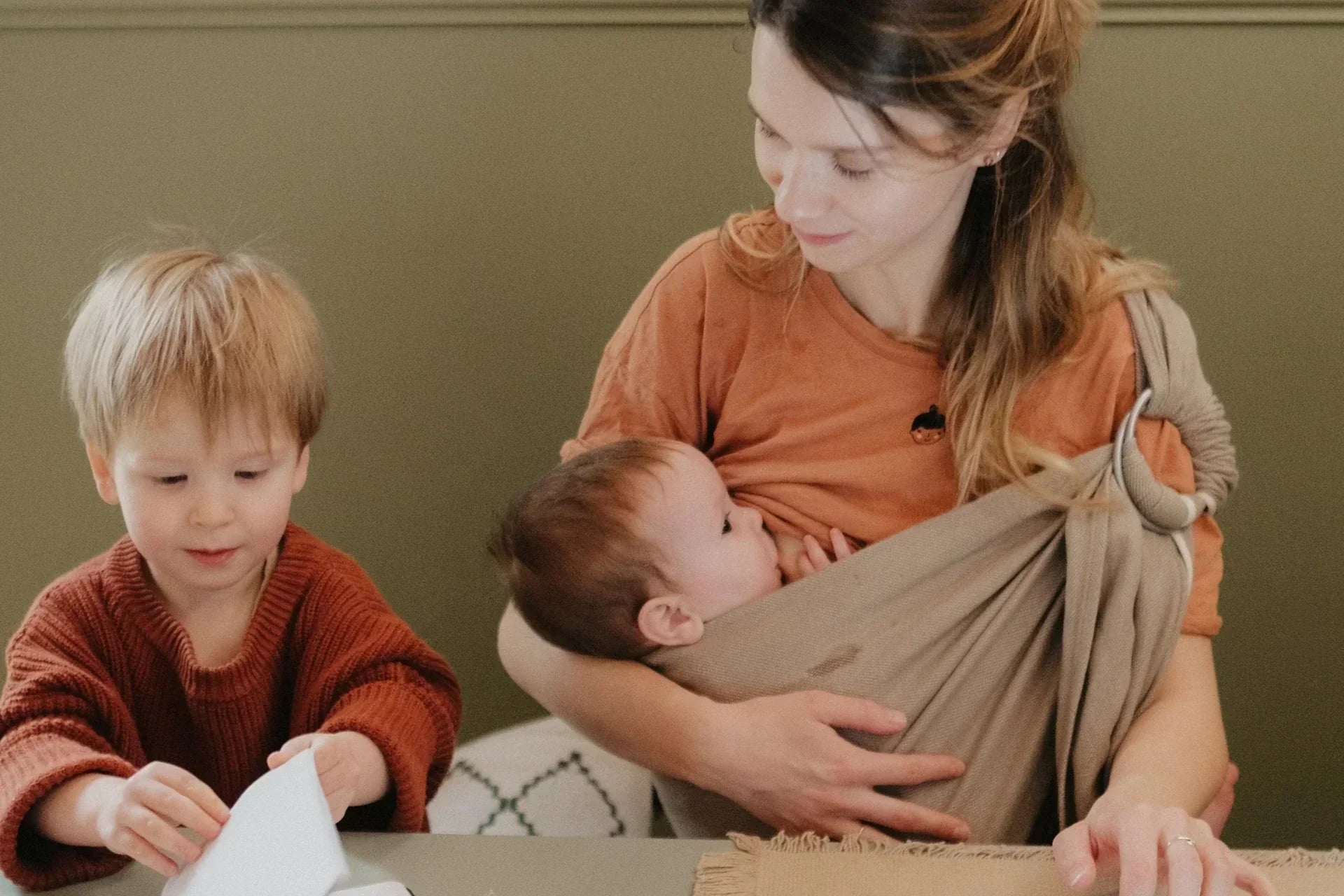
Is breastfeeding in a baby carrier really possible? The answer is yes, a thousand times yes—and it's actually a valuable practice, both for the baby's well-being and the parent's comfort.
Co-parenting: much more than just a practical gesture
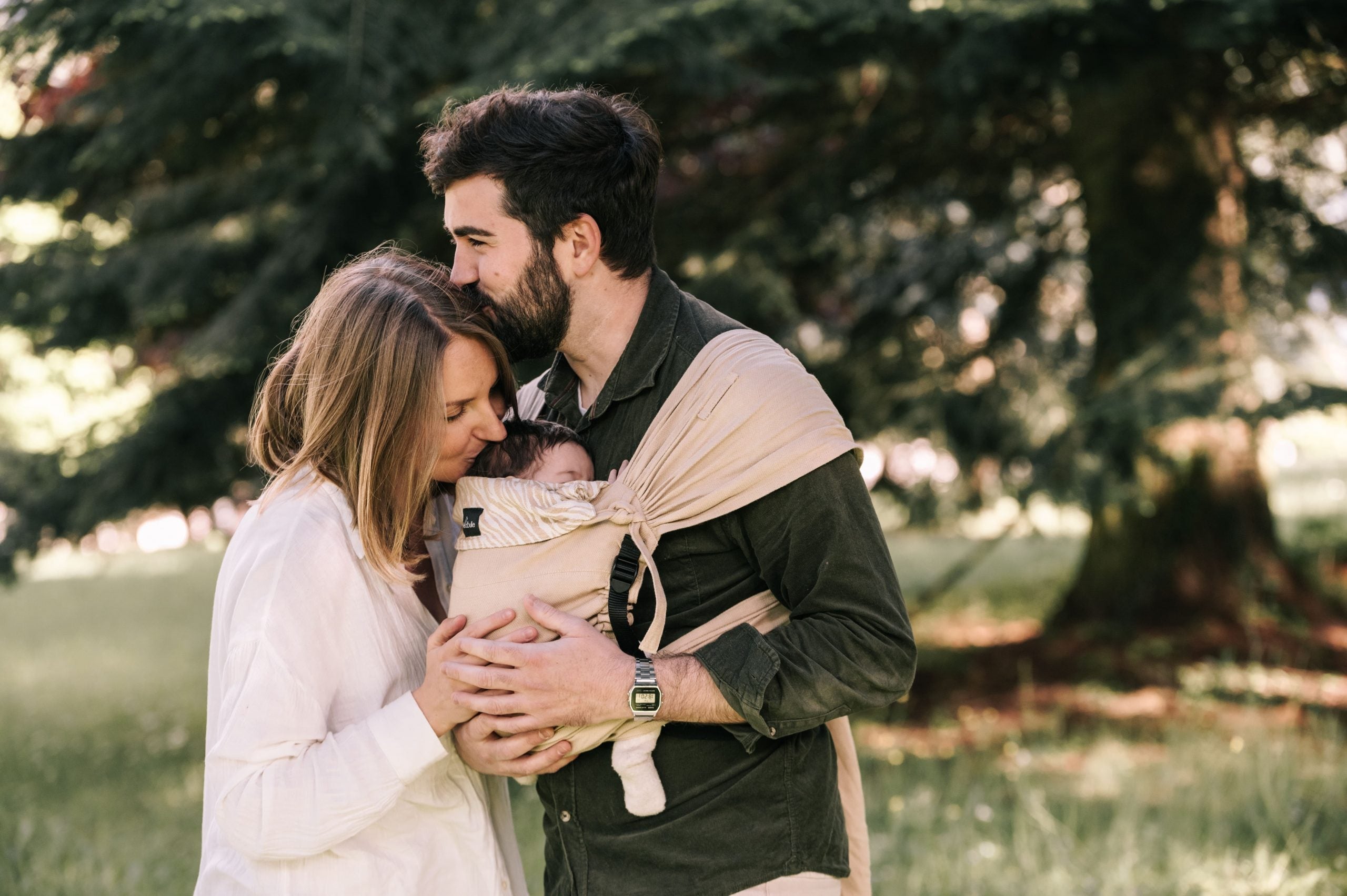
What could be more magical than feeling that little body all curled up against you? Maybe you've already experienced skin-to-skin contact at the maternity ward. That suspended, intense moment when the bond is woven to the rhythm of heartbeats.And what could be more natural to create a deep attachment between you two, as you are still discovering each other... Even if you've always been there, by their side, whispering sweet words through their mother's belly, you have to admit: she has a nine-month lead.But rest assured: carrying your baby is a wonderful way to catch up on this time, to build your bond at your own pace, gently and with closeness. A physical and emotional connection Carrying your baby means physically feeling the fullness of having them against you. Their body curled on your chest, rocked by your breathing, your heartbeat, your movements. Because yes, as soon as the baby is against you, your body naturally begins to sway.Seeing them fall asleep against you, letting go in complete trust... and feeling, yourself, becoming a parent. More and more competent, more and more connected to their essential needs: contact, movement, attention, security. Carrying helps calm their cries, soothe their fears, support their natural development. And, little by little, they will no longer just fall asleep against you, but will discover the world... your world. Safely, in this caring "pocket" that allows them to explore without being jostled, at their own pace. Much more than a practical solution Yes, carrying your baby allows you to have free hands. Yes, it's practical for walks, errands, falling asleep. But above all, it is a deeply instinctive and nourishing gesture.Unlike other mammals, human babies do not know how to move around at birth. They need to be carried. This is how they feel safe, how they develop their body, their brain, their five senses... and much more.Some babies demand a lot, others less. But all fundamentally need it. Otherwise, nature would have planned things differently. A carrying method that suits you All that's left is to find the carrying solution that suits you: according to your desires, your morphology, your daily life. The key is that you feel comfortable, autonomous, and confident in placing your baby in it.For that, don't hesitate to contact a carrying instructor. They are professionals trained in physiological carrying. They will teach you much more than knots: they will give you valuable keys about babies' needs, and help you find the most suitable solution for your duo.At Néobulle, we believe that carrying is a wonderful tool to strengthen the parent-child bond, support the baby's development, and allow each co-parent to find their place, naturally.Do you have a question or want to share your experience? Join our community or contact our carrying advisors.
The role of the co-parent during breastfeeding: an essential pillar
Breastfeeding is much more than just a nourishing act: it is a bond, a mission, a total immersion.
The role of the co-parent during childbirth: presence, support, and shared magic
The presence of a co-parent during childbirth has become a given for many. This intense moment, both physical and emotional, is no longer experienced alone.


