

Focus on the Mei-tai
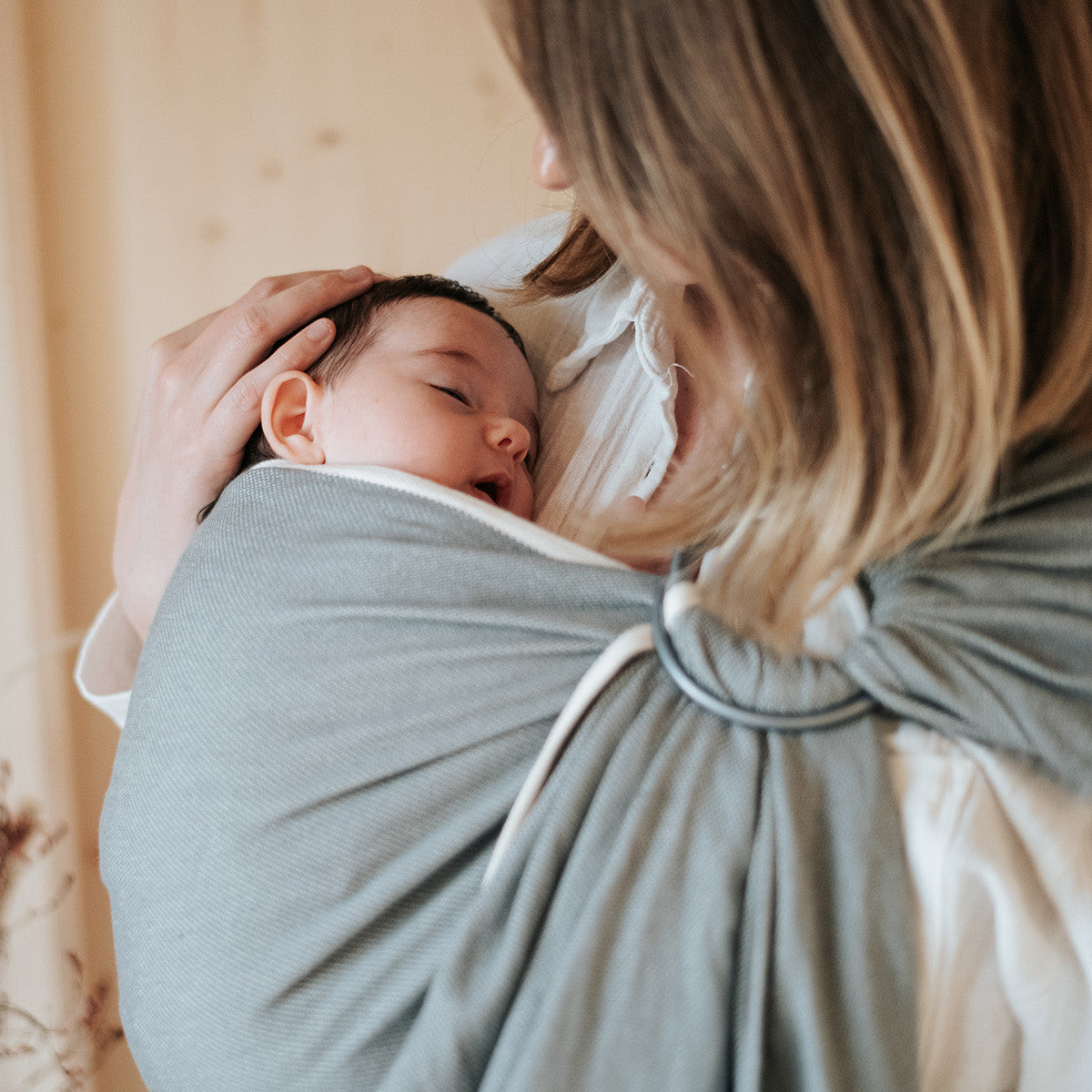
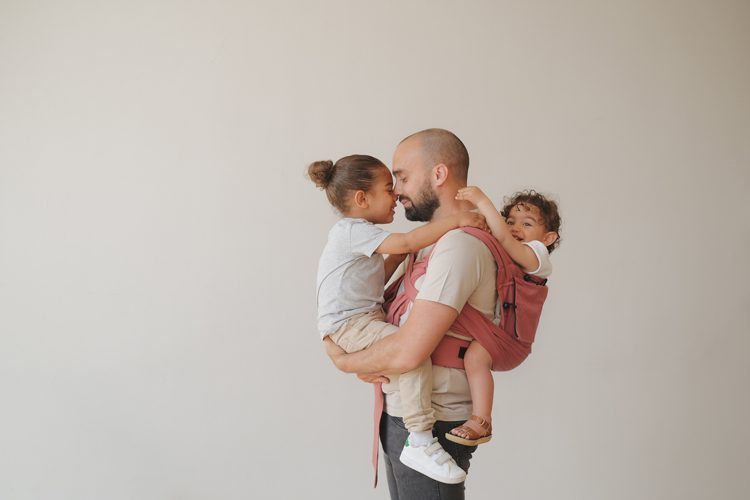
The article of the day is dedicated to the mei-tai, also called Asian-inspired baby carrier or more simply "the thing like a scarf but easier". What is a mei-tai? What are the advantages and disadvantages of this type of system? We explain everything to you! So, what exactly is a Mei-tai? The Asian-inspired baby carrier is presented in the form of a rectangle of fabric (called the apron), with four straps inserted at the corners which form the waistband and shoulder straps. Many traditional carrying systems are used in Asia, but the versions we find here have been highly westernized and often bear little resemblance to their original models (hence the increasing avoidance of the term "Asian baby carrier" in favor of Asian-inspired). What are the main characteristics of the Mei-tai? There are many different mei-tai models on the market. While the earliest versions were very basic (no adjustments), the most recent ones allow for adjusting the size of the apron, notably by reducing the width between the legs and the height, which allows significantly improving comfort and ensuring a better fit to the baby’s size (at least for the reference brands). Among the possible variations, you can find: Straps that are extendable or padded at the shoulder of the wearer Belts that can be tied or clipped (mei-tais in this category are called "hybrids" because they are halfway between preformed models) Most Asian-inspired baby carriers on the market are suitable for children from 3 or 4 months: this is because, even when maximally reduced, the apron often turns out to be a bit too wide and too high to comfortably and safely carry a newborn (risk of collapse in the system). They can be suitable for carrying up to about 3 years old, after which they are generally too narrow to allow for physiological use (support up to the hollow of the knee no longer possible). It is highly recommended to choose a mei-tai with long enough and wide straps to be crossed outside the baby's legs and then attached at the back of the wearer: this provides better support, ensuring the baby is positioned high on the chest, and most importantly, that the load is supported by the straps and not the belt. When passing the straps between the wearer and the child, as suggested in some instructions, the load shifts onto the belt, which exerts quite strong compression on the wearer's abdomen (very discouraged for the integrity of the young mother’s perineum since it increases the risk of organ prolapse!), and the baby will inevitably slide lower on the chest. which makes carrying less stable and less comfortable. Straps that are too narrow, even if long, cannot be crossed outside the baby's leg risk hindering proper blood circulation. The question of whether to pad the strap is much more subjective and totally depends on the wearer's preferences. Nevertheless, in ventral carrying, one often prefers panels that unfold over the shoulder and back, whereas in dorsal carrying, padding is often more comfortable because the strap can unfold less and "pinch" the trapezius a bit. The advantages of the Mei-tai The mei-tai is the perfect compromise between a carrying scarf and a preformed baby carrier. It is a system that has managed to combine some of the advantages of both systems to give a simple, lightweight, and comfortable result to wear. This baby carrier presents very few difficulties in installation: no fold upon fold nor adjustments on the baby (other than those of the panel but which are done beforehand), very little risk of mishandling or error. It is more enveloping than the preformed baby carrier and allows for better close contact, making it consequently more comfortable. It remains less enclosing than a scarf and is perfect for parents who do not like to feel too tight. Regarding the baby, it is an interesting solution to address some installation difficulties, notably: Babies suffering from gastroesophageal reflux, who often struggle with overly enveloping carriers and can be very stiff when they are in pain. Since it passes between the child's legs, the mei-tai allows for a safe installation with a stiff as a board baby and who screams, not very academic but at this stage, we don’t care much — the main thing is to survive! Babies a bit more "older" who haven't been used to the scarf: after 3 or 4 months, it can sometimes be more delicate to install a toddler in a scarf, as they are not used to the sensations and are often not patient enough to let their parent learn the technique. The mei-tai, being more immediate and less enclosing, is generally better tolerated. Babies who present hyperextension and/or torticollis issues, who tend to adopt very stiff and sometimes twisted postures naturally: here again, the mei-tai is often more accessible for parents and better accepted by the child. Note that both its breathable cotton twill composition and the fact that it is open on the sides make it one of the most comfortable carrying systems to use in hot weather. The weaknesses of the Mei-tai The main weakness of the mei-tai is that it can be less adjustable than other carriers, especially for very small or very large babies, and may require additional accessories or adjustments for optimal fit. It remains its less versatile and evolutive nature compared to a baby carrier wrap. This is mainly due to its panel, which, even adjustable, cannot optimize coverage for a child's large age gap: it will be ideal for a newborn but a bit short from 2 years old, or it can be used up to 3 or 4 years old but only from 3 or 4 months old. Another small downside is that its easier installation is less precise adjustments than those of the wrap. If the use of the wrap is very well mastered, one might feel a slightly less comfortable in comparison. The corollary is that it is better to have a well-mastered mei-tai than a poorly adjusted wrap. Finally, like the wrap, you find straps dragging on the ground during setup, which makes outdoor installation in the rain more complicated than with a preformed carrier! Nothing too disabling! The Asian-inspired baby carrier, less known than its counterparts the wrap or the preformed, thus quite rightly deserves its place within the family of ergonomic carriers and would benefit from greater recognition! It’s an excellent choice for parents who are intimidated by using a wrap but still want more closeness than with a preformed carrier.
Carrying a growing child
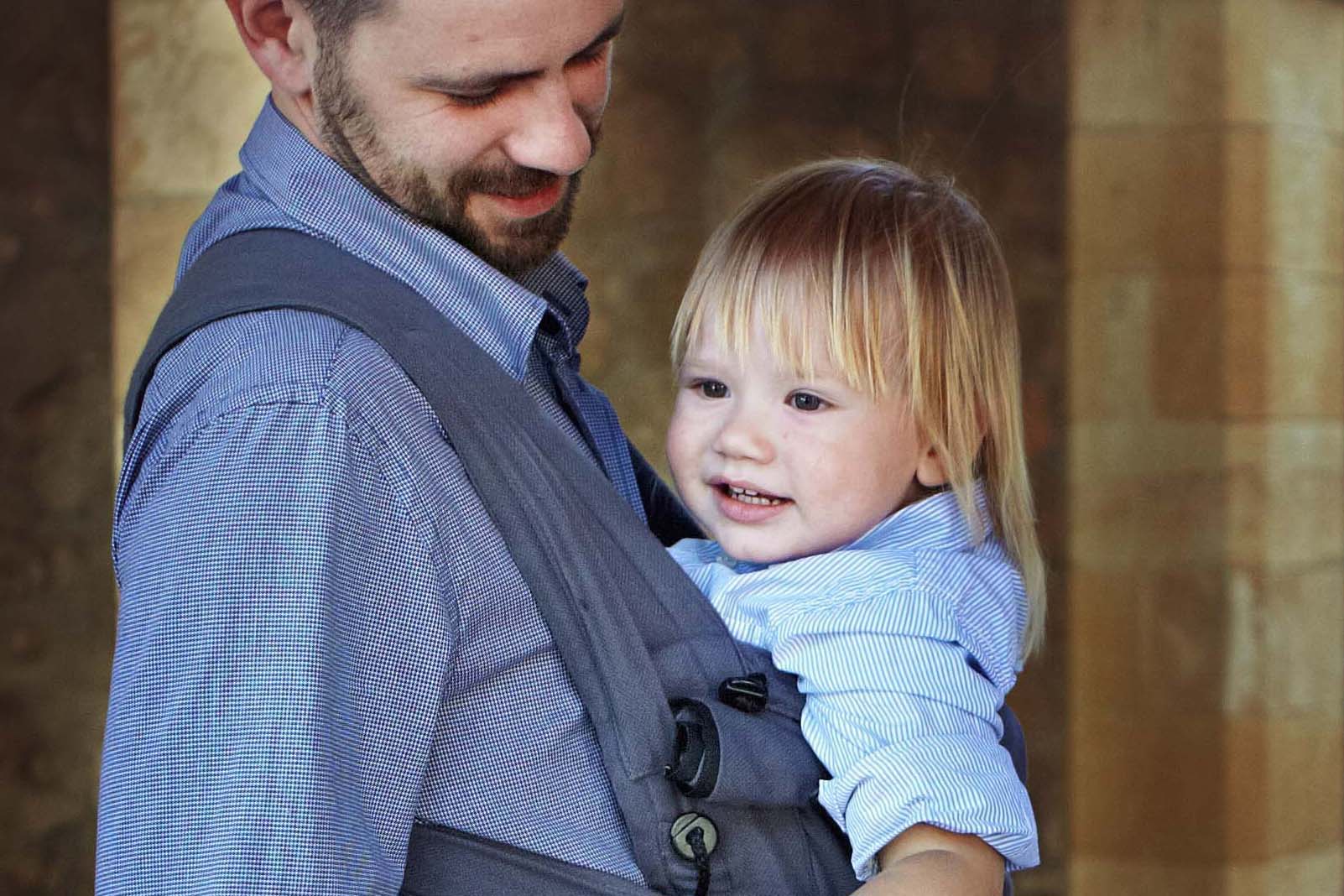
Though it seems both distant and close, that time when your little heart measured 50cm and fell asleep cuddled against you in the sling in just seconds... Now babychou has grown, and the setups look more like a wrestling match than a gentle moment of relaxation. Won't it end up being too heavy? Is carrying still possible (and desirable) with a larger child? The needs of the toddler When discussing carrying a growing child, the common argument heard is that anyway, from 1 or 2 years old, they will walk, implying that it will no longer be necessary to carry them. On paper, this is true; in reality, a little one will not have the same endurance as an adult and unless they are a very good walker, they will inevitably end their journey in the arms or on the shoulders of their caregiver. You have understood it, even full of good will, your favorite can quickly become tired and need a break. They may also have been scared of something (a barking dog, a honking car...) and thus need a big cuddle to reassure themselves. The planned trip could be longer than expected, or after a somewhat exhausting day at daycare. Whether you like it or not, your toddler will end up on you if they are no longer able to walk! Planning a baby carrier allows you to meet their need for rest and/or contact, without ruining your back and neck in the process. Look up to what ages strollers are typically used for difficult trips, extrapolate for the baby carrier. The physical limits of the carrier The question of the child's weight is also a recurring topic when discussing the continuity of carrying over several years. Three important notions should be highlighted: The first is that you do not suddenly wake up one morning thinking, “Well, if I carry my 3-year-old, 15kg child whom I have never carried before...” At least, this is strongly discouraged! Carrying is part of a continuity since birth. We handle a newborn of 3kg, then 4, 5... Our body gradually and gently adapts to the increasing load, we strengthen our muscles, and we gradually adjust our postures as well. Then, outside of pathology or disability, a larger child fortunately does not have the same needs as a newborn! If the toddler can stay with their parents for several hours a day, the 2-year-old will alternate walking and carrying and we will have them on us only in small chunks of 10-15 minutes. Finally, from a purely physical point of view, it is considered that the child's weight begins to impact the health of its carrier from 30% of their weight. Understand that if you weigh 70kg, your toddler will start to feel quite heavy from about 21kg (which is roughly around 6 years old... That leaves some margin!). These are obviously trends, which should be adapted to your form (someone sporty will support a heavier load) and the duration of carrying (the impact is not the same for 5 minutes or 2 hours). Generally speaking, we will favor installations on the back, which put less strain on the carrier's body. Choosing your equipment Parents of a child in the terrible twos know it: they live dangerously! Their child is in the midst of an emotional hurricane and transitions seamlessly from total cooperation in good humor to a remake of The Exorcist, all over a dark story about an open cookie bag when he wanted to do it himself like a big kid (even if 10 seconds before he asked for help to do it, that doesn’t count). Your child is walking well and you think, "We no longer need a carrying system"? That’s ignoring the duality of said carrier. Scenario, starting a walk: "I want to walk! I want to walk!!!" You wanted to go left? Too bad, here he is going right. After 100 meters, he clings to your leg whining, you have to carry him. 100 meters later, he saw a butterfly, he wants to walk. Another 100 meters, he’s back on the verge of despair, he needs to be carried. Another 100 meters, "Oh!!! a dead leaf!!! I want to walk!!!" etc As you can see, the babywearing sling is definitely not the recommended system in this kind of situation (lest you have to fight a furious urge to make him swallow it after 300 meters... without salt...). Too tedious to install/uninstall every 3 minutes! A preformed baby carrier clipped to the waist, a sling, or even a support for carrying on the arms like Hop-la allow you to climb or descend your little sprite without a headache. The type of material will also depend on the length of the walk; if it’s a bit long, it’s better to favor the comfort of the preformed, if it’s for a shorter trip, a sling or Hop-la might suffice! Another argument in favor of these systems: they all allow quick setup, which is not negligible when you have to deal with a grenade ready to explode (meaning: a child not at all cooperative who won’t give you time to make your little adjustments calmly). They are also all compact, and better tolerated by little ones discovering their motor skills and who love to move freely without feeling restricted. Everyday constraints You cannot discuss carrying a growing child without also mentioning the daily life of the family, and the constraints associated with it. Having a walking child also means accepting going at their pace. Is your usual home-nanny commute taking 5 minutes? It will probably take 30. If you're lucky. Sorry, preparing the meal cannot compete with the beautiful pebble that little Choupinou just found and absolutely wants to take the time to admire. In an ideal world, we could take the time to admire all the pebbles on the path, but in real life, you will sometimes have to speed up a bit and carry your child to arrive at your destination within a reasonable timeframe. Depending on the environment, it may sometimes be difficult to let your child walk because they will not be safe. Either because the area is full of too many tempting dangers, or because your little one is tired and switches to headless chicken mode, running around without thinking or paying attention to their surroundings. Putting them on you is then a good way to keep them safe. This is often useful, for example, for city trips when crossing multiple busy roads. It goes without saying that it is unlikely they will agree with your way of seeing things in these moments (fatigue doesn’t help with cooperation), so we come back to the previous point: choose a system where you can zip them up while they scream and fight. It should also be noted that it is safer in these conditions to use a carrying system than just your arms, from which they risk falling or escaping! Finally, once at home, they might also seek your attention and cuddles while you have things to do. Picking them up for a little while then allows you to balance your needs and avoid tensions and frustrations. For example, you could place them on your back while preparing dinner, thus providing the necessary emotional support to decompress from their day, and a view of what you are doing to satisfy their natural curiosity and involve them in your daily life. You understand, it’s not because a child is growing up that carrying them is no longer useful. Just like the advice given for a toddler, as long as you carry them, it’s better to use a carrying system and protect your body as much as possible! The baby carrier remains a weighty ally in daily life and preserves family peace.
Carrying baby facing the world
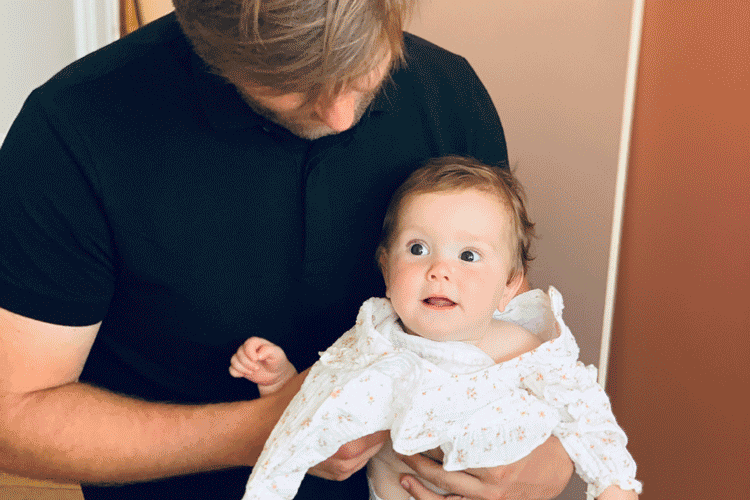
The question of carrying your baby facing the outside comes up very regularly as your baby grows and becomes more interested in what's around him. Logically, when he starts to unscrew his neck to observe everything, we can be tempted to turn your baby outwards to satisfy his curiosity. We are then often asked at what age this is possible, or if our baby carriers allow it. In reality, this is a practice that is rather discouraged and in fact our baby carriers do not allow it. We explain why! 1 – respect for physiology When we discuss the physiology of the toddler, the generic benchmarks given are to check that his base (= his pelvis) is well supported with a wide material base which extends to the hollows of the knees , that the knees come up a little higher than the axis of the hips , and that the natural roundness of his back is preserved. When you turn your baby outwards, there are several concerns: It is difficult to maintain the "sitting" posture and in particular to keep the knees raised. The material gathers between the legs and we find ourselves carrying in suspension with the legs hanging down. While the baby carrier may be able to maintain the correct leg posture, the padding used for stabilization quickly ends up sagging and/or being too short and no longer fulfilling its role. The baby's back is pushed by the contours of the wearer's torso (breasts, pectorals, etc.) against which it is resting, preventing natural rounding in favor of an arch . It's a shame to use a carrying system that claims to be respectful of the physiology of the little one only to end up with a posture that isn't! 2 – stimulations Faced with the world, babies find themselves overwhelmed by an incredible quantity of stimuli , which their developing brain will have difficulty processing. First of all, EVERYTHING is new and unknown to him. Lights, sounds, colors, passers-by, trees, cars, buildings, etc. Being naturally curious , he will try to observe everything in detail, which you will agree is exhausting ! It is also transported at the speed of its carrier, which being much larger than it will also go much faster , and will therefore attempt to carry out its observation work but at an accelerated pace . Certain things are likely to frighten him , like the dog barking as you pass, or the granny rushing towards him to go "gouzi-gouzi" by touching him... In this case he will be "stuck" in front of what frightens him , without being able to avoid it, nor curl up against you, nor seek the support of your gaze. It's a bit like landing on another planet and instead of giving you time to take everything in smoothly, you're being offered a fast-track tour! Even if you're very, very curious and really, really want to see everything really quickly, the experience wouldn't be the most pleasant or ultimately very enriching. An overstimulated child may become nervous, tense, cry more, and have increased difficulty falling asleep . NB: the same problem arises in a stroller and it is not recommended to put the child facing forward until he is able to move on his own. 3 – security If the two previous points were more suggestive and subject to your personal sensitivity, this last one is on the other hand much more notable because it concerns the basic security of your carrying. Facing the world, your child is no longer one with you, his weight is felt much more, he pulls you forward , his movements can unbalance you, and he obstructs your field of vision. This drastically increases the risk of falling forward , and that you find yourself crashing face down on the ground with your baby (himself face down). We won't draw you a picture: the consequences could be serious! Obviously, even when carried in front of you, it is possible to fall, however the risk of this occurring is much lower because the child is less in your way and throws you off balance, and above all you will more easily succeed in protecting your little one a little or tipping to the side, and the parts that will absorb the shock will be less fragile (back of the skull and back versus face, rib cage and abdomen). It is the same principle that applies when in judo we learn not to fall forward. “Yes, but my baby is crying out!” Children are naturally very curious , so it's only natural that they want to see as many things as possible! Put yourself in their shoes, lying on your stomach, and in the end they can only see the underside of your neck or your shoulders (the bust line is convex and "closes" the visual field), nothing exciting, you'll agree... First of all, let's remember that safety takes precedence over everything else, and that when your child asks for something, sometimes you unfortunately have to say no because you know it won't be good for him . For example, he would certainly be delighted to taste chocolate at 2 months, but you won't give him any. Later, he will certainly also want to cross the road alone, and again you will stop him, even if he cries. In this case, it's not about completely restricting your little one, but rather about adapting the carrying to reconcile their desires with the comfort and safety of everyone. We can suggest several adjustments depending on the context: Carrying on the back: this carrying is possible very early (from birth with a sling), and allows the baby to be carried in the direction of travel, and to see over the shoulder of the carrier or to the sides (the posture of the back offers a convex curvature which opens the field of vision). When there are too many stimuli, he can take refuge against his carrier. Side carry : Off-center carrying allows the baby to better see their surroundings while maintaining eye contact with the wearer. A sling is very practical in this configuration. And by arm? The above points are especially relevant when carrying with a tool. The analysis is slightly different when carrying with a hand: We generally carry by arm indoors , in an environment that is less stimulating than the outdoors and that the child is familiar with. Carrying is intended to last a short time (these little creatures quickly get heavy!) which also reduces fatigue and agitation. The carrier constantly interacts with their baby: either through their gaze and speech, or through their gestures, as they continuously change the position and way of carrying depending on their child's movements. In the event of a fall, it is easier to protect your baby. Carrying the child facing the world in the arms is in fact much less problematic than in a baby carrier. We can recommend positions more on the side to encourage exchanges, and with a child supported in a sitting position by the outside of the knee and not with the hand between the legs (promotes extended positions and wrist pain). Special cases : The advice given above applies to the general case, but there are several situations where it will be necessary to qualify it! Non-exhaustively, we can mention: The carrier's disability : a parent in a wheelchair, for example, might have difficulty placing their child facing them A child with a device (club feet for example): some devices can injure the wearer and/or the baby and require installations facing the world Babies with reflux : Some children with gastroesophageal reflux completely refuse to be positioned facing the carrier, and it may be helpful to find adjustments to face the world. So, apart from special cases, as you will have understood, carrying the baby facing the world using a carrying system is not recommended. The fact that it is offered by several brands and baby carriers unfortunately does not guarantee that it is wise and suitable. Is your baby moaning in front of you? Don't hesitate to get help from a babywearing instructor to adjust your setup and find solutions that work for you!
All the times babywearing saved my life!
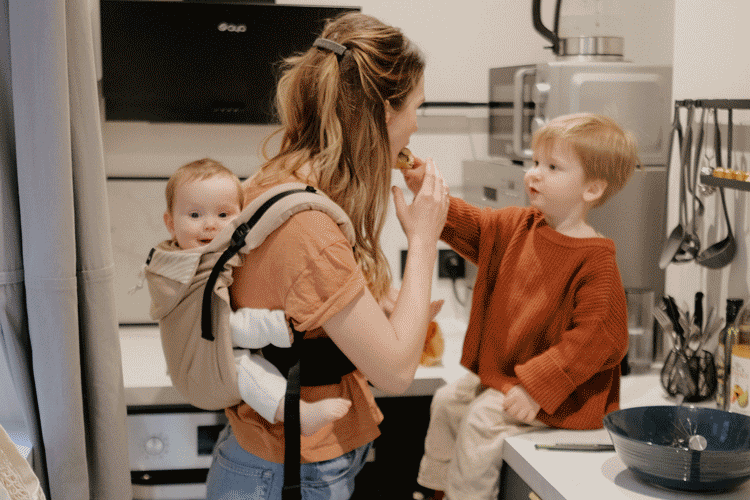
Single mom in the city, parents on the go or with a large family: Babywearing makes everything easier! For me, babywearing means: Giving him time to sleep , allowing me to share quality time with his brothers and sisters, and yes, no jealousy , we think of everyone! Cook on time so that the siblings don't turn into a gang of hungry little monsters. Have a telephone appointment without interference (You know, the endless 45 minutes with the Caf or social security...) Spending time with my friends and avoiding being isolated, half the evening, in the baby's room . Allowing myself a relaxing break , nestled deep in my favorite armchair, without falling asleep of course Offer my baby a safe space in the crowd and protect him from street stimuli: noise, smell, color (see article on carrying facing the world ) If it can prevent him from having his cheek pinched by the annoying little Grandma "how cute is this baby!" Accompany me during the long nighttime trips up and down the hallway , trying to get the baby back to sleep after a nightmare. You know, when you're so sleepy that the only strength you have left is to move your pelvis to rock the baby and hum a lullaby, which you hope will be effective! It's cheaper than driving around the block, and I even have the luxury of staying in my pajamas ... "Actually, by carrying my children, I did everything" - Camille Have both hands free to: Accompanying my eldest to school without risking a "I don't want to go to school" turnaround Validate the bus ticket and hold on to the bar, while watching over the stroller ! Carry shopping bags and diaper packs (no need to go to the gym!) Continue my hobbies , while spending time with my baby. Go fishing (yes, yes…) Strolling through the undergrowth and picking mushrooms, hiking and reaching the summit via stony paths. Board games with friends, Reading, writing, drawing, Knitting . Volunteer at my local library or community center. Save the price difference with a "high-tech-multifunction-super-plus" stroller, while still allowing for lots of cool tricks. Save space , and allow me to move “light” (compared to the bulky stroller mentioned above) On public transport: train, bus, plane In his apartment In the trunk of the car – no more complicated stroller folding instructions! Facilitate Obstacle crossings Stairs Door openings Sidewalks And even going to the toilet at the station snack bar!
Tips and tricks to optimize the scarf 100%
According to the testimonies of parent users No panic, we're here to support you! You can check out our tutorials to learn from home or get closer to our carrying instructors for more personalized support, which is a real plus to encourage you, and an opportunity for exchange with other parents. And if you still have doubts, here is a list of benefits of the sling, that no other carrying system offers. It is always useful and its options are endless! Imagine a little walk "light mode" and baby is doing well, relaxed, so relaxed that it gives you a gift in the diaper: fold the sling over itself, and it becomes a changing mat! An impromptu nap, it will keep warm like a blanket, in the car or on a small patch of grass, when the older kids are playing in the park, for baby... … Or its parents, because it can also turn into a quilt, on the fly, when mom feels a little cold... A doudou available, a soft fabric with the smell of mom or dad, And even for breastfeeding safely (see tutorial link for the knot) And when baby finally falls asleep in his bed, we roll it into a ball, and it turns into a pillow for parents' nap on the couch. Use the leftover fabric after the knot as a paper towel:Wipe mom's forehead after 3 hours of hiking, while baby naps on her back Mess up baby’s face after a wild snack of a chocolate biscuit. But no, it’s not that dirty! Because another important advantage of the sling is that it washes very easily ! A quick machine wash with the family laundry, and there you go, the job is done! And when baby grows up? Then you can recycle the sling: Throw it on a small table and build enchanted huts; tie it under a table to make a little hammock: perfect for solo reading time; transform it into a small puppet theater curtain, Make a cradle so your growing child can, in turn, play with dolls Or let your creativity run free and even cut it up to make: A tote bag, which will follow you everywhere, as a memory of the cuddly years! Decorative accessories for your little one's room.
Simplicity at the heart of the carry
The birth of a baby is an emotional and physical moment of rare intensity. How can one not be amazed and astonished to have succeeded in creating such a perfect little being? He is finally here, in our arms. So tiny. After the tsunami of his arrival has passed, it is still common to suddenly ask a billion questions. Doubt sets in, insidiously. Will I be up to the task? Will I succeed in taking care of him? Which young parent has not felt suddenly crushed by the awareness of the responsibility that falls on them? Responsibility greatly amplified by the societal expectations to do well. Carrying is an excellent revealer of everything that can happen around parenting in terms of involvement and fear of doing wrong. Everyone carries. Yes, yes! When we talk about carrying, we often imagine a baby carrier, but in reality, the first and main carrying in everyday life is done by holding in the arms! Each parent has one or two functional arms, and every baby, at some point or another, needs to be handled, if only to be changed, everyone does it… Then indeed, various tools have been proposed throughout the evolution of the human species, initially rudimentary and increasingly refined. Depending on cultures and traditions, carrying a child can be encouraged, essential, or on the contrary poorly perceived or even discouraged. Sometimes carried swaddled, sometimes not, in more upright or more curled positions, vertical or horizontal, and so on… As soon as you search for information about carrying on the internet, it’s panic! You need to carry physically, with a sling, but beware if the knot is poorly tied, it’s bad for the baby, and if he’s dressed in footed pajamas, no, really, that’s not good… A non-physio baby carrier? But what an horror, it will ruin his spine… Among all this, let’s not forget the famous advice from Aunt Cunegonde, who reminds us that in her time, they didn’t bother with all this, and anyway, they didn’t die from it… and moreover, it will make a spoiled, arm-carrying baby. So, what do we do with babychou? Well, it depends… Primarily on him. Because let’s not forget that he is still the main interested party! Babies all have their own needs; some will love from the start having their little space and splashing on their mat, others, on the contrary, will only calm down when constantly carried by their parents. Neither of the two situations is abnormal, and especially in cases where the child needs more carrying than average, keep in mind that it won’t last forever. We don't know any 15-year-olds in good health who are still carried or pushed around. Birth remains a challenging stage for the newborn who comes from a very contained environment, where they floated in zero gravity in a liquid filtering most stimuli, and where they knew neither hunger, nor discomfort, nor pain. Some need a bit more time than others to acclimate and ask to be a bit more supported. On average, we observe that by around 3 months, most have passed this milestone and are starting to demand to go to the ground. And what about the parent then? Everyone also needs to find their balance in their relationship with the baby. Sometimes it's easier not to question oneself and to respond to the child's needs without thinking, knowing that it will pass. Sometimes it's more complicated to live through and we negotiate with them to find common ground, a compromise... In both cases, there is no rule. No "better" way. The ideal is always to do what suits us and to observe our child. And to accept that needs and responses can vary from day to day because we are not machines (and too bad for Aunt Cunegonde's good advice)! And what do we carry the baby in? Continuing along the same lines, flexibility is key. No study to date has demonstrated increased risks of injuries or malformations related to a so-called "non-physiological" carrying method practiced with a baby who has no underlying pathology. We recommend opting for physiological carrying for comfort reasons, but that's all. The perfect carry does not exist in real life, the only rules to follow are safety rules: carry the baby vertically, with clear airways, and ensuring they won't fall. These are the first objectives to achieve when carrying your little one; the rest is just a matter of comfort. We remind you that behind a pretty photo, there are sometimes many attempts and hundreds of other failed shots! As for baby clothes, it's a matter of common sense: soft and comfortable clothes (who would take a nap in a wedding dress or do yoga in skinny jeans? No one? Then the same applies to baby, ditch the frilly dress and tight pants). And if the pajamas start to be too short and pull on the feet, just change to a bigger size. In short, it's about bringing simplicity back into the equation. Does the baby need to be carried? Let's carry them, as much as necessary for everyone to be satisfied. Does the baby prefer to be laid down? Let's lay them down. The tool suits us and makes our life easier? As long as it respects safety, everything is perfect. Being a parent is undoubtedly the most complex task of our lives, the one that will crystallize all our energy, all our thoughts, and above all our anxieties, for many (decades) years. It is always easy to criticize and judge others' ways of doing things, and whatever we do with our children, it will never be enough! So as long as we are going to mess up, might as well do it wholeheartedly with something that seemed right to us. And incidentally, to build oneself with perfect parents, but what pressure for our children! Carrying in a sling is above all the pleasure of contact with your little one, creating an indestructible bond. No matter the tool or the beauty of the gesture, no one will judge anyone for how well they manage to use a wrap! What matters are the desire, the needs, and that it helps facilitate daily life by reducing tears.
Which material should I choose for my scarf?
In a more supportive and breathable fabric? In a more enveloping knit but less durable? Preferably basic, easy-to-care-for cotton or a firmer linen? Or maybe a bit of viscose to smooth everything out and add a little breeze of freshness? Here you are lost in the jungle of babywearing and the many choices available to you. Need help understanding better? We offer a small article to review the commonly used materials in baby carrier manufacturing and their impact on use. 1 – Fabric or knit? The very first notion to know, the most important, is the distinction between fabrics and knits. Did you think that all wraps were just large pieces of fabric, almost identical? Actually, there are three models divided into two main categories: woven and knitted, with or without elastane! Knowing which category your item belongs to significantly impacts how you will use it! Knit is made from a single yarn, usually cotton, knitted. Of course, not with grandma’s needles: an industrial knitting machine is used. This results in a fabric that is more or less stretchable: take your T-shirt, for example, it’s a knit. Knits entirely made of cotton have a stretch without memory: when you stretch the fabric, it remains deformed afterward. In babywearing, this fabric is pleasant for carrying a newborn but often very little durable: as the baby grows and gains weight, the knit stretches and the child is poorly supported inside, making installation uncomfortable. The thinner the knit, the less supportive it is, if your wrap is so thin that it’s transparent, it’s rather a bad sign for its durability. If the composition label is inaccessible, you can recognize these materials by their behavior: stiff when stretched lengthwise, rather soft and slightly deformed widthwise. Note that the instructions for wraps sold with these wraps often do not match their actual use and suggest impractical knots (notably the "basic knot" style, which is performed entirely before placing the child, but can only be offered with knits containing elastane in combination with cotton). Knits containing a bit of elastane or spandex in addition to cotton (around 5% generally) benefit from a shape memory that allows the fabric to return to its original shape after stretching. These are much more dynamic knits and are therefore more supportive. that their counterparts without elastic. If we want to play on semantics, we can talk about elastic stretchy wrap in addition to extensible. The obtained answer allows the wrap to be used for several months, the actual durability then depends on its width and density, on average we are between 4-6 months and 12-18 months. Knitted Armor Knitted wraps all require 2 to 3 layers of support materials on the baby's back to be safe: simple layer knots like a kangaroo or a crossed-wrapped swaddle with non-deployed panels are not suitable. In most cases, their use for back-carrying is also discouraged. The fabrics are made on a loom, with several warp and weft threads. The weaving used in carrying is what is called twill-weave. We spare you the technical details; basically, when you take a piece of cloth (e.g., a dish towel), it is very stiff when pulled along its length and width, but very stretchable diagonally with a tendency to deform (see the linen pants that seem to grow 4 sizes after 10 minutes of walking? This is due to the deformation of the fabric!). We do not use fabric for making wraps because the rigidity along the lengths tends to cut into the edges and the deformation diagonally is not optimal for providing good support to the baby. It would be safer but less comfortable. The broken twill is less 'dry' in length and width, and elastic diagonally (see for knits if you followed closely: stretchable but with a shape memory that offers more resistance). For example, jeans are made with twill weaving (not broken, but it’s similar!) Woven wraps are very durable, they can withstand traction forces of over 700kg without flinching (Note: if your baby reaches this weight: consult!). A single layer is enough to provide good support for your little one, which especially allows for kangaroo knots. Woven Fabric Armor Jacquard Woven Armor Cross Twill Woven Armor 2 – So, what is better? Is everyone still with me? Let’s continue! The choice between knit or fabric is mainly subjective: carrying is primarily a matter of sensations! Knits provide sensations extremely enveloping, especially those with elastane that give a true second skin effect. You become one with your baby! They are less durable than fabrics but are also less expensive: this can allow at a lower cost to first see if you enjoy carrying before investing in another system that will go further. It is not uncommon to start the first weeks with a sling, then switch to a mei-tai or preformed carrier when the baby grows and/or when you want to carry him on your back with less technical setups. On the other hand, contrary to popular ideas, they are often more technical to handle: when you pull on the material, it deforms before tightening, and it only tightens if you pull in the right direction! The lack of feedback can sometimes challenge a beginner who will have difficulty assessing if their adjustments are correct. Another negative point to consider: they are warm scarves! 3 layers of fabric + the synthetic elastane: beyond 20-25°C, this can become quite uncomfortable! Finally, elastane is a material that has a limited lifespan. Even (and especially) useless in a closet, the sling wears out: do you see the old pair of socks forgotten in a drawer? the elastic that makes CRRRRCCCRCRRRR and breaks when you pull on it? Same thing. At least the sling does not tear and remains safe, but it becomes stiff and much less comfortable. So avoid it occasionally. Fabrics are, on the other hand, very durable and can be used to carry multiple children (or even their own children later on!). The weaving is generally more breathable than knitting, which needs to be very dense to be supportive, and since it is only used in one layer, it is perfectly usable even in the summer (see the article on summer carrying). Woven scarves suffer from a poor reputation of being difficult to handle and a bit stiff: as you will understand, this is not the case! They offer a very pedagogical feedback that allows you to feel the adjustments well, and the signs of good quality are soft and flexible from the first uses. 3 – What about the material? Beyond the notions of yarn work, the composition of the yarn also matters: cotton, linen, hemp, wool, silk, bamboo viscose… You will not get the same result depending on the chosen material! Classically, cotton remains the most used fiber: versatile, soft, lightweight, and easy to wash, it has the ideal characteristics! Linen and hemp are regularly mentioned for summer: if they are indeed cooler, their fibers are also more rigid. This makes the sling a bit stiffer and less easy to adjust. With some exceptions, baby carriers containing linen or hemp are generally intended for heavier toddlers and who stand well enough for their musculature to compensate for less precise adjustments, they are more supportive That is to say, with a thickness equal to cotton, you will feel less the weight of your child with. Silk and wool are materials that are thermoregulators: they keep you warm in winter but stay cool in summer. They are often slightly more elastic than cotton and very pleasant if you can tolerate the somewhat "prickly" side of wool (even if high-quality wools are very soft and have nothing to do with the sweaters and balaclavas that traumatized us as children!). The main downside remains their more delicate maintenance, to be avoided with a baby who regurgitates a lot! Viscose are synthetic materials but generally cool and very fluid. They give scarves great flexibility and are highly appreciated in combination with cotton for carrying very young children and for summer. 4 – Where are the Neobulle ranges located? My sling My sling, My cocoon and My neo are carrying systems made of knitted: they are therefore stretchable and enveloping, designed for carrying in the first year of the baby.My sling is sewn in 100% cotton knit but features a high density that despite being used in a single layer provides quite surprising support! My cocoon My cocoon is made of a blend of bamboo viscose and elastane, making it a stretchy scarf. Bamboo largely reduces overheating associated with the three layers it requires, making it ideal for front carrying only. My Neo My Neo features an apron made of an innovative 3D knit flexible but very supportive. Écharpe sergé brisé coton The vast majority of other ranges are made of cotton either woven with a broken serge weave or jacquard weave: jacquard is a much more complex technique that creates a pattern and is therefore more aesthetic. The resulting fabric is also more flexible, softer, and more pleasant to handle and adjust. Écharpe seacell Finally, the slings and classic range scarves feature a combination of cotton and seaweed viscose, which gives them a great feeling of freshness and more fluidity. All that's left is to choose the colors, and this time: we can't help you anymore!!!!
The maintenance of strollers
You've just bought a baby carrier and the care instructions are as obscure as hieroglyphics? Is your sling your only asset for getting your baby to nap, and you don't dare wash it for fear of making a mistake (but you really have to)? This article is for you! We'll give you all our little tips for pampering your equipment.
Taking a baby on a trip
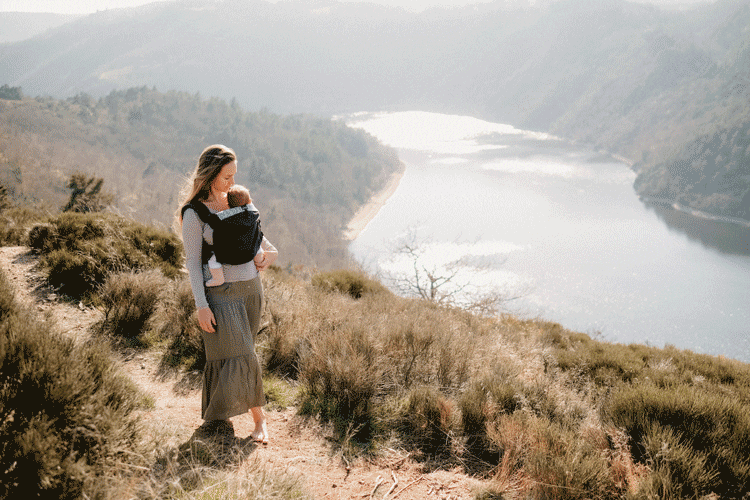
Dreaming of adventure, travel, hopping into a van for a road trip all around Europe... But your family has just grown and you're not quite sure how to reconcile the two. What if carrying gear was a key element to making your project happen? The quest for minimal clutter Young parents know this: the volume of equipment to bring when you have a baby is ! Whether for a short weekend or a longer trip, renting the necessary semi-trailer to carry the "just in case" gear is generally not part of the plan. So begins the painful sorting process. Some choices are simple, but others are more tricky: the maxi stroller is very comfortable for the baby but takes the space of 3 suitcases. Meaning: you'll have to do without, but you'll need to figure out how, without sacrificing everyone’s comfort. This is where the baby carrier finds its first advantage: Flexible, compact, and lightweight, it easily slips between two bags and takes up almost no space. Remember a weekend in the mountains with 3 children and a dog in a tiny car packed to the brim, where the baby carrier was folded as a blanket over the baby and the sling was worn as a snood around my neck (the stroller, on the other hand, wouldn't fit!). Note that space saving is only effective if you opt for physiological baby carriers: large hiking backpacks with frames, besides being very uncomfortable, don't fold well and also take up a huge volume! A little breeze of freedom Who hasn't found themselves stuck in front of a huge staircase, a cobbled street, or a monument visit where stroller access is prohibited? The baby carrier allows you to face all unforeseen obstacles of your trip without headaches. Baby follows you everywhere, regardless of the terrain! Fancy a spontaneous hike on nearby paths? Just clip it on and go! An inaccessible place for the stroller? No need for a last-minute backup plan, nor the risk of theft if you leave the stroller in designated space. Whether for a day at the beach or a sightseeing tour, thanks to carrying you remain free to move around and can travel anywhere without the risk of getting stuck. Travel with confidence in transportation A suitcase in one hand, the stroller to fold in the other, the crying baby to manage in the middle, and the crowd getting impatient behind (without help, of course, that would be too simple)... Does this situation sound familiar to you? It’s the one that often occurs when trying to take the train with your baby. Sometimes, there are also difficulties when taking the plane, between the oversized stroller that must go in the hold or takes the place of another carry-on bag, and the security checks and waiting time before boarding to manage. Seated in a carrier, your child is secured during various handling procedures, you have free hands to manage a possibly fussy baby, and you can also sneak through the aisles more easily if they need to be rocked. The globetrotting baby For the baby, there are also many advantages to traveling in a carrier! Environmental changes can sometimes be more difficult for some little ones to handle: away from home, they can become nervous, anxious, have more difficulty falling asleep, and their routines and references are disrupted. This is all the more true as the transit places can be noisy and overwhelming (crowds, noise, lights...). Snuggled against you, they are reassured and secured and cope better with the various upheavals. Since tourist sites are often very popular, it’s not uncommon to find yourself right in the middle of a crowd. In a stroller, the child is at knee height of the people, even if you are careful they can be jostled, burned by cigarettes held downward, and the sight of legs pressing around them is clearly not the most pleasant. Snuggled against you, they will feel less overwhelmed by the crowd, and they can also enjoy the visits and panoramic views. For older children, they will also appreciate being able to rest a bit when they are tired. The ideal baby carrier for the little budding adventurer Now that the basics are covered: which carrying system should we put in our travel bag? If you have to choose only one, a preformed carrier is probably the most versatile because it combines both comfort with good weight distribution and the practical necessities of emergency or outdoor setups. It is easy to use for passing airport security or re-installing the baby in the middle of the train aisle upon arrival. Compact and lightweight, it also features a very low volume of bulk. Wrap, sling, and mei-tai They remain choice allies as well but will often need to combine with each other to handle all situations. Being very flexible, they easily slip to the bottom of a bag or between two suitcases and will be appreciated for a more cozy side with a very small one. All that remains is to wish you a good trip!


