


Carry the baby in the summer
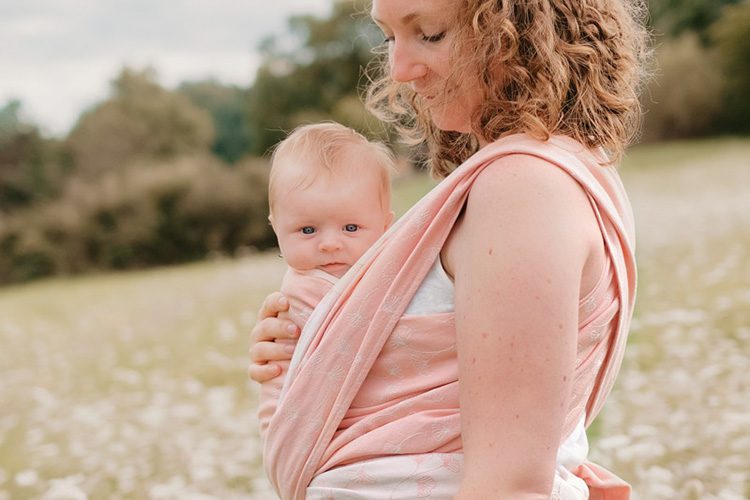
The sun is settling in, summer is arriving, and with it the entirely legitimate question: "But if it's hot, will I still be able to carry my baby?" The answer is YES, but with some common sense practices, which we will take the time to detail below. 1 – Carrying and thermoregulation We all generally know that when it's cold, having your baby in close contact helps them warm up. We also know that skin-to-skin greatly helps the newborn regulate, especially in the first weeks of life. What is less known is that in hot weather, close contact also helps the toddler regulate, and thus suffer less from the heat! Whether it's 30, 40, or 50 degrees, your body is always at 37°C. Luckily, that’s the temperature babychou also needs to maintain internally! Close contact allows them to have a reference point to rely on, and will greatly help them spend less energy to regulate their internal temperature. Also, in a completely counterintuitive way, when it is very hot, it’s better to keep the baby on you than in a stroller, which is entirely made of synthetic padding. The temperature inside the stroller is often higher than the outside air, and additionally it does not help with thermoregulation and is therefore much more difficult for your little one's body to manage. A quick safety note: if your baby is in a bassinet during summer, using a swaddle to protect from the sun recreates an oven and should therefore be avoided! Tested and approved: even for the carrier who might think they will get too hot, after the first 10 slightly uncomfortable minutes, regulation then sets in and… ultimately it balances out! Did you know?In case of fever, skin-to-skin contact and carrying can help lower your child's temperature in addition to what the doctor has recommended (only if you yourself do not have 40°!) 2 – Choice of material Articles in the media have recently highlighted the danger of carrying wraps during heatwaves. These articles are incorrect: they do not differentiate between the various types of carrying systems available on the market and only discuss the most sold wraps in traditional stores, namely knitted wraps! Using a knitted wrap, especially one containing elastane (synthetic = heats up), will be indeed discouraged in hot weather: these wraps require 3 layers Material around the baby to ensure the safety of the installation, and you will indeed end up cooking a little past the 20-25 degrees mark! We also advise against systems that include padding on the seat, as is the case with some popular brands. Carrying scarves and woven slings are, on the other hand, entirely usable without presenting a risk of overheating for your little one: The fabric is always a bit less dense than a knit and is more breathable Being more supportive, one layer of material is sufficient to secure the installation In pre-made baby carrier ranges, we will especially appreciate those made with scarves fabrics that are more breathable than canvas ones. Asian baby carriers (Mei Tai) are also appreciated for their less enveloping aspect. In woven ranges, you will generally find cotton, which is a very pleasant natural material to wear in summer. You can potentially gain additional freshness by choosing blends of materials that include, for example, Seacell, which is a seaweed viscose that provides fluidity and a sensation of freshness to the scarf (note, it’s not air conditioning either!). Seacell "Azalée Rose" "Eucalyptus" sling P'tit Evo "Savane" 3 – Baby clothing Baby clothing in hot weather is generally very minimal: a small cotton bodysuit, or even just a diaper , and that's it! It is always recommended to keep a layer of fabric between your little one and yourself, ideally made of natural material (cotton, linen, hemp, etc.) : direct skin-to-skin contact makes you sweat and isn't the most pleasant. Bonus: don't hesitate to use a burp cloth at the neckline to avoid the "schloupsss" effect that can be quite unbearable when baby lifts their head and gets stuck by the sweat from your chest! Once outside, we gear up a bit more! Hat and sunglasses are mandatory, preferred over bibs and other sunshades that can be useful but hinder the child's head and offer less protection (plus increased risk of suffocation if too covering). The detail we always forget: beware of reflections from certain surfaces that can cause sunburn on the soles of the feet! You can choose to put on a pair of thin socks, use a bit of baby-friendly sunscreen, or simply cover the legs of your baby with a thin burp cloth. 4 – Choose the right time Common sense but it's always good to remind: avoid peak sun at 2 pm! Opt for walks in the morning or evening, preferably in the shade. Note: don't panic if you have to spend 3 minutes in the sun to cross the street! If it's really too hot and you have no urgent reasons, stay calm at home. 5 – Cool down during carrying Nothing very exotic here: it is recommended to take very regular breaks to hydrate your little one (reminder: for breastfeeding babies, water is not only unnecessary but potentially harmful: breast milk at the start of weaning has a composition close to rehydration solutions, and hydrates much better). You can help them better tolerate the heat by using a spray bottle (on the legs and arms, avoid the head!), by passing a cool washcloth, or by lightly humidifying their hat. Regularly check that everything is okay for your little one; if they turn very red, especially remove them from the carrier and offer them a drink. Avoid: putting an ice pack on your baby's back (yes, we've seen it before)... In short, as you understand, carrying your baby in summer is not only not a problem if the clothing and carrier system are well adapted, but it can also help them better manage the heat! Now all that's left is to enjoy!
Carrying your baby: is there a maximum duration?
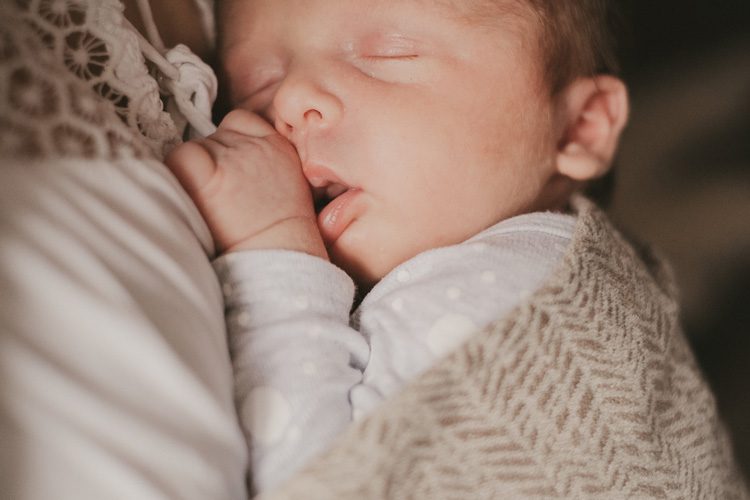
a baby in a physiological position, curled up against his mother in an ecru mesh sling
A babywearing workshop, what is it used for?
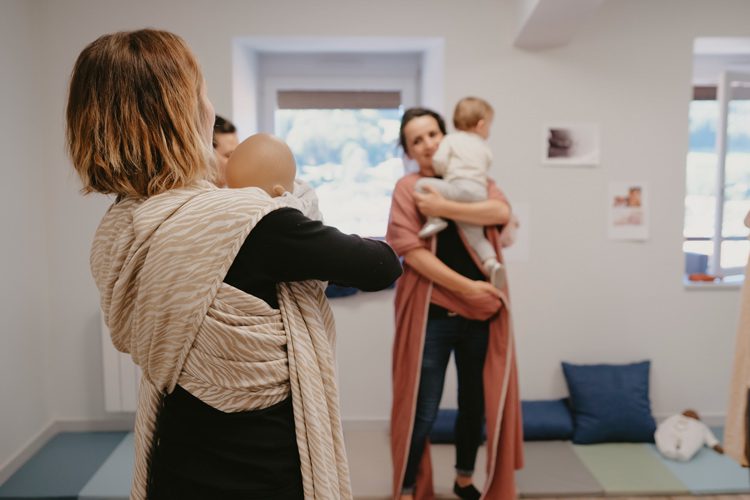
a babywearing workshop, an instructor on her back with a baby, shows a mother and her child how to put on a baby sling.
The benefits of carrying in 8 points
1 - Already familiar sensations Baby spent 9 months in his mother's womb in total symbiosis. Rocked by movements and in a constant temperature. A true bubble of well-being ! Carrying allows a transition that is gentle because it provides continuity from pregnancy. Baby will rediscover sensations already experienced that can give him a feeling of safety and serenity: Warmth Rocking The familiar scent of his parent The voices of his parents Vibrations The physiological position Proximity Feeling contained It is therefore normal for baby to feel the need to be carried and in contact with his parents or attachment figures. 2 - Building attachment bonds What is attachment? It is the emotional bond that connects baby with his attachment figures. Most of the time, it is with his parents that the baby creates his first attachment bonds. Attachment with his baby develops throughout life and allows him to grow on different levels (relational, emotional, etc.). Baby will create the attachment bond with the people who most often care for him and meet his needs. This helps him feel secure and gain confidence in himself. This bond is naturally formed, but, for different reasons and situations, it can also take time to develop. For example : difficult delivery, premature birth, his personal history, life events…but it can happen even without complications. Do not hesitate to seek help from professionals around you if difficulties persist. And carrying in all this? Exactly! Carrying can positively contribute to building the attachment bond! Do not hesitate to carry baby to discover him and take the time to create and strengthen this bond. Feeling his baby, his skin, his smell, his well-being and his calm when he is carried against you are moments that will help you connect with him and feel more confident in your new parental role. "To detach well, the child must be able to attach well"Bernard Golse, child psychiatrist. 3- Fewer tears Why does my baby cry? Crying is the primary means of expression for the baby, so it is a matter of survival. Speech (or signs) comes only later. It is therefore normal for our baby to cry; he is expressing his needs: cuddles, food, drink, sleep, being changed... but also his emotions and feelings (cold, hot, pain…). A baby is biologically immature at birth and has a great need for proximity and contact with his attachment figures (most of the time their parents). Carrying will help soothe your child and make them feel secure. Baby will quickly calm down in carrying thanks to familiar sensations that will give them a sense of security. There will therefore be fewer tears and you will more easily know when they need something else. Some babies cry a lot and others less! Perhaps it will take you some time at first to learn to decode their cries... It is also important to trust yourself, you know your baby better than anyone else. So, in most cases, you will be able to understand them! If the crying persists and seems abnormal, do not hesitate to consult a health professional. Don’t remain isolated when faced with intense crying from your baby, pass the baton if you can, and if you are alone and it becomes too difficult, place your baby safely and go breathe and clear your mind in another room. It is normal to sometimes feel exhausted and overwhelmed by your baby’s cries. Sometimes, crying can also be a sign of digestive discomfort (often observed in the first months of a baby’s life), and carrying will help through massage (belly against belly), movement, warmth, and comfort. Evening is also more conducive to emotional release crying. Carrying will therefore help reduce crying. 4- Promotes Sleep Sleep is a particularly challenging issue for parents. “Is your baby sleeping through the night?” Yes, your baby is SLEEPING through the night. A child's sleep is not the same as an adult’s. For example, their biological clock is set at 25 hours at birth, and it is only later that it matures to 24 hours. Likewise, their sleep cycles are not the same as ours. Before your child can adopt the same sleep cycle as you, they will go through several stages during their early years. These stages will fluctuate and may include regression phases. As you understand, a child's sleep does not resemble ours, and therefore it is normal not to always understand their sleep needs. Carrying and sleep? In carrying, your child can fall asleep and stay awake as they wish. Carrying allows the baby to find their sleep rhythm and helps parents worry less. The feeling of security in carrying enables them to have peaceful sleep. Naps in carrying during the day do not hinder night sleep. Falling asleep will also be greatly facilitated, and you will be less exhausted when putting your child to sleep, and your baby will be soothed and secure. 5- Carrying & Breastfeeding If you have chosen to breastfeed, carrying will be your ally. Indeed, beyond a mode of feeding, it is a way of life you have chosen, and carrying will go in this direction. First of all, the proximity between mother and baby will promote the secretion of oxytocin: the hormone of breastfeeding and attachment. The mother will more easily recognize the signals of hunger because she will be more sensitive to them thanks to proximity. On-demand breastfeeding will thus be facilitated. The carried baby will find the same sensations as when at the breast (warmth, contact, heartbeat...). And will thus be able to gradually space out its feedings. In some cases, the baby can even be breastfed in the carrying device, which can be practical in certain daily situations or when the baby has strong demands (growth spurts, for example). Breastfeeding can be discreetly done in public thanks to the carrying solution. 6 - Promotes psychomotor development Close contact with a parent will allow the baby to develop its brain, which is under construction. Did you know? In one year, the size of a human baby's brain will almost double! Even though the human baby depends on its parent, it has several skills: sensory, emotional, motor... Carrying helps to stimulate its sensory skills already developed in the mother's womb (smell, sight, hearing...). These sensory experiences in contact with its environment will contribute favorably to its development, while being secure in its carrier. The baby actively participates in its carrying (in a physiological position) to hold onto its carrier during movements, changes of direction, etc., which helps it improve its sense of balance and exercise its tone in a developmental logic. For example, as a very young child, it will learn to hold its head, then its shoulders and back. As it grows, it will be among the first to participate in carrying activities (meals, leisure activities...). This is an opportunity to give it a different visual field and discover odors, colors, memorize gestures... Did you know? vision is the last sense to develop intrauterinely! At birth, the baby sees on average between 20 and 30 cm, the perfect distance to dive into the eyes of its carrier when the baby is carried! 7 - Advantage for the carrier Let's now focus on the carrier! What are the advantages of carrying? Having free hands: being able to go about your daily activities with the baby snugly against you! Practical in everyday life and even more so when you have several children to look after. Take more easily time for yourself: walks, outings, meals … without waiting for baby to finish his nap Strengthen the attachment bond with your baby and enhance your parenting skills This is the all-purpose tool! In the city… on a trail… in public transportation… on stairs…! Moreover, carrying tools take up very little space in a bag or the trunk of a car! Respond more quickly to baby’s needs thanks to close contact! This helps the parent observe their baby and learn to better understand him. Preserve your nape when carrying by holding at the right height (high and close against you) Reduces baby’s crying and thus promotes a decrease in stress/anxiety in parents! Supports breastfeeding. Protect your back and develop your muscles by evenly distributing the baby’s weight! For co-parents: experience some unique sensations of pregnancy. This is also a very good transition tool during adaptations: at daycare, with a childminder or grandparents because it provides the baby with landmarks and comfort. 8- A prevention tool Carrying is an excellent prevention tool against plagiocephaly (skull deformation, commonly called "flat head"). Indeed, with carrying, you avoid prolonged pressure on the skull. Be careful not to restrict the baby’s head movements with the carrier! When the baby’s head is free to move, he strengthens his neck and back muscles and quickly learns to turn and support his head. Carrying is also an excellent prevention against physiological gastroesophageal reflux, due to the upright position. It will also help babies suffering from pathological gastroesophageal reflux, which will be more relieved in a vertical position. Regarding digestion, carrying reduces discomfort (sometimes called "colic"), thanks to warmth, belly massage against belly, and the feeling of security it provides. From a motor perspective, the physiological position in the carrying solution is a very good way to promote the maturation of the baby’s hips. « What delights a child is the happiness in which he bathes; if you wish him well-being, work on making yourself happy », Boris CYRULNIK, neuropsychiatrist. Safety rules Discovered face, clear airways (the fabric reaches up to the nape of the neck) Physiological position: rounded back, knees raised higher than the hips, head aligned with the spine, hands near the face, respecting hip spacing. Snug fabric grip Exclusive vertical position Baby's belly against the caregiver Observe and monitor the baby (skin coloration, breathing, signs of well-being…) Appropriate clothing for the baby (keep in mind that a layer of fabric equals a layer of clothing) and the caregiver. Ensure proper hydration of the baby Adapt activities (no extreme sports) and do not carry if your alertness is altered (medications, psychoactive substances, drowsiness…)
Focus on the sling
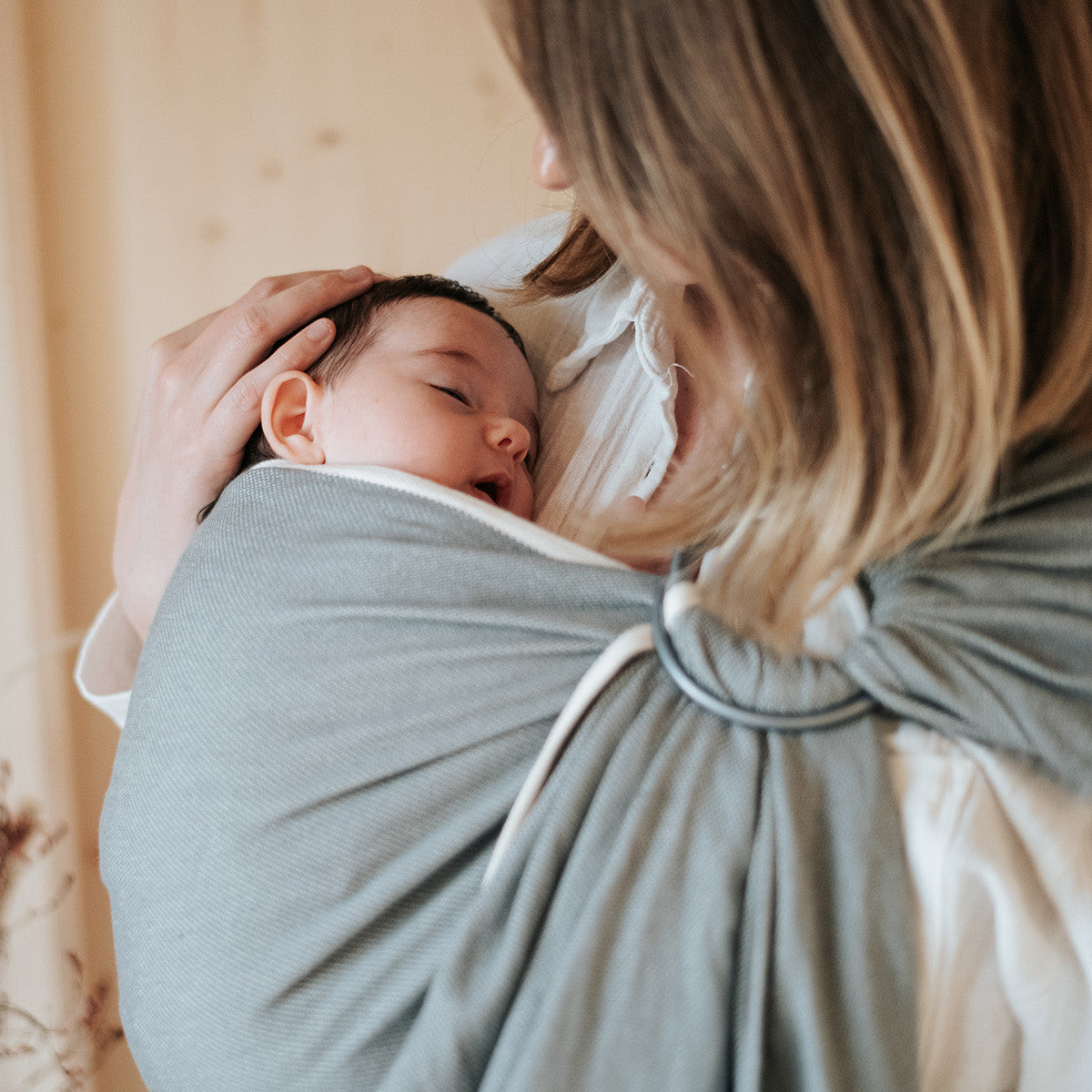
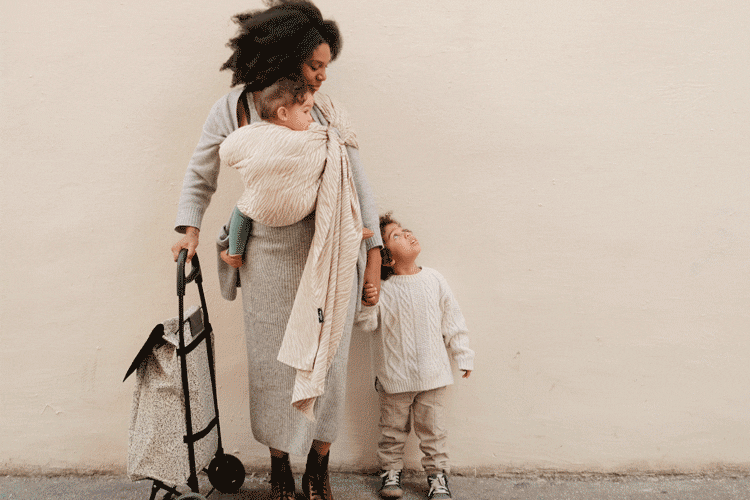
Today's article is about the sling, otherwise known as "the scarf with rings" or even more commonly "the thing that's simpler than the scarf but yes, you can see it on the shoulder there." So, who is the sling for, what is it used for, what are the advantages and disadvantages? We'll give you all the details! What is a sling? The sling is a carrying system made up of a strip of fabric (the same as our baby slings) approximately 1.90m long by 0.70m wide , at one end of which 2 aluminum rings are sewn. To use the sling, you must first "assemble" it, as they say in the jargon, by passing the other end of the material through the two rings, then again in the other direction between the two rings (a bit like the double-buckle belts found in some sportswear). The main features of the sling The sling is put on a bit like a Miss France (or Mister Universe) sash, slung over the shoulder of the wearer , with the excess material hanging from the rings like a tie . The baby is placed vertically in the pocket thus created (like in a sling), and the adjustment is easily done with one hand by applying tension around the baby via the tie which comes out of the rings. Due to its configuration, the sling requires off-center carrying . In fact, on the wearer's torso, two elements must be positioned: the baby and the rings. If the baby is positioned in the center of the torso, there is no more room for the rings and this can lead to problems with the stability of the installation (the material near the rings is quite grouped and cannot encompass the baby's entire seat, stopping instead at mid-thigh instead of the hollow of the knee) and discomfort (it cannot be adjusted correctly because the baby ends up stuck to the rings). The choice of side depends on our laterality: the rings are most often installed on the predominant side because on the one hand it is the arm which will then be the freest (for eating, for example), and on the other hand we are generally more precise in adjusting with our dominant hand. For 95% of right-handers, the rings will be on the right. The situation for left-handers is more ambiguous and depends on how much we upset them when they were younger! The sling is a carrying system that has stood the test of time ; it can be used with a newborn as well as an older baby (in addition to a system that distributes the load better). It is particularly ideal when you need to carry a toddler who is tired of walking for a few minutes. What are the advantages of the sling? The sling is THE practical system par excellence! It does not drag on the ground during installation, can be easily adjusted and de-adjusted with one hand, can be set up in record speed , and requires very little handling . At the expert level (understand: not in the learning phase!), it is the only carrying system that can be installed directly with a baby in your arms without the need to put them down first (useful when they have FINALLY fallen asleep on you, weigh a dead donkey in your arms, but will wake up instantly as soon as they are in their bed). It also allows you to breastfeed while carrying without difficulty. This is the system that you put on in 2-2 for all the little daily carrying tasks , to go and get the mail, throw out the garbage, buy bread, do a quick little errand after getting out of the car, or even to take an older child to school or nursery (NB: at the expert level the sling can be perfectly installed while running after the older child who does not want to put their shoes where often for the others, you have to stay stopped while making the adjustments) but also when the baby is grumpy, wants to be held then no longer wants them... It's both a cocoon for baby and space-saving for the wearer. Taking up little space, it slips easily into the trunk, diaper bag, stroller tray, or around your neck as a scarf. Its off-center use makes it a great ally in everyday life: when baby is on his stomach, he takes up all your space and hinders your mobility, making it more difficult, for example, to pick up an object from the floor, empty the dishwasher, or just, more prosaically, to eat. Your little one is a little more open to the outside world and will more easily observe his environment, or what you show him. Bonus: the space freed up on your chest also allows older children to come and cuddle without their little brother or sister blocking the way. The disadvantages of the sling Since perfection is not of this world, carrying in a sling also has some disadvantages! Off-center carrying on one shoulder also means that the sling is not intended to be used for long periods of time. It is a model primarily designed for backup ! If you plan to go on long walks while carrying a baby, it is better to plan for another system as a complement, otherwise your back and neck may painfully remind you to be careful. We could compare baby carriers to pairs of shoes. The baby sling would be the equivalent of a pair of hiking boots, which you take the time to adjust properly and then walk for a long time without pain. The sling is the pair of flip-flops for babywearing , the shoes you put on "on the fly" to go out quickly without hurting your feet but in which you won't cover a long distance. The subtlety lies in the fact that most of the daily carrying times are ultimately short . No one puts on a scarf for 5 minutes, a sling yes. The estimated 5 minutes often turn into 1 hour (we always get caught!), it is better to have installed your baby in a sling than to keep him in your arms without any other support. The comparison of comfort is thus made not between the scarf and the sling but rather between the sling and the arms . We do at least worse in a way. Someone whispers in my earpiece that it would be enough to change shoulders each time you carry them to balance them: this would be like saying to write with your left hand to relieve your right wrist when you are right-handed, unless you are perfectly ambidextrous, no one does that (and even then, even ambidextrous people ultimately have a preferred side!). In a very hectic daily life with a toddler, we tend towards the easy option, namely always carrying on the usual side . Another small warning: its simplicity of use also paradoxically makes it a system that is sometimes complicated to understand. As with all other baby carriers, it is advisable to take the time to understand the mechanism of use and to take the time to learn how to use it . The main technicality consists of keeping the rings high on the shoulder during installation, the problems of rings "which descend" are often listed in the problems of use. This is entirely linked to the off-center configuration of the carrying: as soon as we start to position the baby in the center at the beginning of installation, this mechanically makes the rings descend when we try to shift the baby a little since we pull the sling with it. To overcome this, simply remember that we cannot work in front , we will make sure to pick up the baby as if we wanted to install him on the hip and move him as far away from the rings as possible when we sit him in the material. The adjustments then bring baby and rings closer together, so you must anticipate by being at the beginning a little further on the hip than what you want at the end. At the end of installation, the rings should be roughly at the height of your child's head . Don't hesitate to get help from an instructor to learn! In short, you will have understood, the sling is an everyday essential . If it generally needs to be supplemented by another baby carrier which distributes the load better in case of a walk, it is the hands-free kit par excellence which will delight you with its practicality and its relative simplicity of use.
Make your days easier, think baby carrier!
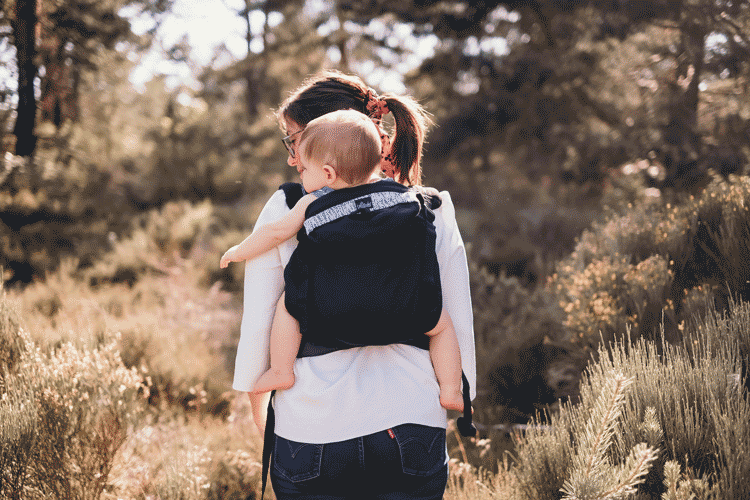
You are a future or new parent and are looking for a way to make your days easier? Make them softer and more pleasant? Carrying your baby can help you! Difficult days? The new rhythm brought by the arrival of a baby in your daily life is not easy. Responding to their needs while ensuring everyday life is synonymous with a new life often very intense, rhythmic with fatigue and the upheaval of your habits. Sleep... eat... prepare meals, do cleaning, laundry, shopping... Take your older child to school, go to medical appointments and external activities, think (a little) about yourself... and... your baby demands you, they need you and your arms! They cry as soon as you put them down. Taking a shower, breathing for 5 minutes, breathing fresh air, resting... becomes sometimes a perilous mission. So, how do you simplify your life? Regain your freedom thanks to carrying Carrying allows you to free your hands! Very practical to continue ensuring at least the basics of daily life. A real hands-free kit that will go everywhere: ditch the stroller when the elevator is out of order. Practical for walks in the forest and crossing paths or roads dotted with holes. A sense of freedom while having a calm baby against you! Softer days Softer because fewer tears! Snuggled against you, you will learn to discover your baby and will be more able to respond to their needs. Think about it, especially at the end of the day when your baby might need to unload their emotions (the "overload"). Softer because your baby will fall asleep more easily and quickly, they will experience familiar sensations from their parent’s belly and will let themselves be carried more easily into the arms of Morpheus. Carrying scares you? It’s normal, it questions you ("and if my baby gets used to it?"), you may fear not being able to tie your sling or losing patience. There are as many carrying methods as there are solutions to meet your needs. From the sling to tie to the clip-on baby carrier, enough to find your happiness and THE solution to make your days easier.

Hiking with baby
The nice days are coming, and with them the prospect of beautiful walks with your baby. It goes without saying that since a stroller is not particularly suitable for scrambling in the middle of the forest (some have tried but did not repeat), carrying your baby is highly recommended to make the experience enjoyable! So yes to carrying, but how, with what, are there any specific recommendations? Let us serve as your guide and let's go on an adventure together. 1st step: safety As with any respectable adventure, it is good practice for the guide to detail the safety rules to incorporate so that the hike takes place under the best possible conditions. Good condition equipment: this seems obvious but it’s always good to point out! Besides the risk of injury from faulty equipment, no one wants to end up carrying their baby in their arms for 5 km during a hike. A well-chosen schedule: in hot weather, prefer the times when it’s coolest, for example in the morning. Coincidentally, the child who acts as your new alarm clock is naturally programmed to wake up very (too) early and allows you to enjoy beautiful sunrises. Generally speaking, avoid routes in direct sunlight at 2 pm, even with good protection, the risk of heatstroke for your baby remains significant. An adjusted itinerary: for the ascent of Mont Blanc, baby must unfortunately grow a bit! More seriously, very long trips can sometimes become boring for children who may become less cooperative after a while. Opt for short enough circuits, which can be done in half a day, for example, allowing you to take your time to enjoy and make all necessary breaks. The route should also be practicable; overly steep or rugged terrains increase the risk of falls and are less suitable for carrying. Regular breaks: speaking of breaks, we invite you to take small pauses regularly to hydrate your baby, check that everything is OK for him, etc. Appropriate clothing: hat and sunglasses are essential! And a good layer of sunscreen as well. Favor light and comfortable clothing, and still bring a small jacket in your bag in case you pass through a slightly cooler forest. Back carrying: last but not least, it is highly recommended to avoid front carrying when the terrain is uneven. Indeed, the risk of falling is increased, especially since a baby affects your balance and obstructs your field of vision, preventing you from clearly seeing the stones and roots to step over. It goes without saying that these recommendations are only supplementary to the general safety rules already mentioned, especially regarding clear respiratory pathways. 2nd step: the baby carrier With safety ensured, we can now focus on choosing the actual carrying system. We have already mentioned it in another article (link to the 10 mistakes), the baby carrier must adapt to your needs and not the other way around, and it is essential here that you feel comfortable with your equipment so that the hike does not turn into a nightmare. When talking about hikes with children, one immediately visualizes large baby carriers with frames and lots of pockets. In reality, these carriers are not very relevant to use, and for several reasons: They are not suitable for the youngest children who cannot stand well They rarely allow the child to be comfortably seated (generally non-physiological, either the legs hang down or the child is sitting but without anything to contain him when he falls asleep) They are abominably uncomfortable: when carrying a hiking backpack, we make sure to place the heaviest elements at the bottom of the bag and as close to your back as possible. Here, you place 2 water packs at the top of the bag, flailing around and far from you! Options sold with sun-shade types are rendered obsolete by good practices, which involve avoiding being in direct sunlight and using a hat and sunglasses. Since this solution is ruled out, the final choice will actually depend on a simple question: do you have a child who walks? Non-walking child: In this case, your baby will be carried throughout the hike. Comfort is therefore paramount! You can use the equipment you are used to carrying with and feel most comfortable with on a daily basis: a sling or mei-tai, for example, can be perfectly suitable. Once installed, you will hardly touch it again. Walking child: This scenario involves the legendary cooperation of the toddler. Like Schrödinger's cat, which is both alive and dead in its box, Schrödinger’s toddler is both too tired to walk but too determined to be carried. Besides wanting to go right when you want to go left, he walks 100 meters, collapses from exhaustion demanding to be carried, then 100 meters further, marvels at a butterfly and wants to walk again, only to collapse 100 meters later and demand to be carried, then pick up a dead leaf 100 meters further and walk again… Immediately put away this carrying sling with which you might quickly end up tying it to a tree, and grab a preformed baby carrier ! The latter remains clipped to your waist, and your toddler will be free to climb up and down as they wish without requiring too much manipulation on your part. Well secured against you, the carrying times will remain pleasant for both him and you. 3rd step: additional equipment You have the baby, the baby carrier, drinks, hat, sunglasses, and sunscreen, you're ready to go. We suggest you pack in your snack bag for your little one: cookies for an older child, a pre-filled bottle for a younger non-buttered, fresh air makes them hungry and they might feel hungry sooner than usual. You can also pack a small first aid kit with bandages, disinfectant, and an insect-repellent stick Our excursion is over, you now have all the basics to go hiking peacefully with your children! Now, just enjoy these beautiful moments shared with family.
The 10 places where a baby carrier is essential!
Because it’s our profession and we are here for that, we tested many situations with our children and compiled a list (not exhaustive!) of the 10 main places where carrying your baby is essential! 1 – Out for a walk in the countryside The stroller bouncing along with the baby on the dirt path, where you end up holding them with one arm while continuing to push the vehicle with the other to avoid too much jostling, is a big no-no. Special mention for mud that gets into the wheels and then redecorates your trunk and apartment. Consider directly a baby carrier, it will be more comfortable for everyone! 2 – In the city The city streets can quickly become a nightmare for young parents: too narrow sidewalks, poorly parked cars, stairs to climb, obstacles are numerous... Having your baby with you guarantees to preserve your daily mobility freedom! 3 – At the market The market and its small bustling alleys are typically places where you appreciate being able to "sneak" through and access stalls without moving all the people in front to keep the stroller beside you. A good opportunity to dust off grandma's shopping cart, which is much more practical than a stroller for storing provisions! 4 – At school Do you have a child to take to school? Know that in many schools, strollers are simply forbidden. Planning a carrying method allows you to both secure the journey with the greatest (easier to manage with your hands free), and to accompany them directly to their classroom without leaving the stroller outside and carrying the car seat (not recommended for your parenthood!). 5 – In public transportation Forget about traveling on public transport during rush hour with a stroller: you simply won’t be able to access the bus already crowded! Access to the metro is also conditioned on the proper functioning of elevators (when there are any!). As for the train, getting on and storing the stroller while managing the baby and luggage is a risky exercise. Bonus: People are less tempted to fiddle with a baby on you than in a stroller where they shouldn’t enter your space and where the temptation to go cooing is strong. 6 – On vacation The beach or the snowy slopes are clearly not the most suitable places to move a wheeled device. With the baby snugly secured on you, you can easily move around in the sand or snow. 7 – Tourist sites Have you noticed how many very touristy places are also paved? Did you also know that many monuments do not allow visits with a stroller that cannot circulate there? Travel with peace of mind by planning to bring a baby carrier that will allow you to go everywhere without constraints (especially when you are not sure about the layout of the place)! 8 – At the bar or restaurant This place is typically one where you might imagine using a stroller to have a drink or eat quietly while the baby is placed nearby. The reality is often less idyllic: after faxing the stroller between two tables with difficulty, once stopped, the baby wakes up and ends up… on your lap. 9 – At the supermarket Pushing and filling your shopping cart calmly without needing to juggle with the car seat (which, as a reminder, is not supposed to be balanced on top due to increased fall risks) and the crying baby asking to be picked up. 10 – At home! The most obvious conclusion: using a baby carrier at home allows you to eat, extend a machine, go to the bathroom (yes, we pass milestones as parents!), or do a few chores without being stuck on the sofa. This is the perfect everyday asset. In short, the baby carrier is the hands-free kit for young parents, ideal for continuing to go about their activities, move around, or go on vacation (almost) without constraints. And you, where have you carried your babies?!
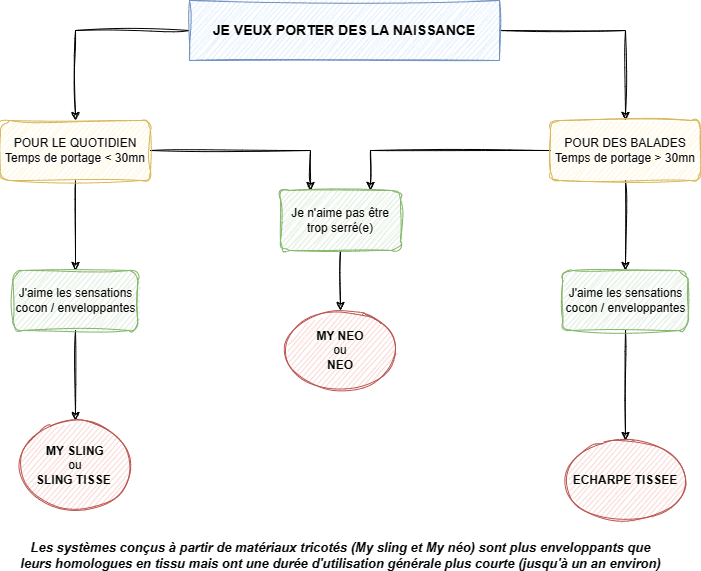
How to choose your carrying method?
Choosing the most suitable carrying method for your needs is an important step for anyone who wants to carry their little baby, whether for daily activities or outdoor adventures. There are many different carrying methods, and we have created 3 diagrams to help you see more clearly. Here are three diagrams to assist you: How to choose a newborn baby carrier? How to choose a baby carrier from 4 months old? How to choose a baby carrier for one year and older?


