

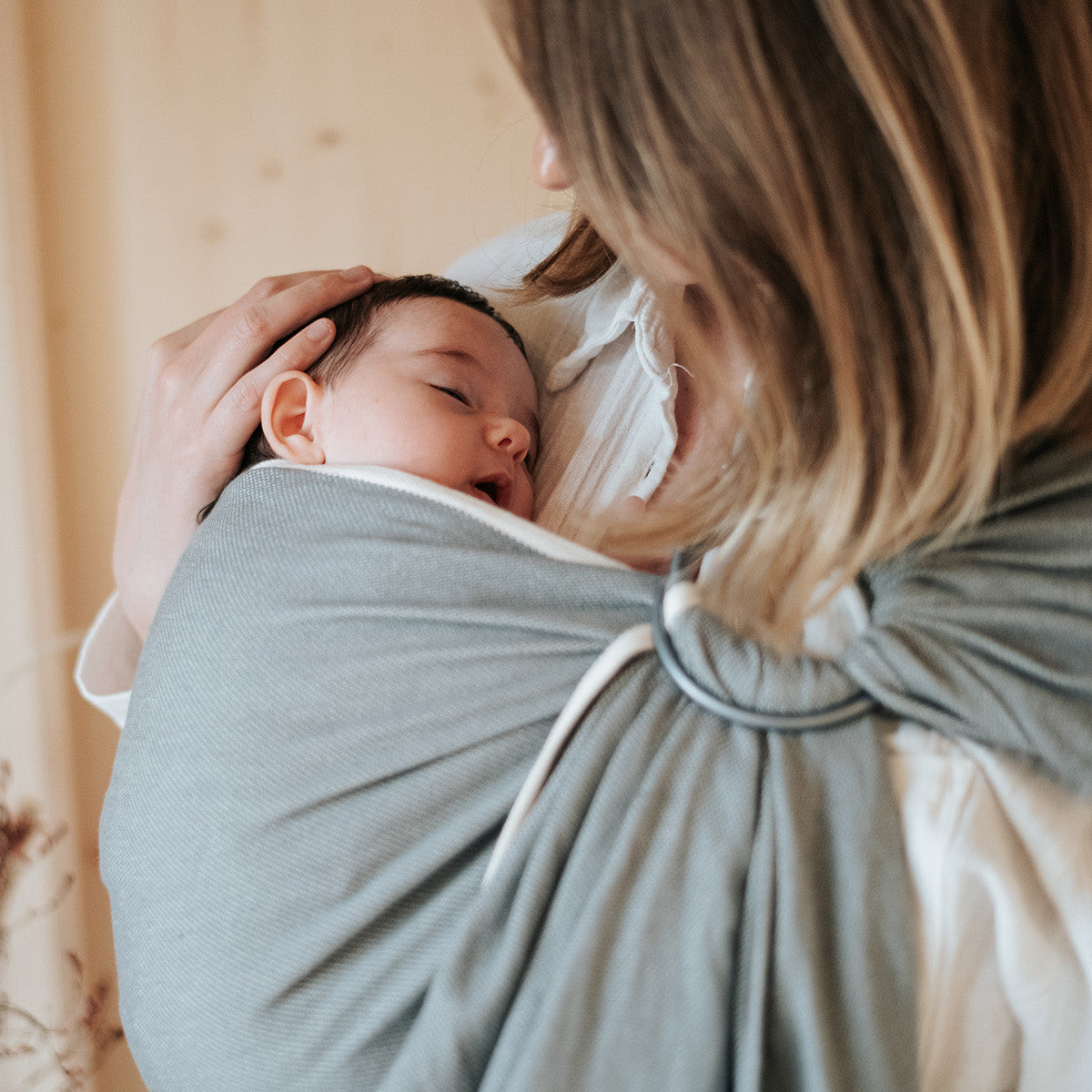
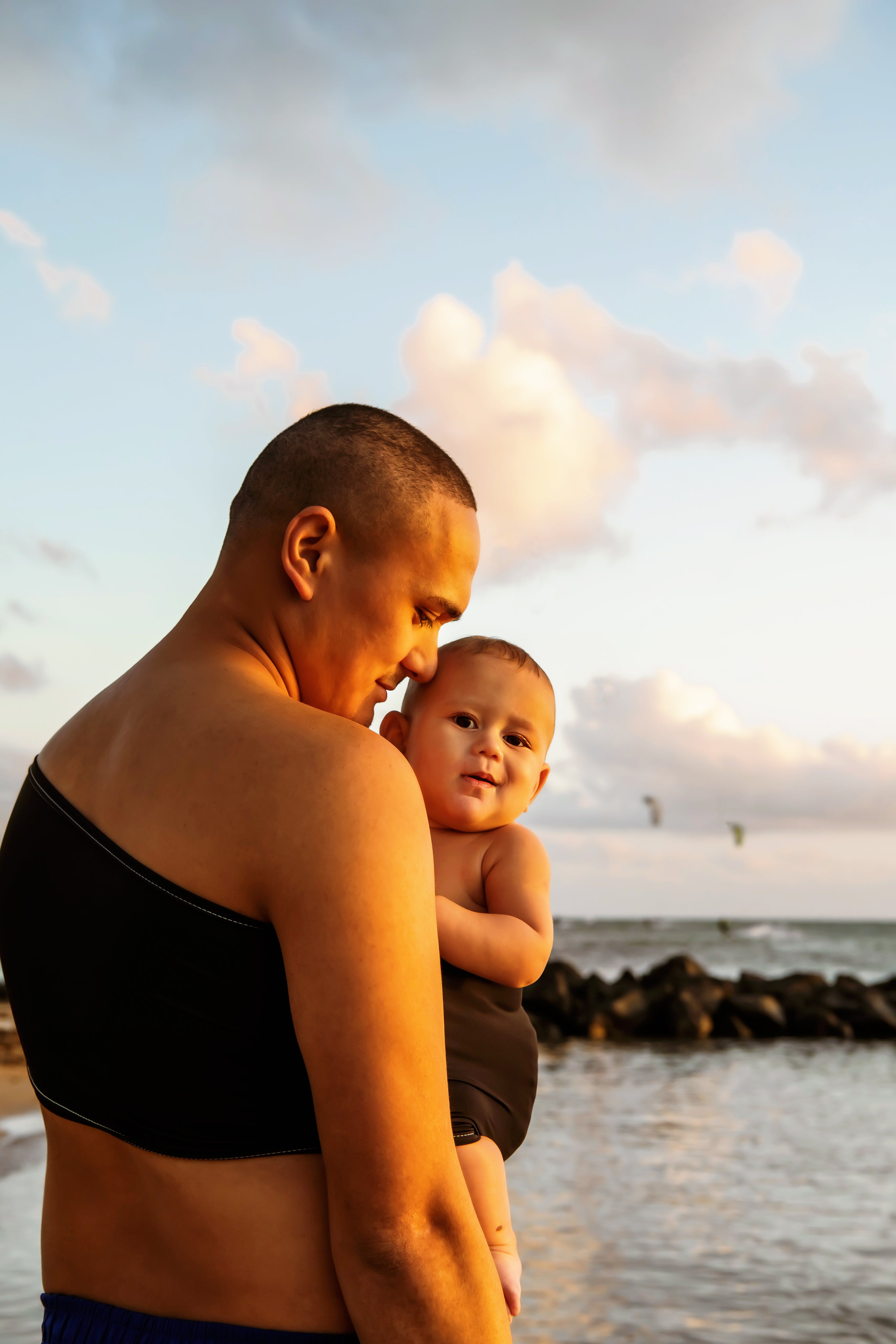



Support a baby suffering from reflux (1/2)
Gastroesophageal reflux disease, on a daily basis All parents who have faced this situation know : between crying, feelings of helplessness, fatigue, and not to mention endless laundry, being a parent of a baby suffering from reflux is hell! And unfortunately, this situation is not rare since it is estimated that this condition affects 1 in 5 babies, or 20% of infants. Warning signs, tips to relieve, carrying tricks... We discuss this through 2 articles specifically dedicated to this topic! Physiological regurgitation or Gastro-esophageal Reflux (GER)? First, a few brief explanations. Gastro-esophageal reflux (GER for short), is what is more commonly called acid reflux. Ladies, during pregnancy, you probably experienced this, and if so, you usually remember. Because it hurts (a lot). It corresponds to a reflux of part of the stomach contents into the esophagus, which is not designed at all to support the acidity of the liquid in question. This causes very unpleasant sensations of burning, and can, over time, cause an inflammation of the esophageal mucosa (esophagitis). It is not uncommon to wonder about the difference between a pathological reflux and physiological regurgitations, especially since it is quite common to hear that a baby who regurgitates is normal, and that a crying baby is also normal. Certainly, this can be true to some extent, but even parents of a first child realize when their baby’s crying is abnormal in intensity. Physiological regurgitations are related to an immaturity of the small valve at the base of the esophagus. After a bottle or a feed, overflows come out (often at the same time as burping), without the baby seeming at all bothered by having soaked your shirt. In fact, he gives you a big smile! Physiological regurgitations occur just after feeding, the milk that comes out is not at all curdled – pre-digested. And most importantly, your little one is neither bothered nor in pain by these. In the case of GER, the refluxes are less related to meals, they occur even when the stomach is "empty", and they are extremely acidic. Among the signs that may indicate this, we can find (not exhaustively): A baby who cries excessively, is very restless, nervous… He often tolerates poorly lying down and you need to keep him upright as much as possible He sometimes regurgitates curdled milk from a distance from feedings He seems to chew often You hear him regularly swallowing something (and he cries or tightens up often right after) He is extremely stiff, very tense, hypertonic and seems to never relax He may have an 'acid' breath He may have a voice that becomes hoarse, hoarse Obviously, not all babies will show the same signals, some will only display a few, others almost all of them… Note that reflux is not necessarily associated with milk regurgitation; this is then called 'internal' reflux. As soon as you have doubts on this subject, it is strongly recommended to inform the doctor or pediatrician in charge of your baby’s medical follow-up, so that they can establish (or not if that’s not the case) a diagnosis, and if necessary, propose treatments to relieve your little one. Relieve the pain The first difficulty generally faced is the pain that your little one encounters. He cries, a lot, really screams that leave you completely powerless to relieve him. We will address more specifically after feeding, which plays a role in this story, but modifying or improving this is often not enough to really limit the damage. This is where the doctor comes in. Gastric dressings, anti-acids (proton pump inhibitors), they have many tools at their disposal and can help your family and relieve your baby. Even if obviously no one likes to give medications to their little one, significant pain heavily tips the balance of benefits versus risks (and let’s be honest, when we have a migraine attack or other pain… we also take an analgesic. It’s the same for our little ones). Reflux can sometimes impact other health spheres of your baby by inducing notably increased ORL vulnerability, or by causing coughing. The first reflex, therefore, is to make an appointment to discuss the subject with a healthcare professional, which does not prevent simultaneously exploring other levers of action, especially through diet. Diet and reflux While baby’s diet is always subject to debate and reflection, it is even more so when the baby shows some particularities! It is often said that in case of reflux, you should space out meals and thicken the milk, but this is not necessarily a very good idea ! Indeed, the most painful refluxes occur not when there is milk in the stomach, but when it is "empty"! It is important to remember that in this pathological case, refluxes are present even outside of meals, regardless of whether there is milk in the stomach or not. The presence of milk helps to slightly soothe the acidity and makes the reflux less painful. In the case of thickened milk, it often turns out to be less digestible, which can promote… refluxes. Moreover, if the baby no longer regurgitates, the stomach contents still come back up, just a bit lower, and instead of burning only during the ascent, it also burns during the descent… Therefore, it is advisable to divide meals into smaller portions given at more frequent intervals (especially since drinking milk relieves pain), to help limit acidity and avoid the "large quantity at once" effect, which is often less digestible. If the baby is breastfed, it is not a question of pulling to thicken the milk, nor stopping breastfeeding! Breast milk is a true "medicine" in cases of reflux, its healing properties especially help greatly in limiting the occurrences of esophagitis. It is also very digestible. Do not hesitate to offer as often as the baby demands. If the baby is not breastfed, a few small tips can help promote digestion: Absolutely warm the milk. At "room temperature," the preparation is very indigestible and requires the baby to expend a lot of energy to regulate its internal temperature after a meal perceived as cold (18-20 degrees Celsius, which is quite cold compared to the body temperature of 37), energy that is not allocated to digestion. Offer the bottle in a physiological manner: the baby semi-sits on the parent’s knees, bottle offered horizontally. There will be air at the top of the head, which is normal and not serious. This way of feeding allows the little one to be active during feeding, to not be overwhelmed by too large a flow, and to more easily pause and feel satiety. Do not hesitate to offer "on demand" feeding, with smaller, more frequent amounts (not necessarily every 30 minutes). The hungrier and more irritable the baby, the more chaotic the bottle feeding will be, and the less well they will manage —> reflux. The truth is that there is no single magic solution when it comes to feeding. It is up to each parent to test and find the balance that seems most suitable. With his baby. There is often a small adjustment in the feeding schedule, where we realize, for example, that the little one is more comfortable if we leave 1 hour 30 minutes between two feedings and that if we give really all the time as he demands, it doesn't really calm him down. It's up to you to see what is most suitable for your family (even if we agree, it's not simple!). Note that in some cases, reflux can be associated with a allergy to cow's milk proteins (generally non-IgE mediated), and in the presence of other warning signs, it may be worth discussing with your doctor to evaluate the relevance of tests and/or elimination. If your baby suddenly shows significant difficulties in feeding (implying: he is in too much pain), it is an urgent consultation reason. Do not hesitate to call 15 for advice. Surviving everyday life... We agree that, said like that, it's not very encouraging, but parents who have been through this know and will confirm: everyday life with a 'GERD baby' as we sometimes read, is a mode of survival! Intense crying is extremely tiresome and difficult to live with for families. It is a condition that should lead healthcare professionals supporting the baby to be very vigilant about the parents' health (especially psychological). It is a factor that particularly promotes postpartum depression or shaken baby syndrome. Once the context is set, what do we do? We do our best.And as much as we can. Relieving pain is a priority. For everything else, if the house is a mess and we eat a little more pasta than usual, well, it's not that serious. It’s the right time to reach out for help around you: grandparents, uncles and aunts, friends… Being able to leave your baby for 1 hour to breathe or sleep, or delegate a bit of cleaning and cooking. You can also find listening ears and resources at PMI centers or parent-child reception areas (LAEP). Generally, it is important to understand that if your child cries, it is not your fault. You are not doing anything bad, it is not related to any incompetence of yours. You are doing everything necessary to help your little one (by the way, you are precisely reading this article!). It is indeed a pathology. So, we've covered what reflux is, along with some resources and key points for daily life. Physiological carrying (babywearing) also proves to be a significant help in everyday life, see the second article dedicated to this topic.

Mothers on the go, a new family experience
The beautiful weather is settling in, bringing with it the desire to take a walk and share beautiful moments with family… Traveling with a baby may seem complex and laborious ? Don't worry, our new range "Moments on the go" is here to make your life easier! In the "On the go" family… In the "On the go" family, I first ask for… the baby carrier! The Néo+ is a so-called preformed baby carrier (with clips and straps), designed for carrying children from 3 months to 3-4 years. Made from the same fabric as our carrying scarves (organic twill cotton), it combines support, comfort, and lightness (which is appreciated when the thermometer rises!). It features multiple adjustments that allow it to fit perfectly to the body types of both babies and wearers, and offers different carrying modes (high on the chest or snug on the hips, crossed straps or not…) allowing everyone to find their ideal setup. Did you like our Néo+? You will love its new version! The little extras of Néo+ Version 2 + in physiology Thanks to a deeper seat that allows the baby to settle in comfortably at the bottom of the pocket immediately, without specific manipulation by the wearer. This deeper seat also makes it possible to use the baby carrier a bit longer (between 3 and 4 years instead of 3 years for the first version)! + in ergonomics We have placed rings at the ends of the adjustment straps of the baby carrier. Thanks to this: The handling of the straps is easier, you can grab them better (especially when the baby is lively while you're trying to install them!) It is easier to quickly identify all adjustment points of the baby carrier, reducing the risk of missing one and thus providing more comfort upon use. + in comfort We have added a small removable pad on the belt strap. People with a very slim physique can skip directly to the next paragraph. For the vast majority... for others for which the foam pads of the current belt do not go all the way around their hips, no more worries about straps slipping or pinching the back or stomach: the pad provides softness, a better distribution of pressure, and greater stability on the hips. + more hikes Do you instinctively look for an anchoring point on your straps when carrying your baby on your back during longer walks? We thought of you and integrated thumb rests into the baby carrier! + Made in France Well, honestly, on this side, nothing changes, everything is still entirely sewn by our talented seamstresses in our workshop in Saint Bonnet le Châteauneuf (Loire)… We just added a discreet small tricolor flag on one of the straps because we are happy and proud to continue producing in France! Did you know that our fabrics are also woven and dyed in the Loire? Want to learn more? Discover our article on the Values of Nébulle here! And + accessories thanks to loops placed at key points of the baby carrier, designed to hold the rest of the new features! The allies of family adventures Because when you're a parent, every outing is an adventure, we wanted to support you all the way! Tired of struggling with 15 extra bags for the baby? You love carrying your baby but don’t know how to transport the baby’s belongings? The “On the Go” family offers its new accessories: the On-the-Go Swaddle and the On-the-Go Bib. The On-the-Go Swaddle is a practical and ingenious fanny pack. It contains a removable changing pad and allows you to easily carry everything needed to change your baby anywhere. Need to bring a bodysuit, pajamas, and some diapers? It all fits inside! To prevent the search for small objects you stuff inside (like keys, for example) from turning into a treasure hunt, the on-the-go swaddle features internal storage pockets. The on-the-go swaddle follows your needs and desires, and can be adapted to your preferences: Clip onto the neo+ v2 belt in front carry Clip onto the shoulder strap of the neo+ v2 in back carry Clip around the stroller handles Carry it over the shoulder, even for a trip without the baby! Afraid of not finding a way to reheat the baby's meal during a walk? The bib on the go completes the range! Insulated container, it can hold either a bottle, a small water bottle, a snack, or a meal… It also clips onto the buckles of the neo+ v2, or any other bag or pant loop! Enjoy the freedom with your baby! What adventure will you embark on?
Pampering his Little Evo
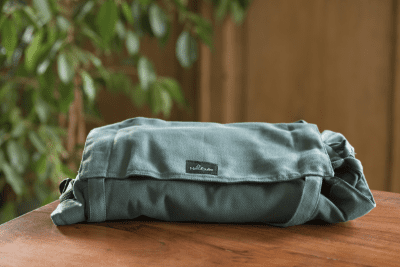
You just received your P’tit Evo, you finally have the box in your hands, and the question arises: « By the way, can it be washed? And how? » Don't panic, we're going to tell you everything! Before using with your little one It's finally here, the temptation to use it RIGHT NOW is so great... But we all know how it ends: we tell ourselves it's okay just to try it and wash it, and then we end up using it and don't find the time to put it in the machine... Be strong, RESIST! Like new clothes, it is highly recommended to wash your baby carrier before first use. Unlike our carrying scarves, which need a first wash at your place to reach their final size and behavior, our P’tit Evo are sewn from a textile whose dyeing process includes a pre-wash and are therefore already “ready to use” in this regard. Nevertheless, the fabric passes through many hands, is handled on various surfaces, etc... So once at your home, it's not very “clean”. One of the great joys for our little ones is chewing on the straps of their carriers, so we strongly recommend that you put it in the washing machine before installing your little miracle! How to wash your P’tit Evo? Since the P’tit Evo is made of quality cotton, it is a not very fragile baby carrier and very easy to maintain, which is a crucial criterion when you have a refluxing baby. Washing can thus be simply done in the machine (and not by hand!), preferably with eco-friendly detergent. To prevent premature wear of the fabric and excessive energy consumption, we advise sticking to a cycle at 30 degrees max, with a gentle spin (800 rpm). Ideally, when possible, wash it alone to prevent other clothes from bleeding onto it, and put it in a laundry net or pillowcase so that the straps or belt clips don't get caught in the drum seal (if not, we recommend closing the belt clip). Cotton, being naturally soft and flexible, does not require fabric softener (which unnecessarily fats the fibers). Remember to set all adjustments (seat width and apron height) to the maximum looseness so that the fibers do not deform and the drying is faster. Unless absolutely urgent (you know who you are...), using a tumble dryer is not recommended. because it risks damaging the fabric and the belt foam. Tip: don't hesitate to use a hanger to stretch it more easily! Besides the first wash, which is highly recommended before first use, the subsequent frequency is quite variable… It all depends on the speed at which it will get dirty (a baby who regurgitates a lot or not especially…), and to what extent it is indispensable in your daily life! We leave it up to you to assess when the smell of curdled milk becomes more annoying than just passing the baby carrier a few hours later. Tip: the little evo is like a pair of jeans: the more you wear it, the softer, more flexible, and more plush it becomes! With each wash, it’s normal for it to be a little more rough, but it will transform back into a cozy cocoon very quickly! And daily use? In everyday life, everything comes down to common sense. For example, avoid leaving your little evo on the back seat of the car and in direct sunlight, which could cause discoloration of it (Note: discoloration does not compromise the integrity of the baby carrier, it’s just a cosmetic issue), and it might be interesting to check from time to time that everything is okay in terms of seams or that there are no rips in the seat. We have carefully inspected it from all seams before handing it over to you… Now it’s up to you to give it a little look from time to time! There are no other particular precautions to take, as our baby carriers are specifically designed to accompany all your daily adventures and are not fragile by nature! You’re now ready for the maintenance of your little evo, we hope it will allow you to share many wonderful adventures with your baby!
Swimming with your baby
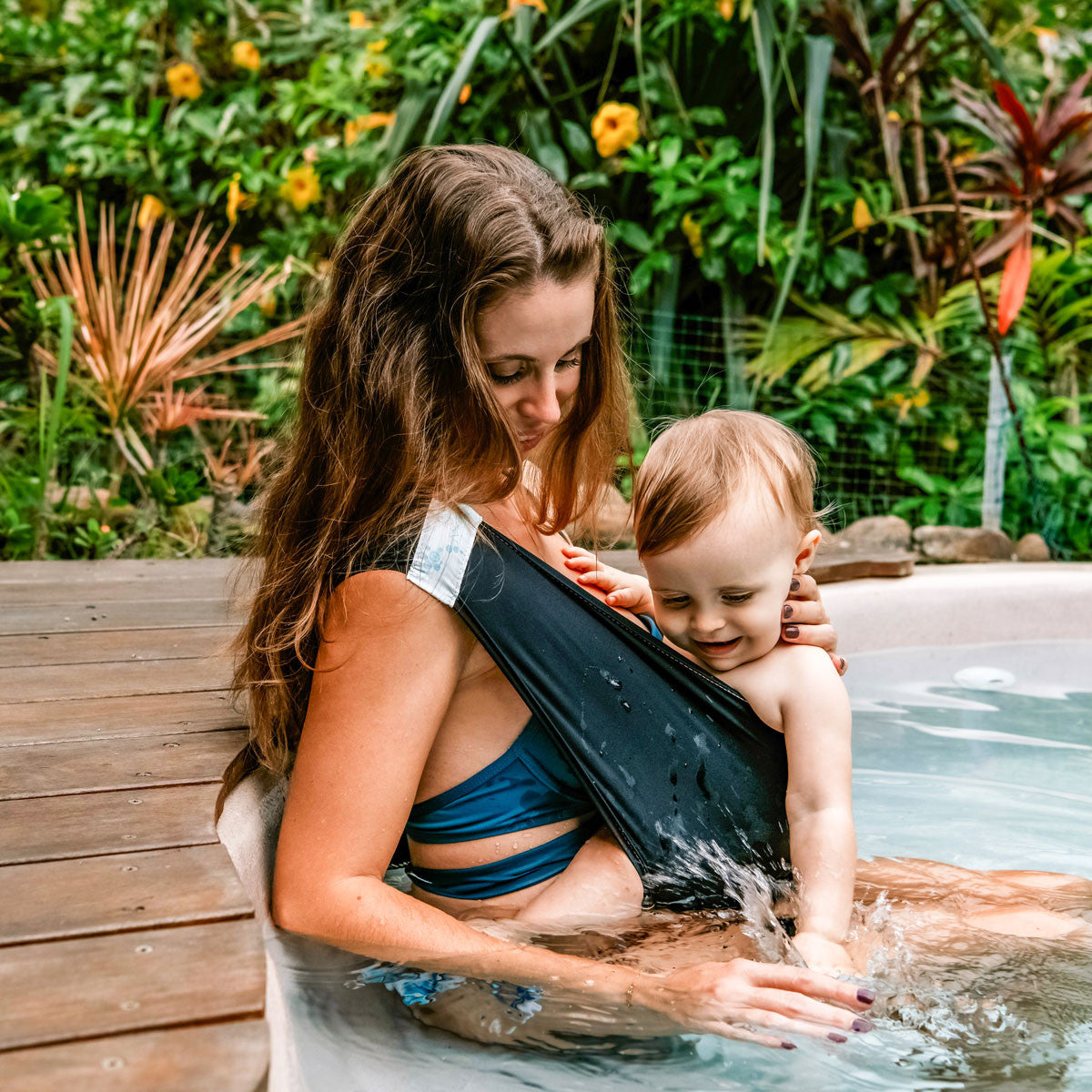
Whether it’s because the nice days are coming, or more simply because we’re considering a family pool outing or swimming sessions with baby swimmers, questions about swimming with a baby are frequent. From what age? How? With what precautions? Can you carry them in the water? We tell you everything! When can you take your baby swimming? Before planning a trip to the pool or the sea with your little one, you need to be a bit patient! Indeed, it is generally recommended to wait around 4 to 6 months (mainly for immunity reasons). This recommendation is based on the fact that it usually involves crowded places, where humidity and heat can promote germ spread, but not only... A very small baby generally has more difficulty regulating their body temperature, and as a result, risks getting cold very quickly in water cooler than 37°C. Even in your well-maintained personal pool, unless the water is at 36-37°C, you’ll need to wait a bit! Meanwhile, if it’s very hot, nothing prevents you from dipping your baby’s little feet at home if you feel like it! What precautions should be taken? We mentioned the child’s age above, as well as the water temperature. It’s important to note that even with an older baby, this remains a key parameter to consider because the smaller your little one is, the faster they will cool down. As a rough guide, for baby swimming sessions, the water is generally a bit warmer (around 33-34°C) than during regular opening hours. A tip when planning a family outing is to come right after a session, while the water has not yet cooled down to its usual temperature. Generally, we always remind that during summer it’s advisable to avoid exposing your child to the sun during the hottest hours of the day. Ideally, choose swimming times before 11 am and after 4-5 pm, in the shade, with appropriate sun protections (hat, sunglasses, UV-protective top, sunscreen, etc.), and remember to offer drinks regularly. Stay vigilant and keep constant watch over your child whenever you are near a water point (reminder: a child can drown in just a few centimeters of water, and unfortunately, it can happen very quickly!), and also be attentive to their general condition. (blue lips, shivering, heatstroke…) And what about carrying during all this? Already your everyday ally, carrying is also a real asset to facilitate going to the pool or the sea. First of all because unfortunately, you can't teleport from the car or bus directly to the water's edge! You need to carry the bags, but especially possibly manage a hyperactive baby, etc... Carrying the youngest allows you to be more reactive and more pragmatically just cross the beach, for example, which is not possible with a stroller. If you go to the pool, it is also not allowed to move around inside with the stroller (hygiene, etc...), having them in a carrier is simpler and more stable than holding them in your arms. Secondly, it allows you to secure your movements on sometimes slippery ground, or again to take care of 2 children at once in an environment that requires vigilance. There are now dedicated swimming carriers systems. This is notably the case with our Aquabulle, made of lycra, which offers the advantage of being very quick and easy to put on, and to dry very quickly. Note that the "real" baby carriers are generally, like strollers, forbidden in pools, while the aquabulle is allowed! Water carrying can help some little ones who are a bit overwhelmed by reassuring and containing them, and open up to new sensations during this special contact with their parent. Carrying in the water requires a system that can be easily removed so you can immediately take the baby out in case of problems (forget straps designed for swimming, as they are dangerous). It is not recommended to be alone to manage 2 young children in the water, nor to go to places where there is no foot support. You are now prepared for the next swims! So, pool or beach near you?

Which baby carrier should I choose for hiking?
Stand up campers and raise your hearts! You are eager to share your passion for hiking with your baby, and to introduce them to beautiful landscapes, but you are hesitant about the carrying equipment that would be most suitable for this activity? This article is for you! The Classic In the field of hiking, when we think of baby carriers, we immediately imagine rigid "tours", which offer some storage but are quite not very physiological or ergonomic. These models are designed by hiking gear specialists certainly, but not by baby-carrying specialists. This small nuance is actually a key point, because logically: a baby does not behave exactly the same as technical equipment, clothing, or water bottles (if that’s the case: consult!). Among other things: The child is often suspended by the crotch: top comfort during several hours of walking… There is no real support for the baby, so they cannot fall asleep without ending up completely crooked (corollary: the parent ends up with a completely unbalanced load) The child is very far from their carrier: the center of gravity is very shifted backward and their movement perception is amplified. This design choice is all the more surprising as it goes completely against usual best practices, which involve positioning heavy loads as close as possible to the carrier, to limit lever effects and the perceived weight increase! No one would think of placing a moving water pack 30cm behind the top of their bag. This type of gear is also particularly heavy and bulky (frames, large volume), and you need to wait until the child is at least 9-10 months old to install them. The Comfortable So what gear to choose? Well, it depends. Not on the wind direction or the captain’s age (although... ), but mainly on whether your little one walks or not… Option 1: Babychou does not walk In this setup, you can be sure that they will be carried throughout the entire hike. It’s on comfort that you should focus! Since comfort is subjective, the simplest is to use the carrying system you feel most comfortable with: wrap, mei-tai, or preformed, even if some lengths hang down anyway you are not supposed to re-install the baby 15 times Once gone. Bad point: If your usual favorite is the sling, in this case, it’s probably not the one to prioritize, due to the asymmetry that might make it quickly unpleasant ! Option 2: cute but functional In this configuration, things get complicated. The child is TALL. The child is STRONG. The child wants to CONQUER THE WORLD. And they want to do it ALL BY MYSELF. But not too much, though… Understand that he will launch an assault on the universe, but only 100 meters at a time. Then he will be too tired. You will need to carry him. Then let him re-explore ME ALL ALONE, ME BIG 100 meters. And so on. During the X (insert a very high number here for your patience) km of the hike. Preserve your mental health (and your eardrums) and put away the baby carrier. This is exactly the right moment to pull out a preformed baby carrier ! Clipped to your waist, it will allow you to let your little one climb up and down as often as needed during his trip, while avoiding complicated adjustments. Lightweight and compact, preformed ergonomic baby carriers are really essential for parents who enjoy walking without being too bulky. And they guarantee comfort for both the baby and the carrier! Tip: Is the walk a bit long? Our neo + offers 2 different carrying modes that allow you to switch during the hike which part of the carrier is used, and comfortably extend the outing. So, ready for new adventures with baby?

Le P'tit Evo: Birth of a baby carrier
On the occasion of the arrival of the P'tit Evo in our ranges, we invite you to dive with us behind the scenes of creating a baby carrier.From the initial idea to carrying your little one, the journey is long and full of obstacles! Shall we tell you about it? 1 - The origins: the idea It seems simple written like that, but finding new product development ideas, it's sometimes a real headache! Especially since it’s not just about designing an item, but first ensuring that it will be aligned with parents' needs that we support. At Néobulle, since the carrying range has become quite extensive, the field of possibilities narrows. However, there are still some gaps to fill, and notably we had in mind for a while that it was a shame not to offer a baby carrier inspired by Asian designs (mei-tai) that would be suitable for a newborn. The mei-tai is a perfect compromise between wrap carriers and preformed baby carriers. It combines comfort and the enveloping feel with the ease of installation. To learn more about mei-tai, click here! Our évolu'bulle, which falls into this category, is very well appreciated but it only allows carrying from 3 months old, which is too late for many families who love the cocoon-like feeling of a wrap but do not want to learn the knots. With more and more requests from carrying instructors (indicating that the interest was also present among parents for whom it would be intended), we decided to embark on this adventure! 2 - Defining the criteria The first step in design is to define the specifications that the baby carrier must meet. For us, it included: suitable for a newborn expandable shoulder straps easy to use comfortable evolving at an affordable price And of course, in addition to Néobulle's usual requirements, including the complete components of the baby carrier made in France, sewing done in our workshops in Saint-Bonnet-le-Château (42), and fabric certified organic cotton without toxic dyes. The shoulder straps were a tricky point because depending on whether you carry in front or on the back, the behavior of the strap changes: in front, the straps that unfold are often more comfortable, but on the back, they are less stretchable and padded straps are then preferable. Since the P'tit Evo is intended for carrying young babies, we favored front carrying but included removable padding for parents who might use it on the back later. Having similar age criteria to those of the Néo model, (our preformed baby carrier for 0-2 years), very naively we thought that it would be easy and that it would be enough to reuse the same apron and replace the straps (spoiler alert: no!). In general, it is important that the ranges are coherent and that the specifications take into account the other baby carriers we offer so that all complement each other in their use and that it is easy for parents to find their way around. 3 - The prototypes The prototype is the realization, the moment when we start serious things. It is also the moment when we often realize that the idea that seemed brilliant on paper is actually disastrous! Take this story of reusing the Neo apron, for example: well it doesn’t work at all. Because between the preformed straps and mei-tai straps, the tension lines applied to the apron are not at all the same, and we ended up with a very wrinkled fabric and a baby that was not at all wrapped. Critical failure. To better explain the course of this testing phase, you need to imagine that there are several people involved more or less closely, and who need to coordinate, all across different locations! Séverine (the big boss) sends precise manufacturing instructions to Caroline (our prototype sewing specialist). Caroline makes a prototype at home.Elise (who is responsible for home seamstresses) picks it up to bring it back to Séverine. Séverine has Delphine (the carrier instructor) try it on when she is in the premises. Delphine notes what’s wrong. Séverine and Delphine rack their brains trying to understand how to fix it, noting everything carefully on the analysis and report sheet (or rather: forgetting to note it, then getting scolded by Elise for thinking about it and doing it)Elise brings everything back to Caroline, who creates a new prototype taking the comments into account.etc... etc... Of course, every time we correct something, there’s a risk that it will modify everything else! Starting with a strap that doesn’t fit, ending with an apron that’s too loose, then returning to poorly fitting straps... The corrections must take into account the result in carrying, but without forgetting that it is not only about producing a prototype, then our seamstresses must be able to manufacture it on a large scale without too much risk of error (which could lead to later after-sales returns). In the middle, it’s also necessary to insert tests with other instructors to get their opinions and ideas, always very valuable. And real babies. , because babies are just substitutes that are not always realistic enough in their behaviors. Also with parents of various morphologies to ensure that the baby carrier will fit everyone. Friends and family are then involved (they serve science and it's their joy!). And above all, after a while, you need to try to make sense of the different trials, correct without reproducing the previously encountered problems (after 7 or 8 prototypes, it becomes difficult!), not to mix up the prototypes... and not to give up! 4 - The Holy Grail! 15 prototypes and several hours of head-scratching later, finally, the Grail! The perfect prototype! Dance of joy and champagne, we can now launch production! Our little hands in the workshop are briefed on all the details of manufacturing: cutting, sewing, tips for assembly, nothing is left to chance. They are the ones who add the little doses of love and sleep powder necessary for the baby to be perfectly settled and soothed! The baby carrier is sent for testing to ensure it complies with safety standards. And meanwhile in the offices, we need to prepare the launch: Photo shoot (thanks to our one-day models!) Step-by-step photos for the manual Video tutorials Color choices and their names Packaging design Manual creation (layout, texts, legal notices...) Internal training on usage (so everyone can advise you properly afterwards!) Product sheets for our websites, partners, and resellers and I forget some! 5 - It's starting Finally, the big launch day! Moment of truth: will our little newcomer appeal to you? Did we think of everything? A big release is always a bit stressful. Coincidence of the calendar: from idea to sale, about 9 months will have passed (which is exceptionally short! We are usually closer to the gestation of an elephant than that of humans!)... At Nébulle, baby carriers are our real babies ;-) And so: do you like this little evo?!
Postpartum after a cesarean
Your labor was or will be by cesarean section and you don't know if carrying your little one is possible and if so under which conditions? This article is for you! The immediate postpartum, what precautions Whether after a vaginal birth or a cesarean, carrying your baby in your arms or using a carrier system is possible right after birth, but requires some precautions: Avoid pressure on the abdomen: the perineum being weakened by pregnancy, it performs its role less effectively and pressure on the belly tends to push the organs downward, increasing the risk of complications such as organ prolapse Take time to recover: pregnancy and childbirth are trials for the body; taking care of yourself allows to recover physically and psychologically Sometimes it is said that after a cesarean, you should wait a month before carrying your child. While it is true that a cesarean being an operation, recovery can sometimes take longer, the scar may take more or less time to heal, pain may be observed, and it is therefore important to be especially cautious not to push too hard. It is also worth noting that it is not realistic to imagine that the young mother will not carry her baby at all! Sometimes we find ourselves in very paradoxical situations where carrying a baby with a carrier is discouraged but where the new mother ends up carrying the baby in the stroller or in a car seat, which turns out to be much worse than the initially prohibited situation! A well-adjusted baby carrier allows distributing the load across the entire chest, often relieving tensions observed in the arms (tensing, fear of dropping the baby, baby appearing heavier) and overloading the abdomen, so it is a real ally, especially after a somewhat complicated delivery. Whether carried in arms or with a device, it is recommended to listen to your body: when a feeling of heaviness is felt in the perineum, if possible, it is strongly recommended to lie down to relieve the area. Which baby carrier to use? All physiological systems allowing to carry high on the chest (to avoid pressure on the abdomen, especially the scar which can be painful) are usable. In brief: Carrying scarves Slings Mei-tai carriers Preformed carriers allowing high shoulder carrying (Neo or MyNeo, for example) Preformed baby carriers that distribute the load only on the pelvis are not recommended, not least because the waistband will be positioned directly on the scar! Non-physiological baby carriers that do not allow a proper fit and promote the baby hanging on the caregiver's body will tend to put more strain on the abdomen to compensate for their poorer stability. You understand, using a carrying system after a cesarean is entirely possible. It is always important to listen to your body and not push yourself in case of pain or heaviness. Remember that baby carriers are not meant to allow you to tidy up the house immediately postpartum: rest is essential above all!
Wearing winter
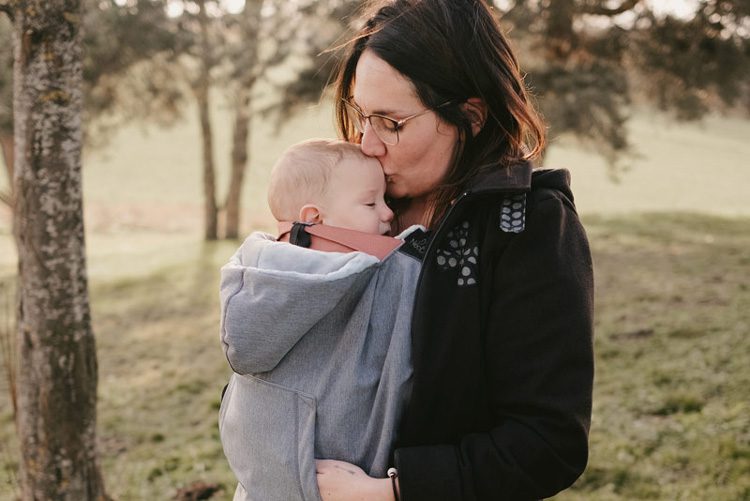
Too hot? Too cold? It's the eternal question of ALL parents, which becomes a reality until the child is old enough to clearly express how they feel (and where, generally, you don't believe them anyway, but that's another topic...). The most obvious solution is to favor contact and proximity with your little one, and therefore carry them. But how to cover them and be sure they won't be cold when temperatures drop? We offer you a brief overview of best practices. Dress baby in the baby carrier It is always recommended to dress your baby normally, as indoors, remembering that the carrier counts as clothing: if your little one has a small undershirt on the floor on their mat, for example, you should remove it in the carrier, because the material of the system around them replaces it. When you want to go outside, you dress more warmly, but around the baby and yourself, not each individually. The first reflex is often to want to put a jumpsuit (pilot suit) or a coat on your child. This raises several problems: It is very uncomfortable for your baby, especially if you try to maintain a physiological position: imagine sitting, crouched in a ski suit, and you'll get a little preview! It's quite stiff: it generally prevents your baby from bringing their hands to their mouth, which they need to calm and reassure themselves. This is also true in a stroller! It creates significant layers at the joints, which can especially hinder proper blood circulation in the legs It can hinder the proper clearance of the airways by creating thickness at the throat It prevents proper adjustment of carrying systems and can pose safety issues (increased risk of falling, especially in a sling) And most importantly: since the baby is farther from you, they also cool down much more because they no longer benefit from your body heat! Which is totally counterproductive. Carrying over your coat is also discouraged: Impossible to make a proper installation this way Risk of injury from buttons and zippers And like with the jumpsuit: the farther the baby is from you, the easier they cool down. The idea is then to have your little heart dressed in normal indoor clothes, possibly a thin undershirt if it's really -10°C, and then: Cover what extends beyond the baby carrier: hat, slippers/leggings (hands are against you and do not get cold) Put on your usual coat and we position a carrying blanket to make the connection on the baby (wide coats tend to cover the respiratory pathways). The advantage of doing so is that in case of passing through warmer places (such as a store), it allows you to easily uncover your baby and prevent him from "cooking" in his suit and crying while you finish your shopping. Note that thick clothing is also discouraged in cars: The harness of the car seat or shell must be very snug on the baby; with a suit, it adjusts to the thickness, but in case of shock, it flattens and the child can pass through the harness, so he is no longer protected The car's heating quickly warms the interior and your baby will be way too hot. NB: Neobulle's carrying blanket is designed to be used also in the car, making it a go-to tool for everyday logistics! Clear the airways The fear of cold should not make you forget the basic safety rules; clearing the airways is at the top of the list. It is not uncommon in winter to see parents pull up the blanket or their coat all the way to the top of their toddler’s head, to be sure that cold air will not bother him. In fact, cold air won't bother him, but the air in general will not circulate! And it’s likely you’ve noticed that he needs some air to breathe. Like with the baby carrier, the blanket or coat should reach up as high as the back of the neck of your child, leaving the face visible and clear. A hat or a hood is more than enough to protect his head. "Put on your little woolly sweater, you'll catch a cold!" In quite general terms, behind the fear of cold is actually the fear that the child won't get sick, largely fueled by popular beliefs and the injunctions to "dress the baby well because they get cold easily, you know". On one hand, overbundling is not better than underbundling. And most importantly, you don’t get sick because of the cold, but because of pathogenic elements in the environment (viruses, etc...). If cold can slightly sensitize the mucous membranes and humidity can promote germ proliferation, it is not directly responsible for falling ill. You could run naked in the snow, for example; if your path did not cross with a virus, you would stay healthy (plus cold preserves). ) ! Avoid passing from arm to arm and kisses, airing out the home, washing hands well, and wearing a mask if you are ill will be much more effective measures to protect your little one from winter ailments (bronchiolitis, for example)! Singing in the rain Carrying your baby also makes outings easier in rainy weather. We dedicate this paragraph to those who have already had to urgently figure out how to install the rain cover on the stroller in pouring rain, to those who had to mop up their flooded entryway with water dripping from the rain cover and mud from the wheels, and to those who found themselves pushing the stroller in a deluge without a free hand for an umbrella. We know you know! (Others, we leave it to your imagination) With just an umbrella, you can continue your journeys calmly and dry ! Carrying and winter activities Mountain activities, does that appeal to you? Yes, but with a good baby carrier! Many winter activities are accessible when you carry your baby. Of course, we advise against climbing Mont-Blanc, but a short walk or snowshoe hike is entirely possible ! The usual precautions are quite basic: Favor back carrying due to increased fall risks with front carrying Avoid a too long walk, especially if it is very cold (remember that your baby does not exert physical effort and cools down faster than you) Take small, regular breaks to move your baby a bit and ensure that their extremities do not get too cold. Feet, in particular, are very prone to frostbite. This risk is greatly reduced by using a physiological baby carrier and by the close proximity to the carrier (far from you in a child carrier with supports, the child cools down much faster !) In case of extreme temperatures, you can opt for lightweight woolen clothing instead of cotton: soft and thin, they keep the baby warm without making them sweat or overheat, and allow freedom of movement and comfort. You also appreciate carrying if you have clothes to retrieve from the snowfront (étonnantly, the wheels of the stroller roll much less well on snow). In short, you understand that close to you, it is much easier to assess whether your child is hot or cold, and they better regulate their temperature. Incidentally, it also keeps you warm, which adds to the pleasure !
Which pre-shaped baby carrier should be used from birth?
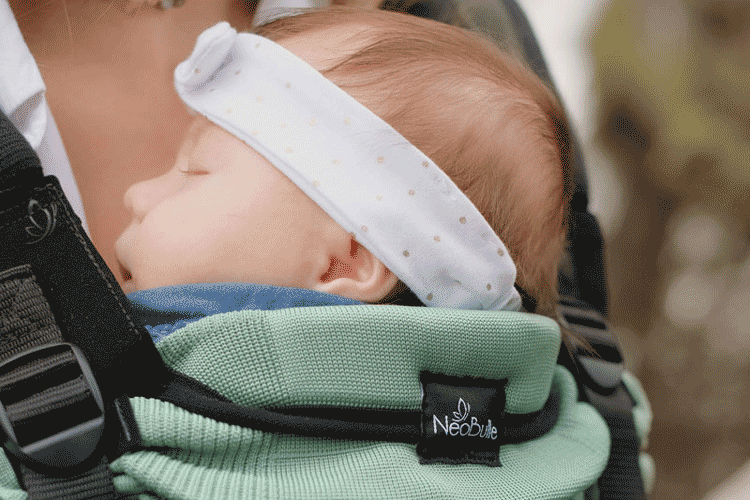
Your little miracle will arrive soon and you want to carry her. You have read everywhere that the sling is ideal, but it scares you or doesn’t appeal to you at all. Don’t panic: the carrying market is very diverse and there are now preformed baby carriers perfectly adapted to the specifics of the newborn! What should we pay attention to in order to choose well? We’ll explain everything to you! The Hypotonic Newborn At birth, the infant is completely hypotonic: to simplify, it is all soft, a bit like a rag doll, and is not capable of voluntary and controlled movements nor of simply stabilizing its body. This is mainly due to the immaturity of part of its nervous system (myelin sheaths, which help transmit nerve impulses, are not well formed), and also the muscles that have not yet been trained. The tone of the newborn will follow the maturation of the myelin sheath: initially along the spine, which will allow axial tone development (around 3-4 weeks, you will notice that the baby begins to stabilize on its vertical axis), then along the arms and legs (about 5-6 months for the baby to voluntarily grasp something). Carrying a newborn involves taking into account the lack of tone to offer an arrangement that compensates for it. In a carrying sling, precise fabric adjustments are used; in a baby carrier that doesn’t allow such fine tuning, you can play with 2 factors: The size of the panel The fit of the bodies A baby carrier of the right size A too-large baby carrier risks floating and gaping in the back of a small baby, not offering the necessary stability to compensate for the lack of precise adjustments: the newborn risks collapsing inside, which is not optimal for freeing their airways To reduce the size of the panel, brands offer several options. Option 1: using a reducer / cushion: With a reducer or cushion, the panel itself is not adjustable, but the baby sits higher on the device, which artificially decreases the height. In this configuration, the baby’s feet cannot come out because the seat is too wide, so they remain inside. This causes a problem where the support under the soles of the feet stimulates a pushing reflex: the baby will automatically start pushing with their legs, and soon they may stand up inside the system. Generally, around 3 or 4 months, they will be too big for the reducer but too small for the main system, and you will be stuck. The use of a reducer should always catch your attention: you are sold a baby carrier designed for a child of at least 6-8 months, trying to fudge so that it looks like it’s for a younger one. A more illustrative corollary: it’s like selling you a pair of shoes two sizes too big, claiming the foot will grow, and telling you to use insoles until it fits properly. Option 2: offer adjustments on the panel: Adjustments allow you to reduce the height and width of the back panel and adapt it to the actual size of the baby. This solution is more relevant because it allows for better overall adjustability of the system. The limitation is that you cannot evolve a panel from birth to 4 years because the amount of material necessary to carry a larger child cannot be folded enough for the size to be small enough to stabilize a newborn. There are therefore baby carrier sizes, generally with ranges such as: birth/2 years, 3-4 months/3 years, 1 year/5 years. A carrying system sold to carry from birth to 4 years must always catch your attention too! No material in baby gear is as adjustable because the needs of a newborn and a 4-year-old are too different. You need to change stroller, bed, car seat, etc. Carrying systems are no exception to this rule. The fitting of bodies The concept of body fitting is a key notion that involves finding a carrying height that allows the newborn to naturally align with the carrier’s body. This enables stability and is largely what allows physiologic carrying to avoid needing to hold the head because it rests on the chest. Respecting body fitting is essential as long as the child cannot support their back on their own! It is considered that sitting is well acquired (around 8-10 months if we want to be precise, when they can sit up alone). Generally, to find the right position, aim above the woman’s breasts and the man’s pectorals: if the carrier is too low, the baby’s head ends up right in the middle and has no choice but to lean backwards or to the side to avoid it (it’s like putting two rigid cushions right on your head—you will try to go around them and won’t settle into them). The other consequence is that the baby, losing the necessary anchoring for stability, sinks. While body fitting is quite intuitive for women, for men it initially requires a bit more reflection because it’s not natural to bring the child up on their body: you really need to aim as high as possible, as if you wanted their head nestled in the neck. (for more comfort, the installation can be slightly shifted). Let's go back to our preformed baby carriers, problem: the vast majority of these are designed to distribute the load on the belt. This results in carrying low on the pelvis, which is not at all compatible with what we just saw regarding body fitting. Therefore, it is necessary to look for a baby carrier whose design allows for high carrying on the chest: these are recognizable by the attachment of the strap on the belt and not the apron. This allows, by adjusting the straps, to lift the child instead of pressing him down. Attention: this type of carrying distributes the weight entirely on the straps (meaning: the carrier’s shoulders), so for comfort it is essential to take the time to tighten well to have a baby as high as possible and in close contact with you. This prevents the very unpleasant hanging effect. The body of the young mother We have covered the needs of the little one; it is also important to consider the needs of the young mother. Immediately postpartum, it is strongly advised against applying pressure on the abdomen to allow the perineum to strengthen and the organs to return to their proper place. With a baby carrier that distributes the weight on the belt, one might be tempted to place the child at the waist to lift him and seek proper body fitting, but doing so compresses the belly by exerting downward pressure, creating a "toothpaste tube" effect between the organs and the perineum, which, as you understand, is a very bad idea! Even without going to such extremes, simply feeling pressure on the belly is generally quite uncomfortable, especially since the belt is often rigid. Using a baby carrier that distributes the load on the straps is therefore essential for the mother’s proper recovery. The belt, in this context, only serves to stabilize the initial setup; during carrying, it becomes useless and could even be unclipped if desired. It is also preferable that this belt be flexible and not rigid: even if not tight around the abdomen, it could hinder the young mother. Worn high on the chest, the weight of the baby will also be less felt, which is reassuring when one has not yet fully regained control of one's body. The Neo range At Néobulle, the Neo range was designed to try to best adapt to the various constraints listed above. Neo and my Neo have been specifically designed for carrying a newborn, with a reduced apron size and a carry mode exclusively on the straps to avoid having to worry about choosing the right type of carrier when the baby has just arrived and you're tired. The My Neo in knit is perfect for the first year, the Neo in fabric wrap can be used up to 2 years old for your little one. Neo Plus is aimed at slightly older babies, from about 3 months up to 3 years. It is a transitional age product for a child who still requires high chest carrying but, as they grow, will weigh more and will find carrying more comfortable with a weight distribution on the hips, this baby carrier offers two carrying modes with two possible strap attachments: on the belt or on the apron. You are now a little better equipped to choose your ideal baby carrier by outsmarting marketing tricks! Now all that's left is to enjoy your little sweetheart. https://www.youtube.com/watch?v=lZfwO6HLkYY


