



Pregnancy

Qu'est ce que la Matrescence ?

Qu'est ce que la Matrescence ?

La Matrescence ou l’éveil d’une identité : Traverser le post-partum et tisser le lien

On parle souvent de la naissance comme d’un point final, l’aboutissement de neuf mois d’attente. Pourtant, pour la femme, elle n’est que le prologue d’un bouleversement bien plus vaste : la Matrescence. Ce concept, qui fait écho à l’adolescence, décrit cette période de transition radicale où une femme devient mère. Ce n’est pas un interrupteur sur lequel on appuie, mais une métamorphose lente, parfois chaotique, qui redéfinit chaque cellule de l’identité.

Le post-partum : cet espace entre-deux

Le post-partum n’est pas seulement une convalescence physique ; c’est le terrain de jeu de la matrescence. C’est un espace de vulnérabilité où le corps, autrefois sanctuaire de la vie, devient un territoire de don de soi. Dans cette phase, la femme doit faire le deuil de celle qu’elle était — sa liberté de mouvement, son insouciance, sa disponibilité psychique — pour laisser place à celle qu’elle devient.

Cette période est souvent marquée par une ambivalence profonde. On peut éprouver une gratitude immense et, dans le même souffle, une fatigue qui frôle l'effondrement. Reconnaître cette dualité est essentiel : la matrescence ne demande pas d’effacer la femme derrière la mère, mais d’apprendre à les faire cohabiter sous un même toit.

L’attachement : une construction, pas une magie

On nous vend souvent le "coup de foudre" immédiat à la seconde où l'enfant est posé sur le ventre. Pour certaines, c'est une réalité. Pour beaucoup d'autres, l'attachement est une construction, un tissage patient qui se fait maille après maille.

Le lien d’attachement est ce fil invisible qui sécurise l’enfant et stabilise la mère. Il se nourrit de la proximité, du regard, du souffle et du contact peau à peau. C’est ici que la physiologie vient au secours de la psychologie : le contact physique libère de l’ocytocine, cette hormone du lien qui apaise le système nerveux de la mère et régule celui du nouveau-né.

Le portage comme soutien au lien

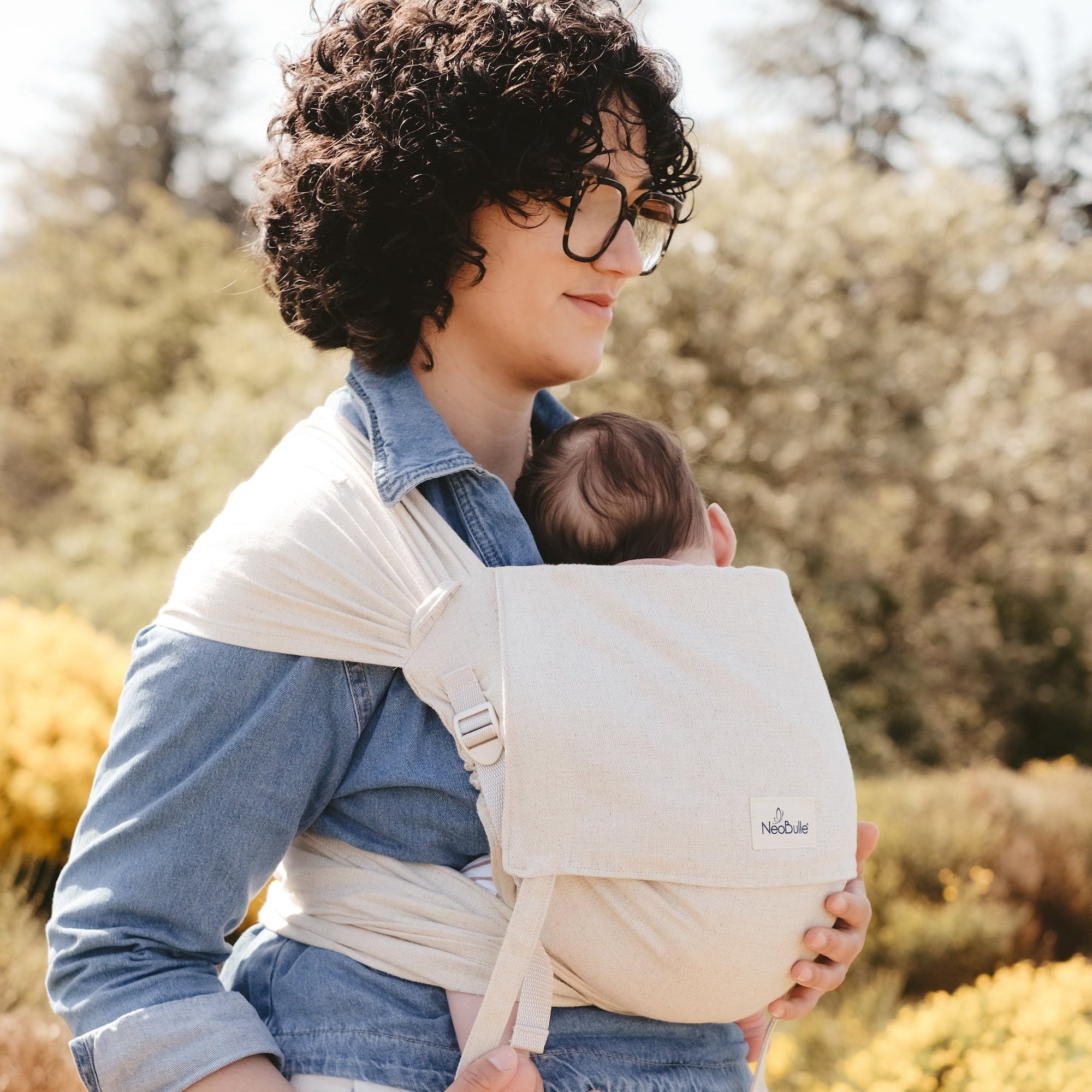
Dans ce contexte de mutation, le portage s'inscrit comme un prolongement naturel de la grossesse. Porter son enfant n'est pas un simple choix logistique pour garder les mains libres ; c'est une réponse directe aux besoins de la matrescence et du post-partum.

  • La continuité biologique : Après neuf mois de fusion, la séparation peut être brutale. Le portage offre une transition, un "utérus à ciel ouvert" qui rassure le bébé par les battements du cœur et la chaleur, tout en permettant à la mère de retrouver une certaine verticalité.
  • La communication instinctive : En portant, la mère apprend à décoder les micro-signaux de son enfant avant même qu’ils ne deviennent des pleurs. Cette compréhension mutuelle renforce le sentiment de compétence maternelle, souvent malmené par les doutes du début.
  • L’ancrage mutuel : Le poids du bébé contre soi, son odeur, son rythme respiratoire... ces sensations agissent comme un ancrage sensoriel puissant. Le portage aide la mère à s'installer dans son nouveau rôle non pas par la théorie, mais par l'expérience du corps.

Vers une parentalité décomplexée

La matrescence nous apprend que la vulnérabilité n’est pas une faiblesse, mais une ouverture. Traverser le post-partum, c'est accepter de ne pas tout savoir, d'être "en chantier". En plaçant le lien et l'attachement au cœur de cette période, on s'autorise à vivre une maternité plus douce, loin des injonctions de perfection.

Naître mère prend du temps. Et dans ce voyage, la proximité physique reste sans doute la boussole la plus fiable pour retrouver son chemin vers soi, et vers son enfant.

Related articles
GrossesseComment prendre soin de son périnée ?

Pregnancy and childbirth

How to take care of your perineum? This is a highly important topic for a woman's life. The perineum is a universe in itself, comprising a constellation of muscles and ligaments that are particularly stressed during pregnancy. This precious instrument deserves special attention during these 9 months. The benefit of taking care of it is mainly to avoid long-term problems, and to greatly reduce the chances of episiotomy or tearing during childbirth. Your perineum, your pregnancy, your baby… and your woman’s life Your perineum supports the weight of your uterus, baby, and amniotic fluid. Under this constant pressure, all these ligaments and muscles stretch and lose their elasticity. Especially if you are expecting twins. When the baby is born, your perineum will need flexibility and tonicity. Pelvic floor re-education is often discussed. It is usually necessary, but if your perineum is too damaged, it will not regain all its capabilities. The perineum, when it has lost its elasticity, is the origin of incontinence, a taboo subject that is rarely discussed. Yet, it is a fairly common problem among women. Not to mention that the perineum plays an important role in sexual pleasure. Physical activities? Yes, but gentle ones… If you have chosen prenatal yoga as a preparation for childbirth, you are already taking care of your perineum. If you have chosen swimming, that’s pretty good too. And if you regularly walk, it’s even better! Generally speaking, gentle physical activities that involve breathing and the pelvis are recommended. Especially since they are good for morale and gradually prepare the rest of the body for childbirth. However, some sports should be avoided. Especially those that exert natural pressure on the perineum. All jumping sports are broadly discouraged for pregnant women. Aerobics or long-distance running are also not in their favor. If you ever need to carry heavy loads at work, or are used to carrying your older children, it’s best to delegate. Colleagues, friends, or loved ones… A little help? Exercises, from the fourth to the eighth month At the beginning of the second trimester, preparation sessions for childbirth begin. The midwife raises awareness about the perineum and gives you some advice. This is a good opportunity to ask questions. Practicing these exercises regularly will be key. Massages, starting from the seventh or eighth month But how to massage the perineum? We provide the instructions right below! First, wash your hands to avoid germs. Take advantage of this opportunity to enjoy a few minutes of calm conducive to relaxation so you won’t be disturbed. Whether kneeling or lying in bed with your back against the wall, sit comfortably to start the massage, which, to be effective, should last 5 to 10 minutes. Now is the time to take the massage oil. With your thumb turned and pressed down towards the bottom of the vagina, perform rocking movements from left to right, then from right to left, applying enough pressure. Don't hesitate to watch videos online. During the last two months before the baby's arrival, it is recommended to massage yourself 2 to 4 times a day. This will REALLY make a difference during childbirth! To assist you, we have designed Néobulle's perineum oil, studied to take care of your perineum before and after pregnancy. After birth, exercises again One or two months after the birth of your beautiful baby, the postnatal consultation allows you to check in with the midwife or gynecologist. They will prescribe about ten sessions of perineal re-education. Moreover, even in the case of a C-section, re-education is recommended. While waiting for this appointment, you can start gentle exercises to do alone for a few minutes each day. Sitting on the edge of a chair, start by inhaling through your nose, then contract your anus, vagina, and abdomen one after the other for about ten seconds before exhaling. It's a good way to get back on track and reconcile with your body. Néobulle perineum oil At Néobulle, a brand committed to the well-being of babies, a massage oil has been created that expectant mothers love, especially for its pleasant smell and effectiveness. This 100% natural and organic soothing oil prepares expectant mothers for the birth of their baby. It softens the perineum to facilitate the passage of the little one by increasing the effectiveness of massages. After birth, the passage of the baby sometimes causes a small swelling (edema), painful scratches, a small tear, or even an episiotomy. Néobulle oil, used at this moment with gentle application and not massage, provides relief and quick healing. In case of C-section, it helps to heal and fade hematomas if present. An essential to have!

GrossesseJour J : conseils malins pour un accouchement serein

D-Day: Clever tips for a peaceful childbirth

The big day is approaching, little by little. Here are some tips to keep in mind for the big day, the day of the great meeting with baby. For some moms, labor progresses quickly, for others it takes longer, but in any case, trust in yourself and baby is key. In a (Neo)bubble Create a calm and warm atmosphere where you will feel safe. Soft lighting, intimate ambiance, and gentle music are a good starting point to help steer your thoughts positively and thus reduce stress. By imagining your little wonder soon in your arms and thinking of the joy awaiting you rather than focusing on the pains... It’s not always possible, but whenever it is, take advantage of it. Relax and move your body Moving and walking between contractions will help mobilize your pelvis and speed up the process. Don’t hesitate to move as you feel. Sitting, standing, squatting, hanging, on all fours, or leaning forward... only you will know what is best for baby and you, with the help of the midwife. Whatever your position, the dad, sister, mom, or the person accompanying you can apply pressure on your sacrum, that small bone at the base of the spine. They can also massage your shoulders or neck to help you relax. The benefits of massages To allow your body to gradually let baby descend, the pelvis needs to change. Massages will provide essential flexibility to relax muscles and make space for the little baby who will soon be in your arms. The pleasant sensation of massages helps to focus less on the pain. These moments of calm between contractions will bring you moments of peace to refocus. Under the effect of massages, your body produces endorphins, which are responsible for the production of oxytocin, this hormone that causes contractions and helps guide baby out. Breathing and relaxing your face The muscles of the mouth and those of the perineum are closely linked. The more you clench your teeth, the more you tense up during contractions. Keep in mind to relax your jaws as much as possible to facilitate the work. Baby will move towards the exit more easily, little by little. Breathe deeply and fully. This will help refocus your thoughts on baby and the love you already feel for him. The relaxing oil for NeoBubble’s delivery Severine Martial, a nurse and founder of Neobulle, designed this oil through her contact with mothers who do not want an epidural. The idea came to her after the birth of her first of four babies. She wanted to give birth without an epidural, but since it was very long, she thought of creating a natural remedy to shorten the labor. And the oil was born... a few months after her baby! How to use it? This precious elixir, 100% organic, applied as a massage on the lower back or abdomen, allows you to stay in your bubble, better manage and reduce pain, while increasing the effectiveness of contractions. And if you cannot tolerate being touched, which can happen, it is designed to be inhaled. In this case, place the oil inside your wrists and breathe deeply. After birth Like most Neobulle products, the relaxation oil was designed as a multi-purpose care for your well-being and to accompany you in your life as a mother. You can keep this bottle with multiple benefits to use after birth. Its components with comforting virtues help better manage the arrival of the baby, especially when hormones drop and tears may flow easily.

lecture_5minUn petit coup de mou dans votre rôle de parent ?

A little slump in your parent role?

Do you also feel it, this routine that exhausts us, this daily grind that bores us? Everything is fine, we lack nothing, baby is in good health. And yet, between diapers, bottles or breastfeeding, laundry, meal preparations, school schedules, and obligations, we can feel that this routine puts us to sleep. So we love them dearly, huh! All of them: the little ones, the big ones, my partner... And despite this powerful love and these countless tirelessly repeated tasks, with baby snug on the hip in a sling , we get bored... and sometimes even, we feel guilty for not doing enough, for not being enough... While we don't stop for a minute! Rest assured: You are not the only person feeling this way This does not diminish your parenting skills The love you have for your family is not questioned You can join a parent support group And yes, I know... We all dream of a bit of adventure, travel, big meetings, our fulfilling great job... But motherhood and cocooning sometimes have this little imprisoning side, which could trap us in feelings of devaluation! Indeed, the society of doing, of doing quickly and showing everything to everyone, does not help to highlight the background work, invisible and repetitive, of a parent, and I would even say, of a mom... The amazing dads, I haven't forgotten you, but I am sure you will agree with me that all these daily tasks are unfortunately still not shared enough within households, and are far too often the domain, not always chosen, of women. This is all the more true during maternity or parental leave. And surely, it doesn't help either, to: Not have time to get dressed before 3 p.m., because baby keeps you busy Have dark circles under your eyes because you haven't had a full night's sleep in months Wear your maternity sweatpants because you haven't found the time to buy new pants Forget the last visit to the hairdresser... Take a shower quietly at 11 p.m. when everyone is finally asleep Never have 10 minutes alone, not even in the bathroom And I forget others! So, when you catch yourself mumbling for the umpteenth time "I still haven't had time to do anything today", know that it's not true! I invite you to list everything you accomplish and achieve during the day, believe me, you will be positively surprised by the result! Think to ask for help from your surroundings Call a resource person who will tell you how fantastic you are And when you start doubting your skills because you just broke the record for changing the 2000th diaper, don't forget that : You are the best person for your child Try to set achievable short-term goals and see them come true And of course: carrying your child can help you (see article all the times carrying saved my life) But giving birth and raising a little being, love and education, takes time! Nature does things without rushing, and yet everything is accomplished. Lao Tzu And in a system where everything goes very fast, where everything changes all the time, we sometimes tend to forget it. Let's try to cultivate values of patience, perseverance, resignation, and ... humor, always. "You are annoyed to launch a new layette machine because baby decided to redecorate all these pajamas in vomit color? Tell yourself that in 15 years, you will be hanging football socks or crop tops to dry!" And ... We can also look at this monotony from a positive angle. Because this dense and ritualized way of life allows us to juggle multiple tasks. A bit of perspective helps us see that we are getting there, come what may, day after day, without failing. And finally, when we realize that not everyone has the chance to live this cozy purr, it becomes much softer, even precious. Cooking is the factoryWhere the day is preparedWe hum, we bottle-feedThe coffee is willing to passBread slices, bootsWe do everything at the same timeWe dress one or two girlsThe day has begunMechanical workIn the morning gesturesThe gestures we know wellIt's nothing, it's daily happiness Anne Sylvestre